Over the 39 days of FIFA World Cup 2026, Pikasa tracked every mention of FIFA across the media, social and video ecosystems of three federations - Argentina, Bosnia & Herzegovina, and Croatia - in Spanish, Bosnian and Croatian, without a single manual read. The result is a live, engagement-weighted map of exactly how football's governing body was talked about, market by market, week by week, and story by story.
Across all three markets, critical coverage of FIFA outweighed positive coverage by roughly 8 to 1 - and the gap was driven almost entirely by officiating, not by the football itself. This case study shows what that map looked like, the real controversies that moved it, and what it demonstrates about Pikasa's ability to give federations, editors and rights holders an early warning system for reputation - not a monthly report, but a live read of the room.
Key takeaways
- Critical coverage of FIFA beat positive coverage roughly 8 to 1 in every market, regardless of language, audience size, or how far the team advanced.
- Argentina ran deepest (to the final) and was also the most critical (44%) and the most FIFA-focused market - nearly 1 in 5 World Cup articles named FIFA directly, 2-3x the share seen in Croatia and BiH.
- All three markets show the same critical-tone spike in the same week (late June-early July), each driven by a different real controversy: Argentina's Egypt VAR row, BiH's Norway-Israel FIFA-suspension story, Croatia's goal-line tech complaint.
- The consistent pattern across markets: officiating and governance stories move FIFA's coverage negative - match results and tournament performance don't.
The Scale Behind the Sample
The tone analysis in this report is a deep-dive audit of 3,000 hand-classified articles - but that sample sits on top of a much larger conversation that Pikasa tracked continuously and in full. For each market, Pikasa ran three progressively narrower keyword trackers: every World Cup mention, then World Cup mentions tied to the national team, then the specific intersection with FIFA.
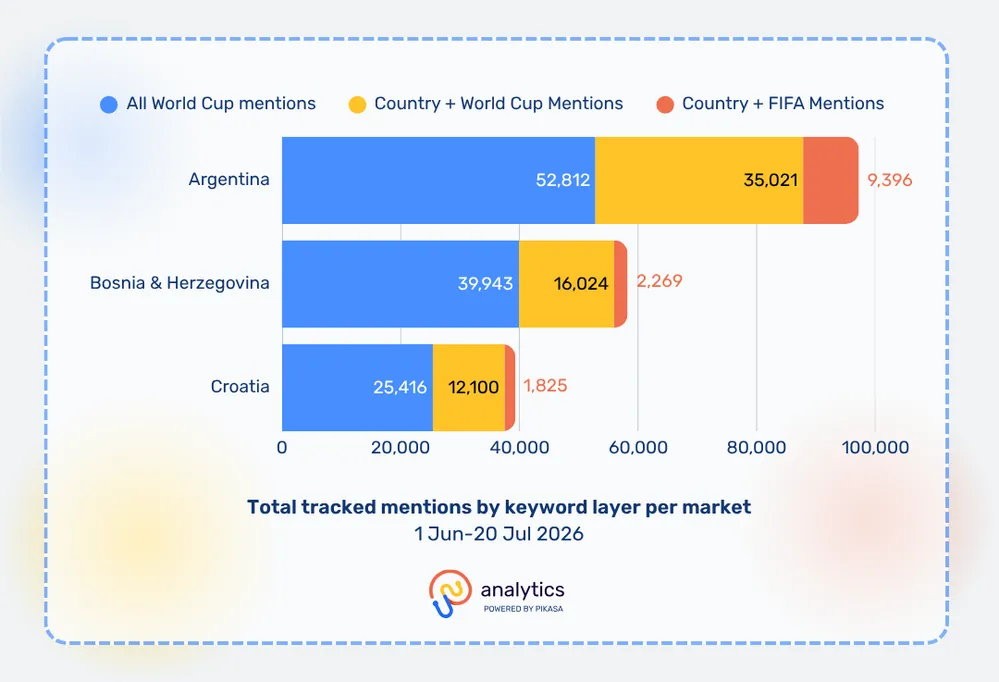
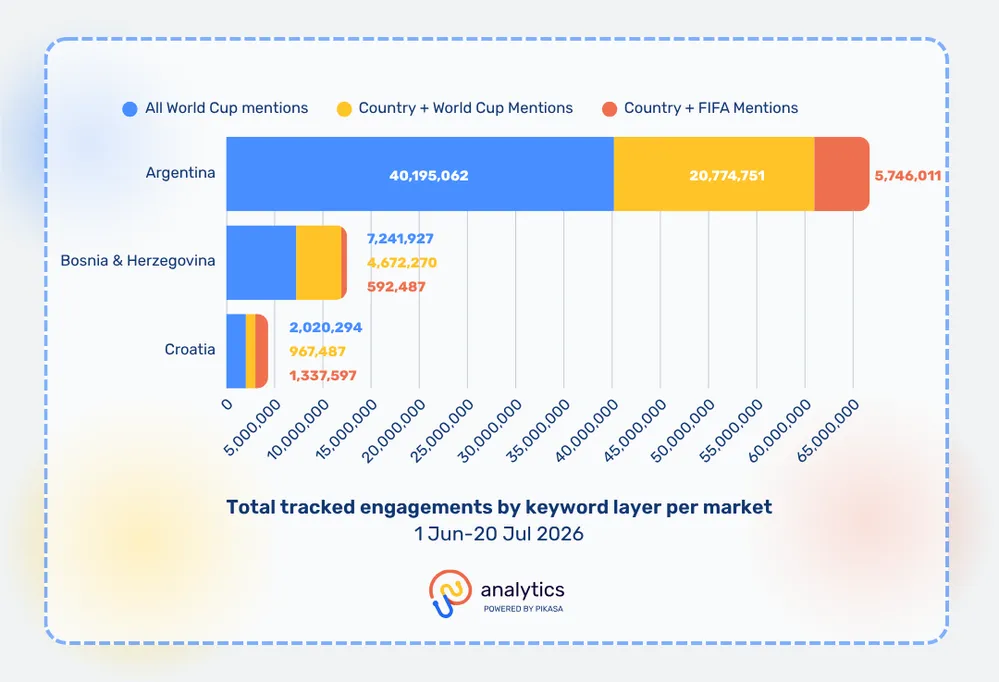
Narrowing from “World Cup” to “FIFA” shows how much of the total conversation actually touched football's governing body directly - and it's here that Argentina stands apart:
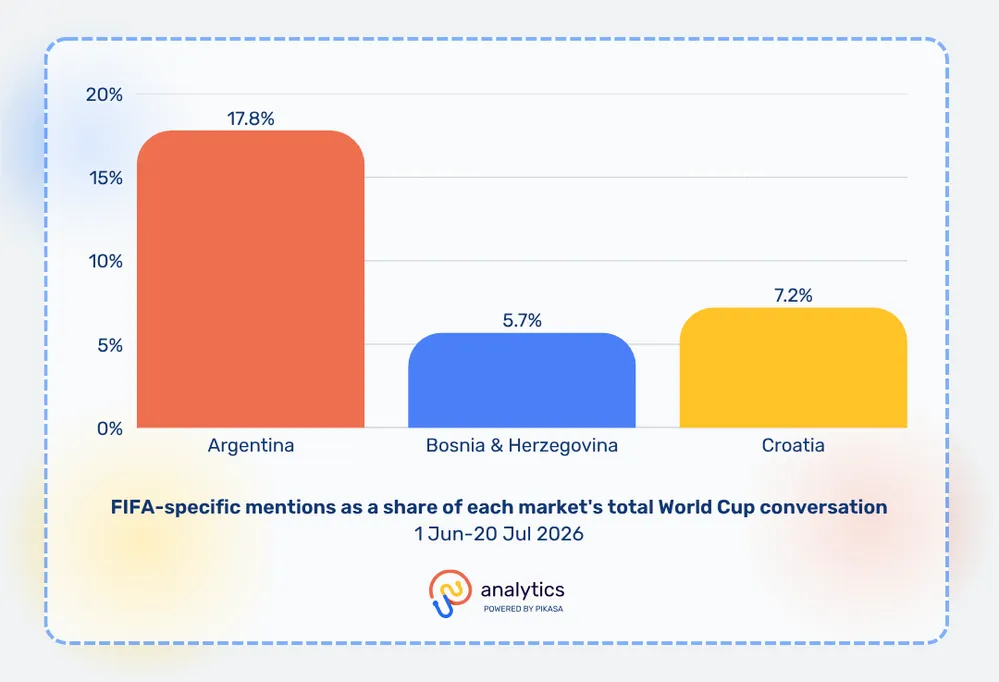
Nearly 1 in 5 World Cup articles in Argentina named FIFA directly - more than double Croatia's share and over three times Bosnia & Herzegovina's. That lines up exactly with what the tone data shows later in this report: Argentina's run to the final, the Egypt VAR row, and the Falklands/Malvinas flag dispute all kept FIFA itself in the frame, not just the football. In BiH and Croatia, FIFA was a background actor - visible, but rarely the headline. Knowing that split, in near real time, tells a federation exactly how much of its media environment is a governance conversation versus a sport one.
Headline Finding: Critical Coverage Dominates Everywhere
Pikasa classified every article into one of seven tone categories. Regardless of market size, language, or how far each team advanced, the shape of the conversation was remarkably consistent: critical coverage was the single largest category in all three countries, more than double the next-closest tone.
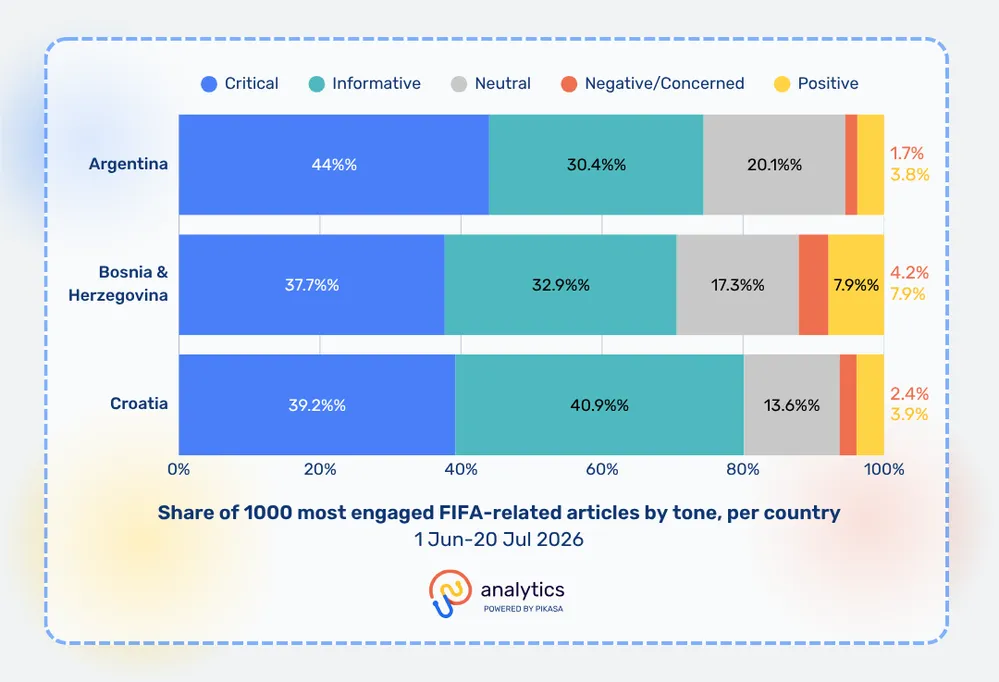
Positive and supportive coverage never broke 8% in any market. The takeaway for federations is blunt: absent a controversy, FIFA does not generate warm coverage on its own - it generates volume, and that volume defaults critical unless something positive (a goal, a story, a piece of good news) actively displaces it.
Anatomy of a Reputation Spike
The real value of always-on listening is speed: Pikasa didn't just measure that criticism rose - it caught the exact week, and the exact story, that moved each market.
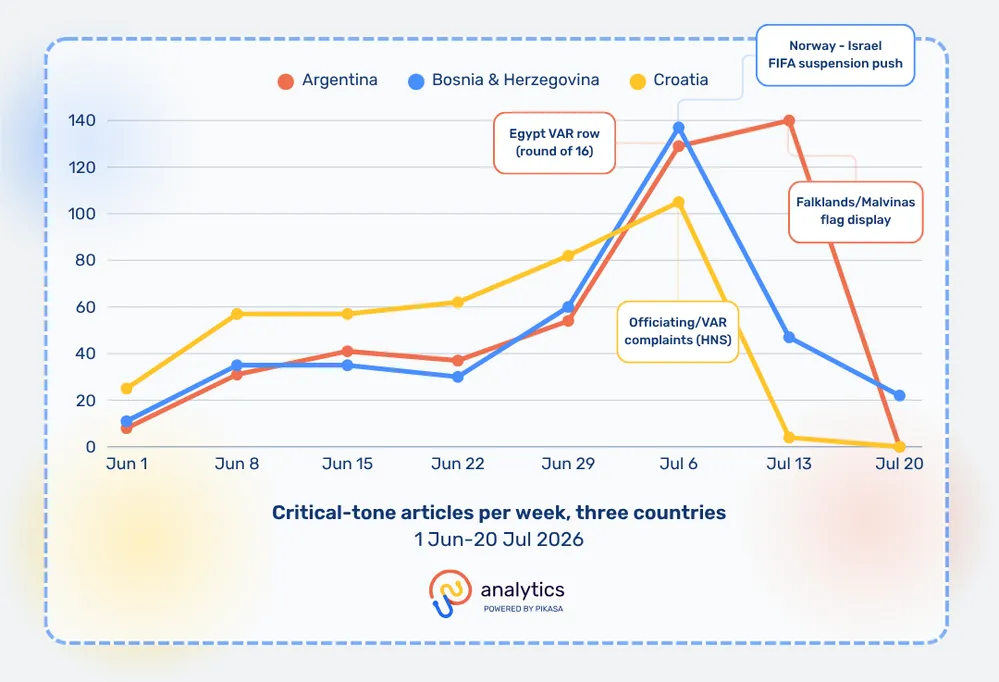
All three lines break upward in the same seven-day window, but for three different reasons - proof that Pikasa's tone engine is reading real news, not just topic volume:
- Argentina spiked around the Round-of-16 win over Egypt, after VAR disallowed an Egyptian goal and waved off a late penalty appeal. Egypt's federation lodged a formal complaint and coach Hossam Hassan said his side had been “cheated”; FIFA referees chief Pierluigi Collina publicly defended the call. A second, larger critical wave hit in mid-July after Argentina's Falklands/Malvinas flag display drew calls for sanctions and even for England to leave FIFA.
- Bosnia & Herzegovina spiked in the same week as Norway's campaign to have Israel suspended from FIFA gathered pace - Bosnian outlets covered the story as a European federations' story even though BiH itself wasn't party to it, showing how a single global governance story can dominate a national feed.
- Croatia's spike centered on the Croatian federation (HNS) formally writing to FIFA after goal-line technology failed to register a foul, plus a separate VAR review of a disputed handball - a pure officiating-and-technology story with almost no positive counterweight that week.
Three Markets, Three Different Conversations
Volume and tone tell only part of the story - who is talking, and how loudly, matters just as much to a federation deciding where to focus a communications team.
Argentina - the loudest room in the tournament
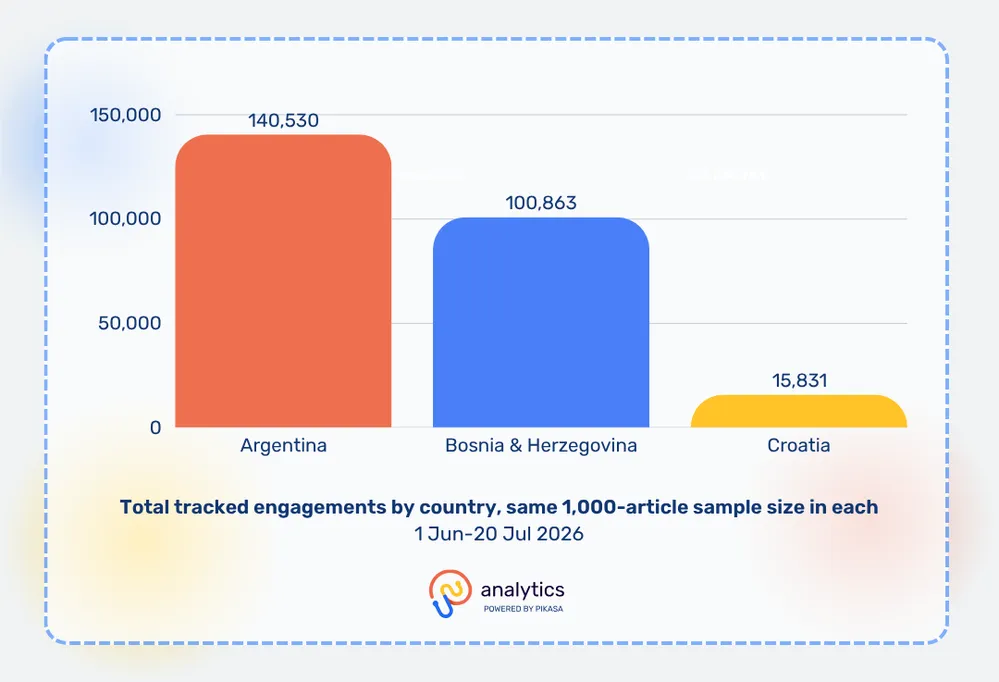
1,000 articles generated 140,530 engagements - by far the highest of the three markets, reflecting Argentina's run all the way to the final, where they lost to Spain on 19 July. 44% of coverage was critical (the highest share of the three), concentrated in broadcast-adjacent outlets: TyC Sports and La Nación alone accounted for nearly half of all tracked articles. FIFA opened an investigation into Argentine conduct after the final itself - a reminder that even a deep tournament run doesn't insulate a federation from scrutiny; if anything it raises the stakes of every decision.
Bosnia & Herzegovina - the most emotionally varied feed
100,863 engagements from 1,000 articles, and the only market where positive/supportive coverage broke into meaningfully higher territory than the others (7.9%) - driven by Kerim Alajbegović's goal-of-the-tournament nomination alongside Messi and Mbappé, and BBC recognition for Ermedin Demirović. But BiH media were also the most likely to import global FIFA governance stories wholesale, as the Norway-Israel suspension push shows - a useful signal that a federation's own on-pitch performance is only one input into how its media talks about FIFA.
Croatia - small audience, sharp scrutiny
The smallest market by engagement (15,831) but nearly identical in tone shape to the other two - 39% critical versus 41% informative - showing that critical share doesn't scale with audience size. Telegram and Index drove the most-engaged critical stories, almost all tied directly to refereeing and VAR technology rather than results on the pitch.
What Pikasa Actually Did Here
Every chart and figure in this document came from the same pipeline a federation, broadcaster or rights holder can run continuously:
- Cross-language ingestion - media, Facebook, Instagram, YouTube, TikTok, LinkedIn and Telegram tracked natively in Spanish, Bosnian and Croatian, no translation lag.
- Automatic tone classification - every article scored into critical, informative, neutral, positive, negative, concerned or supportive.
- Engagement-weighting - reactions, shares, comments and views rolled up per source and per keyword, so volume and true reach are never confused.
- Keyword and entity tracking - granular tags (e.g. “fifa+argentina”, “world cup+bih”) let a single dashboard isolate exactly the intersection that matters.
- Week-by-week trendlines - spikes are visible the week they happen, not the month after, giving comms teams time to respond while the story is still live.
See It on Your Own Story
This case study covers three federations during one tournament. The same pipeline runs continuously, on any keyword set, in any language, for any club, federation, sponsor or governing body that needs to know not just how much people are talking - but what they actually think, and the moment that changes.
Methodology note: Analysis based on 3,000 tracked articles (1,000 per market) mentioning FIFA in the context of World Cup 2026, 1 June - 20 July 2026, classified by Pikasa's tone engine. Real-world events referenced (Egypt-Argentina officiating dispute, Croatian federation's technology complaint, Norway's FIFA-suspension campaign, and the Spain-Argentina final) are independently corroborated by public reporting.
Written by
Natasha Dimova
July 22, 2026