Digital media outlets wrote most of the articles while social media got the engagement. Across the same three World Cup 2026 markets covered in our tone-analysis case study - Argentina, Bosnia & Herzegovina, and Croatia - Pikasa broke out every tracked mention by platform: Media, Facebook, Instagram, YouTube, TikTok, LinkedIn and Telegram. The split between where the volume comes from and where the engagement actually lands is the sharpest finding in the whole dataset.
For a federation or rights holder deciding where to spend a communications team's limited attention, that gap is the whole ballgame. This case study shows the size of it in three different markets, what drives it, and how it shifts the moment the conversation turns specifically to FIFA.
Key takeaways
- Post volume and engagement live on completely different platforms: Media outlets write 78-90% of tracked posts but capture only 1-21% of engagement.
- Instagram (and in Croatia, TikTok) is where the actual audience is - a single Instagram or TikTok post in Argentina outperforms a media article by 300x+ on average.
- Croatia is the outlier market: TikTok, not Instagram, is the top channel, and its lead nearly doubles (24%→41%) when the conversation narrows specifically to FIFA.
- Argentina's FIFA-specific conversation skews toward YouTube instead (4.3%→12.7%), suggesting longer-form reaction content rather than quick social posts.
- Takeaway: platform mix isn't fixed - it shifts by market and by story, so a monitoring strategy built around one market's channel mix will miss where another market's crisis actually spreads.
Headline Finding: Posts ≠ Reach
The same nine events trackers behind our tone-analysis case study also logged full platform breakdowns. Looking at each market's broadest tracker - every World Cup mention, 1 June to 20 July - the mismatch between post volume and engagement is immediate and consistent across all three languages.
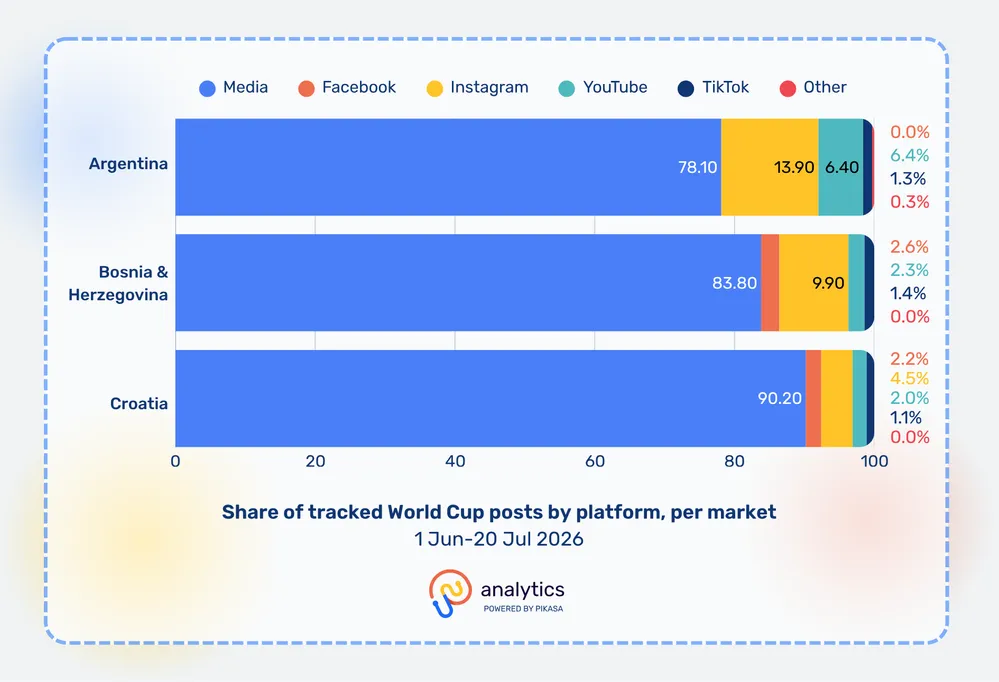
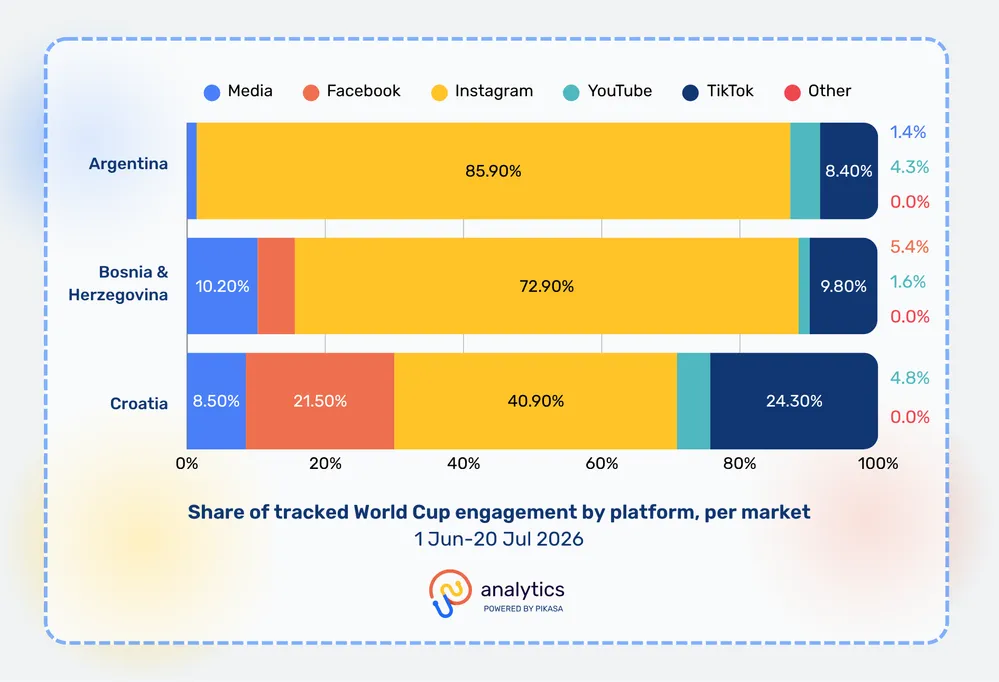
Media dominates the top chart in every market - 78 to 90% of posts. It barely registers in the bottom chart. Instagram inverts that pattern everywhere, and in Croatia, TikTok rivals Instagram outright, something neither Argentina nor Bosnia & Herzegovina show at this scale.
The Reach Multiplier
Put another way: what does a single post on each platform actually deliver, on average? This is the number that should inform where a comms team spends its time monitoring, and where it should expect a crisis to actually spread.

The multiplier is largest in Argentina, where a single Instagram post (4,706 engagements on average) or TikTok post (5,008) outperforms a media article (14) by more than 300 times. It's smallest - but still dramatic - in Croatia, where TikTok (1,828 engagements per post) is the standout channel rather than Instagram, and even Facebook (771) out-performs Instagram (723) on a per-post basis. Bosnia & Herzegovina sits in between, with Instagram and TikTok running neck-and-neck around 1,300 engagements per post.
When FIFA Enters the Frame, the Platform Mix Shifts
Narrowing each market's tracker from “all World Cup mentions” down to the specific intersection with FIFA changes not just the volume, but which platform carries the story. That shift is itself a signal worth watching.
| Market |
Platform |
Share - All World Cup |
Share - FIFA-specific |
Shift |
| Argentina |
YouTube |
4.3% |
12.7% |
+8.4pt |
| Bosnia & Herzegovina |
Facebook |
5.4% |
8.4% |
+3.0pt |
| Croatia |
TikTok |
24.3% |
41.1% |
+16.8pt |
Croatia is the clearest case: TikTok's share of engagement nearly doubles, from 24% of all World Cup content to 41% once the conversation is specifically about FIFA - the goal-line technology failure and the Collina/VAR storyline went most viral there, not on Instagram or in traditional media. Argentina's FIFA-specific conversation skews far more toward YouTube (12.7%, up from 4.3%) - consistent with longer-form analysis and reaction content around the Egypt VAR row and the post-final investigation. In Bosnia & Herzegovina, Facebook's share rises modestly (8.4%, up from 5.4%), reflecting how the Norway-Israel suspension story was discussed and shared in community groups rather than gone viral on video platforms.
None of these shifts would be visible from post counts or from a single blended engagement number - they only show up once volume is broken out platform by platform, tracker by tracker.
Three Markets, Three Different Audiences
Argentina - an Instagram-first conversation
86% of all World Cup engagement ran through Instagram, with TikTok a distant second (8%) and Media barely present (1.4%) despite generating the most posts by far. A federation managing Argentina's channel needs to think of Instagram as the primary reputational battleground, not the newsstand.
Bosnia & Herzegovina - the most platform-balanced market
Still Instagram-led (73% of engagement) but with meaningfully more weight on Media (10%), Facebook (5%) and TikTok (10%) than Argentina shows - a market where a crisis could plausibly break on any of four different channels rather than one.
Croatia - the only TikTok-first market
The single market where TikTok (24% of all World Cup engagement, 41% of FIFA-specific engagement) rivals or exceeds Instagram. Any monitoring strategy built around Argentina's or Bosnia's platform mix would have missed where Croatia's FIFA controversies spread.
What Pikasa Actually Did Here
This breakdown came from the same trackers used in our tone-analysis case study, with one additional layer switched on - full platform attribution:
- Native platform coverage - Media, Facebook, Instagram, YouTube, TikTok, LinkedIn and Telegram measured separately, not folded into a single blended number.
- Posts vs. engagement, side by side - every tracker reports both, so volume and reach are never confused with each other.
- Per-post benchmarking - average engagement per post, by platform, shows exactly which channel over- or under-performs its share of voice.
- Keyword-layer comparison - the same platform breakdown run at every narrowing level (World Cup → country → country and FIFA) surfaces shifts a single snapshot would miss.
- All of it live - platform mix can be checked mid-story, not reconstructed after the fact from a monthly export.
See It on Your Own Story
This case study covers three federations during one tournament. The same platform-attribution pipeline runs continuously, for any event set, in any language, for any club, federation, sponsor or governing body that needs to know not just how much people are talking - but on which platform, and how far it actually reaches.
Methodology note: Figures are drawn from Pikasa's live Tracker Summary dashboards for nine sets across three markets (1 June - 20 July 2026): a broad World Cup tracker, a country-specific World Cup tracker, and a country and FIFA tracker, each reporting posts, reactions, shares, comments and views natively per platform. “Other” combines LinkedIn and Telegram, both under 0.1% of engagement in every market measured.
Written by
Natasha Dimova
July 28, 2026