This analysis was conducted by Pikasa using its real-time media intelligence platform Analytics.Live, covering the period of Q1 2026. Using the platform’s AI-powered capabilities, all collected content was automatically detected, filtered, and classified by topic. The system identifies relevant articles in real time, groups them into thematic categories, and analyzes both volume and engagement.
Тhe analysis provides structured and consistent overview of how e-commerce is covered across the Bulgarian media landscape.
Policy Over Market: Who Controls the Story?
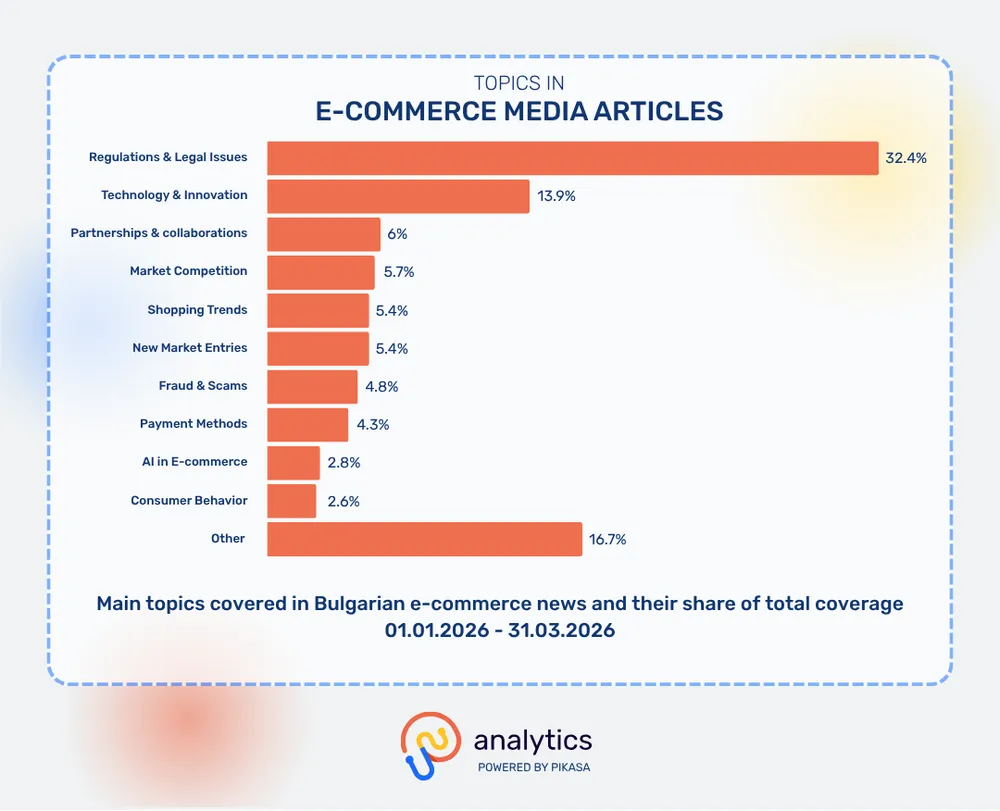
The Bulgarian e-commerce media landscape is clearly dominated by regulatory topics, which account for 32.4% of total coverage, making them the single most influential driver of the narrative. This is not only visible in volume, but also in the nature of the headlines themselves, where topics such as the introduction of a €3 fee on small shipments, EU-level digital service regulations, and investigations into platforms like Temu or Amazon appear repeatedly across multiple outlets. The same stories are often redistributed across different media, amplifying their presence and reinforcing a perception that regulation is the central force shaping the industry. Unlike other topics, which tend to be more diverse and fragmented, regulatory content is highly institutional, consistent, and repetitive. This creates a top-down narrative environment where e-commerce is framed less as a dynamic business ecosystem and more as a sector under constant legal and policy pressure. As a result, public perception is shaped primarily by compliance, restrictions, and structural changes rather than growth, innovation, or consumer value.
Innovation vs Reality gap: Technology is visible, but not locally grounded
Although Technology & Innovation represents 13.9% of total coverage, making it the second most discussed topic, the headlines reveal a clear disconnect between global technological developments and their local relevance. Much of the coverage focuses on large-scale, international narratives such as AI investments worth hundreds of billions, automation trends, and big tech transformations, including companies like Amazon planning workforce restructuring or global spending on artificial intelligence. However, there is limited evidence of how these innovations are being implemented or experienced within the Bulgarian e-commerce ecosystem itself. This creates a dual narrative where technology is presented as transformative and inevitable, but also distant and abstract. In contrast to regulatory topics, which are immediate and directly impact businesses and consumers, innovation is discussed more as future potential rather than present reality. This gap suggests that while the Bulgarian market is exposed to global technological discourse, it has not yet fully localized or operationalized these changes in a way that is visible in media storytelling.
Disproportionate impact of risk-related narratives on perception
While topics such as Fraud & Scams (4.8%) and Payment Methods (4.3%) do not dominate in volume, their impact on perception is significantly higher than their share suggests. These stories are typically concrete, local, and emotionally engaging, featuring examples such as fake online shops, fraudulent car sales, or misleading pricing practices. Because of their nature, they are more memorable and more likely to shape consumer attitudes than neutral or positive coverage. In contrast, narratives around reliability, innovation, and improved customer experience are less visible and less emphasized. This creates a perception gap: even with relatively low frequency, risk-related stories disproportionately reinforce caution and skepticism, positioning e-commerce as an environment that requires vigilance rather than one associated with convenience and value. For brands, this highlights a missed opportunity to actively rebalance the narrative and strengthen trust through more visible, positive storytelling.
Market dynamics exist, but are framed through extremes, not stability
Market-related topics such as Partnerships & Collaborations (6.0%), Market Competition (5.7%), Shopping Trends (5.4%), and New Market Entries (5.4%) collectively indicate an active and evolving e-commerce environment. However, the headlines show that these dynamics are often framed through extremes rather than steady development. On one side, there are stories about rising prices of electronics, market distortions in product pricing, and competitive pressures, while on the other, there are announcements of major acquisitions, cross-border expansions, and new platform entries like JD.com entering Europe. What is missing is a consistent narrative around gradual growth, operational improvements, or mid-level business strategies. Instead, media coverage tends to focus on disruptive events, sudden changes, or high-impact developments. This creates a perception of a volatile and rapidly shifting market, rather than one that is steadily maturing. At the same time, Consumer Behavior (2.6%) remains relatively underrepresented, indicating that while the market is active, the end-user perspective is not deeply explored or analyzed.
Control Over Growth: Regulation Shapes the Narrative
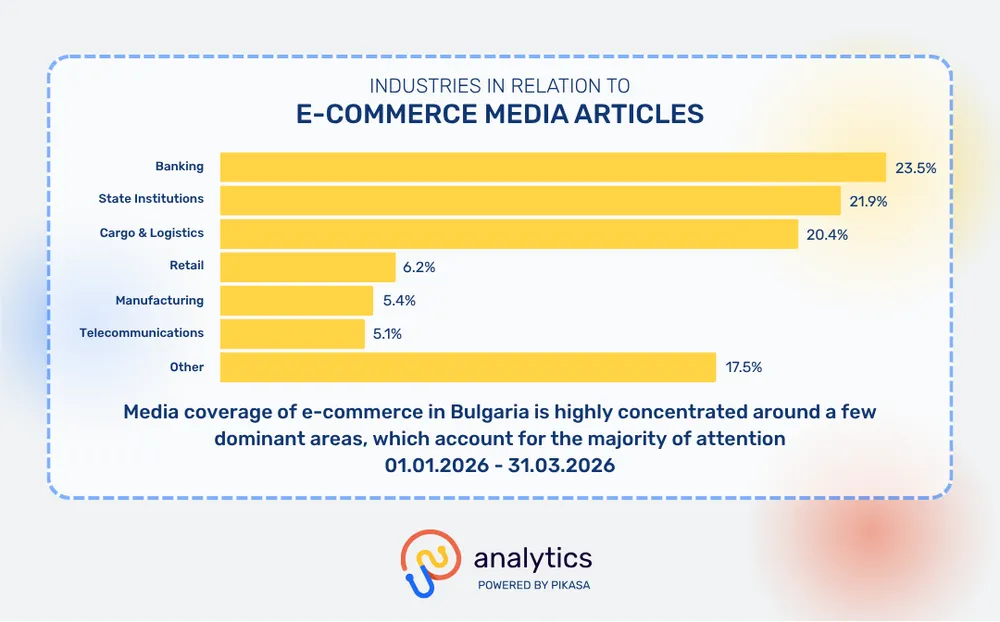
Bulgarian media strongly frames e-commerce through regulation, with State Institutions representing 21.9% of total coverage. Headlines frequently highlight new rules, taxes, investigations, and enforcement actions, including EU-level policies and shipment-related fees. These stories are widely amplified across media outlets, reinforcing their visibility. Instead of focusing on business expansion or innovation, the narrative is centered on compliance and control. This positioning suggests that e-commerce is primarily shaped by institutional influence rather than competitive market dynamics.
Physical Over Digital: Delivery Drives the Story
Despite being a digital industry, a significant portion of coverage is focused on the physical movement of goods, with Cargo & Logistics accounting for 20.4% of all topics. Headlines often emphasize delivery costs, cross-border shipments, courier performance, and supply chain disruptions. This reflects practical concerns that directly affect consumers, but also shifts attention away from digital innovation and platform development. The result is a narrative where e-commerce is understood more through its operational challenges than its technological progress.
The Missing Consumer Voice
Although consumer-related topics drive engagement, they are underrepresented in coverage. Retail accounts for only 6.2%, while Consumer Behavior (2.6%) remains relatively low. Most retail-related headlines focus on issues such as counterfeit products, misleading offers, or price increases, rather than positive shopping experiences or brand strategies. This creates a clear gap between what audiences engage with and what media consistently reports. The consumer perspective exists in reactions, but is not proportionally reflected in the narrative, leaving an incomplete view of the e-commerce landscape in Bulgaria.
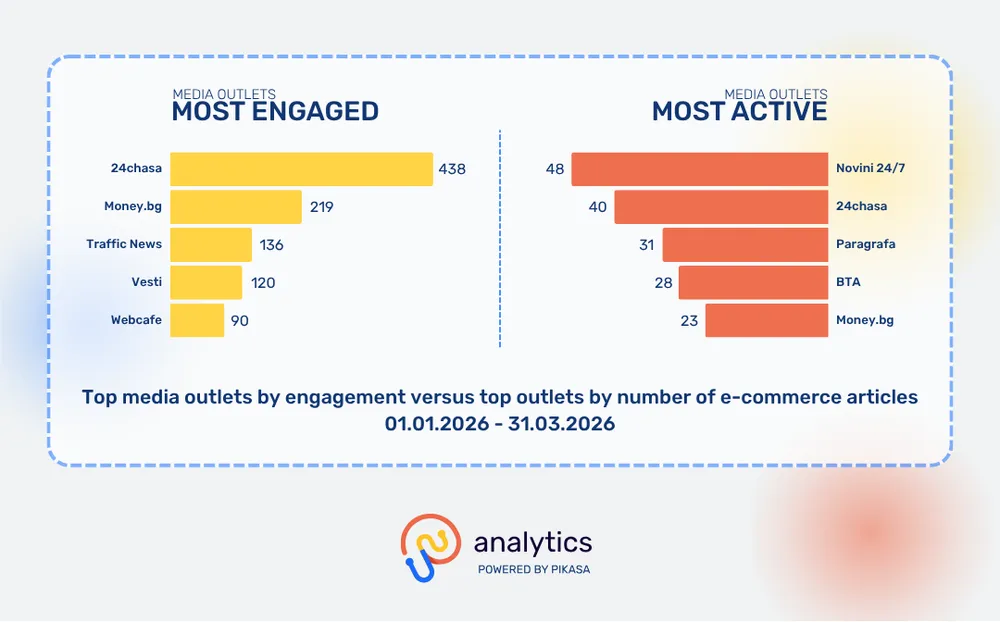
This overview highlights the media outlets that generated the highest number of engagements and the highest volume of news articles related to e-commerce in Bulgaria. It shows a clear difference between outlets that produce more content and those that drive stronger audience interaction, indicating that visibility does not always translate into impact.
Across these leading media sources, brand presence follows a distinct pattern. In 53% of the content, foreign brands are mentioned, dominating the narrative and reflecting strong international influence. In comparison, domestic Bulgarian brands appear in only 20% of the coverage, showing significantly lower local visibility. The remaining 27% of articles focus on general industry topics, such as trends, regulations, and market developments, without referencing specific brands.
Three Parallel Realities of Bulgarian E-commerce
The media presents e-commerce in Bulgaria through three clearly different lenses, shaped by the types of brands being mentioned. Foreign brands such as Amazon, Temu, Shein, and AliExpress dominate the narrative, but are mostly associated with regulation, investigations, and risk, including tax cases, EU scrutiny, unsafe products, and market control. Even when innovation is discussed through companies like Apple, Samsung, or Walmart, the focus often remains on scale, competition, or disruption rather than everyday user experience.
In contrast, domestic brands such as eBag, Gladen.bg, euShipments.com, EasyPay, myPOS, and Speedy appear in a more practical and growth-oriented context. They are linked to platform development, logistics expansion, payment solutions, and local market adaptation, such as the transition to the euro. However, despite this more positive and operational narrative, they have significantly lower visibility and do not shape the broader media story.
At the same time, a large portion of articles does not mention any brands, focusing instead on general topics such as EU regulations, customs rules, taxes on small shipments, and consumer protection warnings. This creates a system-level narrative where e-commerce is presented through rules and policies rather than through companies or competition.
Where Narrative Meets Opportunity
E-commerce in Bulgaria is not lacking growth, it is lacking narrative balance. As the data shows, media coverage is heavily shaped by regulation, financial risk, and operational concerns, leaving consumer experience and innovation underrepresented.
This creates a perception gap: the story is driven more by control and risk than by growth or the user perspective. At the same time, there is a gap between what media covers and what people actually care about.
The next phase of e-commerce growth will depend not only on performance, but on who succeeds in reshaping the narrative toward customers, real experiences, and innovation.
Written by
Meriton Nagavci
April 16, 2026