Bosnia and Herzegovina heads to the polls on 4 October 2026 to elect its tripartite Presidency alongside parliamentary, entity and cantonal bodies, with the campaign already playing out as intensely online as on the ground.
- 645 articles and 67 social posts tracked across 79 BiH outlets and all major social platforms (17–23 Aug 2026), totaling 18,091 engagements.
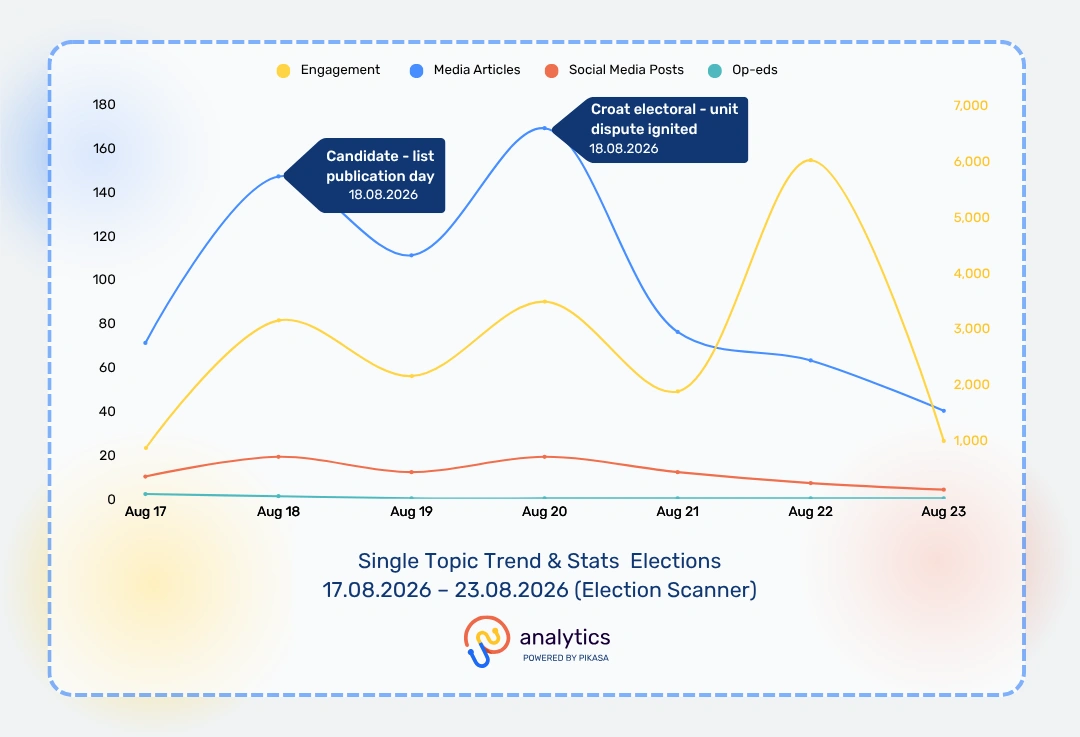
- Coverage peaked three times (18, 20, 22 Aug), with engagement spikes following about a day behind each surge in published volume.
- Social posts converted at nearly 2x the rate of articles (213 vs. 118 engagements per piece) despite being a tenth of total volume.
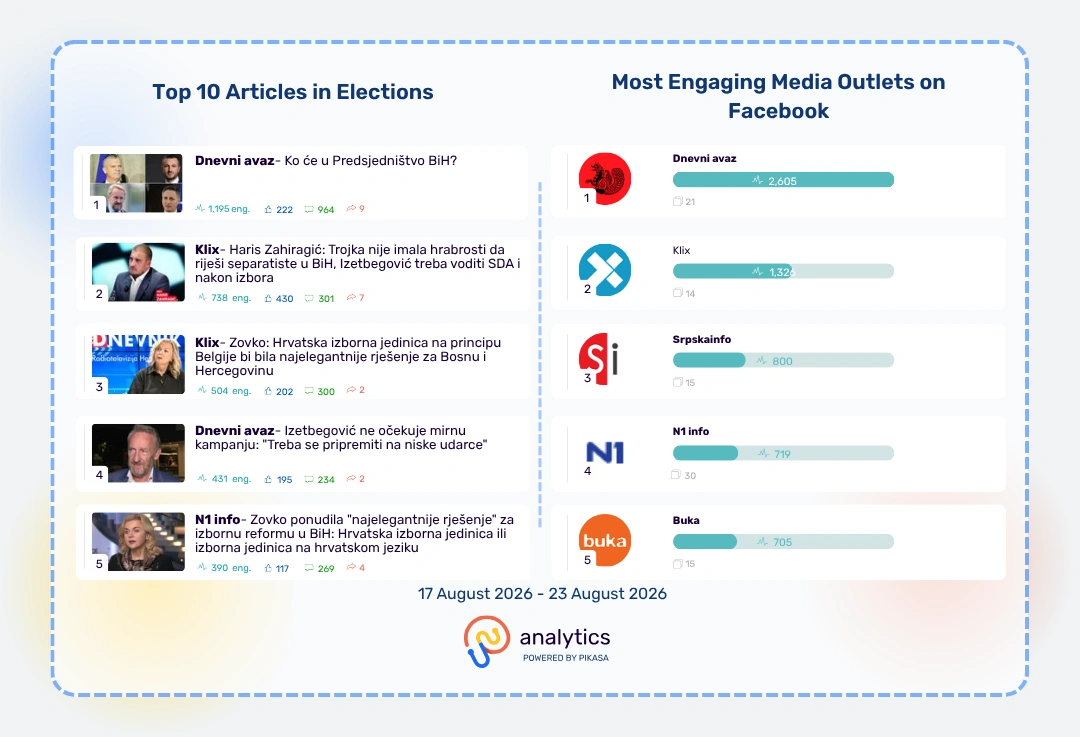
- The Croat electoral-unit dispute over the BiH Presidency seat drove 7 of the week’s 10 most-engaging articles.
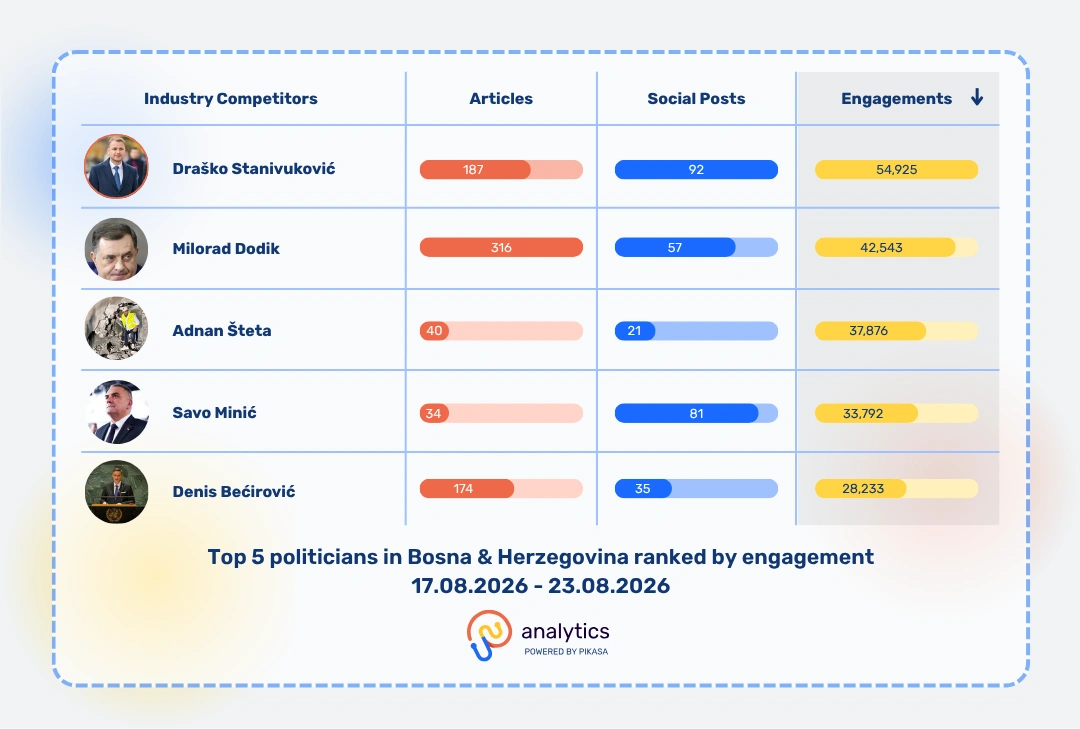
- Draško Stanivuković led on impact (54,925 engagements) despite Milorad Dodik generating far higher volume (316 articles).
- SNSD more than doubled HDZ BiH’s engagement (46,770 vs. 20,944) on comparable article counts.
- Dnevni avaz led Facebook engagement (2,605 from 21 posts), roughly 2x Klix (1,326 from 14 posts).
- Hate-speech comments clustered at 34–42% of total comments across the ten most-targeted politicians.
- Election Scanner will continue weekly tracking through the campaign.
Bosnia and Herzegovina’s Presidency Race Is Already Being Fought Online
As Bosnia and Herzegovina heads toward its Presidency vote, a parallel contest is unfolding across news portals and social feeds. Through Pikasa Analytics’ Election Scanner, the platform tracked the week of 17–23 August 2026 across 79 media outlets and every major social network, logging 645 articles and 67 social posts worth a combined 18,091 engagements. The picture that emerges is less about who publishes the most, and more about who breaks through.
| |
Media Articles |
Social Media Posts |
Columns |
| Posts/Articles |
645 |
67 |
3 |
| Engagements |
9,347 |
8,744 |
17 |
| Engagement per Post |
118 |
213 |
8 |
| Number of Profiles/Articles |
79 |
41 |
2 |
Coverage crested three times through the week - 18, 20 and 22 August - each spike in articles followed roughly a day later by a matching spike in engagement. Social posts converted at nearly double the rate of articles per piece published, 213 engagements per post against 118 per article, even though they made up a tenth of total volume: a small number of highly-shared posts driving outsized reaction relative to the week’s 645 articles.
From Banja Luka to Sarajevo: The Politicians and Parties Driving the Digital Narrative
Draško Stanivuković leads not on volume but on impact, drawing 54,925 engagements from 187 articles and 92 social posts - his coverage of “Elections,” “Infrastructure” and “Electoral Campaign” converting at a rate few others matched. Milorad Dodik produced the heaviest press volume of the week, 316 articles tied to “Trial of Milorad Dodik,” “EU Integration” and “Communication,” yet settled for second place on engagement at 42,543. Further down the field, Adnan Šteta and Savo Minić posted some of the strongest returns of the week - 37,876 and 33,792 engagements - from a fraction of the coverage recorded for the leaders, proof that emotional resonance can outperform volume.
The same pattern holds at party level. Savez Nezavisnih Socijaldemokrata (SNSD) dominated with 481 articles and 46,770 engagements, more than double Hrvatska Demokratska Zajednica BiH (HDZ BiH)’s 20,944 - despite HDZ BiH publishing a comparable 406 articles. Beyond the top two, engagement drops off sharply: no other party cleared 11,000.
.webp)
Elections and the Electoral-Unit Dispute Dominate While Other Topics Fade
Across the week’s general topics, “Communication” and “Culture” led on volume - 1,689 and 1,269 articles respectively - while “Culture” converted best per article at 15.60 engagements, the strongest ratio of the five topics tracked. But it was a single storyline that came to dominate the news cycle: the dispute over a dedicated Croat electoral unit for the BiH Presidency. Seven of the week’s ten most-engaging articles trace back to it, led by Dnevni avaz’s “Ko će u Predsjedništvo BiH?” at 1,195 engagements.
Who Sets the Agenda? The Outlets Amplifying the Debate
On Facebook, Dnevni avaz converted 21 posts into 2,605 engagements this week alone, roughly double Klix’s 1,326 from 14 posts - a gap that widens further across the full monitoring period, where Dnevni avaz’s page produced 47,649 engagements against Klix’s 37,269. Srpskainfo, N1 info and Buka rounded out the top five, each converting 700–800 engagements from a comparatively small number of posts.
More Than Just Numbers: What Engagement and Hate Speech Reveal
Engagement signals more than reach - it also carries risk. Elmedin Konaković drew 1,500 hate-speech comments this week, 34% of the 4,370 total comments on his coverage, while Denis Zvizdić recorded 685 at the same 34% share. Nerin Dizdar posted the highest concentration among the ten most-targeted politicians, at 42%. Notably, hate-speech percentages clustered tightly between 34% and 42% across the board - a consistently hostile comment environment rather than an issue isolated to one figure or party.
.webp)
Monitoring the Momentum: How Election Scanner Will Track the Race Ahead
As campaigning intensifies, Pikasa’s Election Scanner will continue to track daily shifts in coverage, engagement and hate speech across every tracked politician, party and outlet, publishing a new report each week through the election period. In a contest already this crowded, the ability to separate signal from noise is what determines whether a campaign, newsroom or observer sees a shift coming - or reads about it after the fact.
Methodology
Data collection involved monitoring articles from Bosnian and Herzegovinian digital media outlets, alongside posts across Facebook, Instagram, TikTok and YouTube. Advanced machine-learning algorithms and automated content analysis systematically tagged mentions of politicians, parties and topics, with hate-speech comments identified and scored separately. The analyzed period spans 17–23 August 2026.
Written by
Natasha Dimova
September 04, 2026