Pikasa Analytics analyzed Armenia's election media conversation from the beginning of February to the 10th of June 2026 through Analytics.Live, examining more than 133,000 articles and over 122,000 social media posts. The study maps visibility, sentiment tone and key narratives (from corruption to party dynamics) to show how media attention shaped the campaign, defined the tone and amplified the result. This is the fifth study in our Election Focus series, following the ones from Bulgaria, Hungary, Slovenia and Albania.
Key takeaways:
- Pashinyan was mentioned in more articles than the next 10 politicians combined. His 48,380 article mentions, against a combined total of 47,638 for all rivals, equating to more than a third of all mentioned politicians, representing a level of media saturation with few precedents in Pikasa Analytics' regional election coverage.
- Neutral coverage outperformed partisan framing across all three candidates. Factual, event-driven reporting consistently generated the highest per-article engagement regardless of which politician was being covered. This finding directly challenges the assumptions about the electoral value of aggressive or emotionally charged media strategies.
- Civil Contract generated more engagement than Strong Armenia despite trailing in both articles and social posts. With 5,053,250 total party-level engagements against Strong Armenia's 4,443,676, Pashinyan's party demonstrated a capacity to convert reach into depth of interaction that its rivals could not match.
- Election day itself was the peak of media activity. Unlike Bulgaria where coverage surged before voting day, Armenia's publication volume and engagement both culminated on June 7th, with 2,493 articles published and approximately 450,000 interactions recorded, suggesting an electorate that remained engaged and uncertain until the very end.
On the 7th of June 2026, Armenia held their third “free and fair” parliamentary elections since the 2018 "Velvet Revolution", which saw the two-term incumbent Prime Minister Nikol Pashinyan from the Civil Contract party successfully defending his primacy against his main opponent, the Russia-affiliated Samvel Karapetyan with his newly founded Strong Armenia party, as well as the former president Robert Kocharyan leading the Armenia alliance party. This election was widely framed as a referendum not only on Pashinyan's governance, but on the country's fundamental geopolitical orientation. Pashinyan ran on a pledge to secure peace with Azerbaijan, normalize ties with Turkey, and strengthen ties with the European Union, seen as a Western pivot sharply contested by both pro-Russian opposition forces.
Ultimately, while the votes are still being finalized and certified by the State Election Commission, as of the publication of this report only three parties secured enough votes to join the new National Assembly line up: Pashinyan and his Civil Contract got 49.85% of the votes or 64 seats, Karapetyan captured 23.31% of the votes (29 seats) and Kocharyan and Armenia Alliance got gained 12 seats with 9.95% of the vote.
Pashinyan's Total Dominance In Every Metric
As was the case with Bulgaria's new Prime Minister Rumen Radev, the politician-level data leaves little ambiguity about where media attention was concentrated. Of the 133,421 articles tracked across the monitoring period, Nikol Pashinyan was mentioned in 48,380, more than three times the figure for his nearest rival. Samvel Karapetyan followed at 16,122, while Alen Simonyan and Gagik Tsarukyan - the latter of whom just barely missed securing a single parliamentary seat - clustered closely around 6,000 articles each. To put Pashinyan's dominance in perspective, he accounted for more articles than the next 10 tracked politicians combined. What is peculiar, though, is that absent from the top 15 most mentioned politicians is Robery Kocharyan, having mere 1,480 articles written about him.
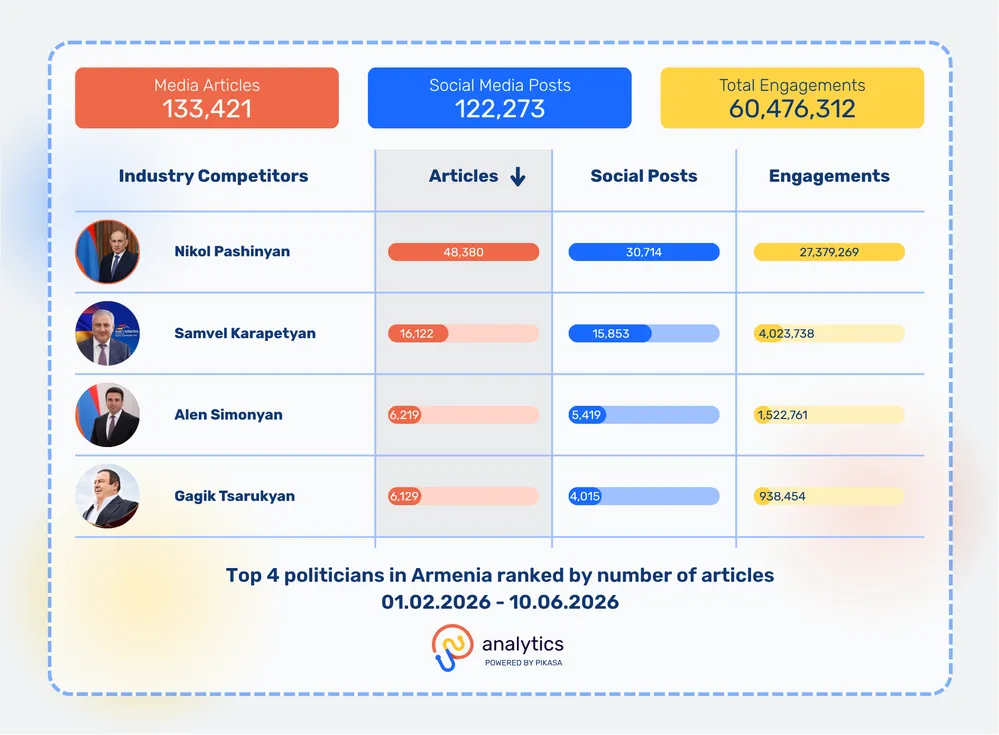
This pattern still holds true for social media metrics as well. Pashinyan's 30,714 social media posts dwarfed Karapetyan's 15,853, and the engagement gap is even more striking - Pashinyan generated 27,379,269 total engagements, compared to just 4,023,738 for Karapetyan.
On the other hand, the clearest divergence between traditional media and social media metrics is observed in the case of Kocharyan.
Despite receiving relatively miniscule coverage in traditional news coverage, he ranked a comfortable third in terms of total social media posts (8,597) and, more notably, second in overall engagement, generating 4,474,372 interactions. This indicates that while Kocharyan's presence in traditional media was comparatively modest, discussions about him resonated strongly with the audiences across social media platforms.
The Party Landscape - Strong Armenia Punched Above Their Weight
At the party level, the data tells a more nuanced story. Strong Armenia led in both article coverage and social media volume, outpacing Civil Contract by a wide margin. Armenia Alliance ranked third in articles but first in social posts, echoing Kocharyan's own pattern of stronger social presence than traditional media presence.
Nevertheless, this inversion of the politician-level figures is analytically significant because it suggests that the opposition consolidated its media presence at the party brand level, while Pashinyan's campaign was driven almost entirely by his personal brand rather than by Civil Contract as an institutional actor. This dynamic in the split of quantitative distribution of media coverage was comparable to what Pikasa Analytics observed in Bulgaria’s elections, where Radev similarly overshadowed his own party in coverage volume.
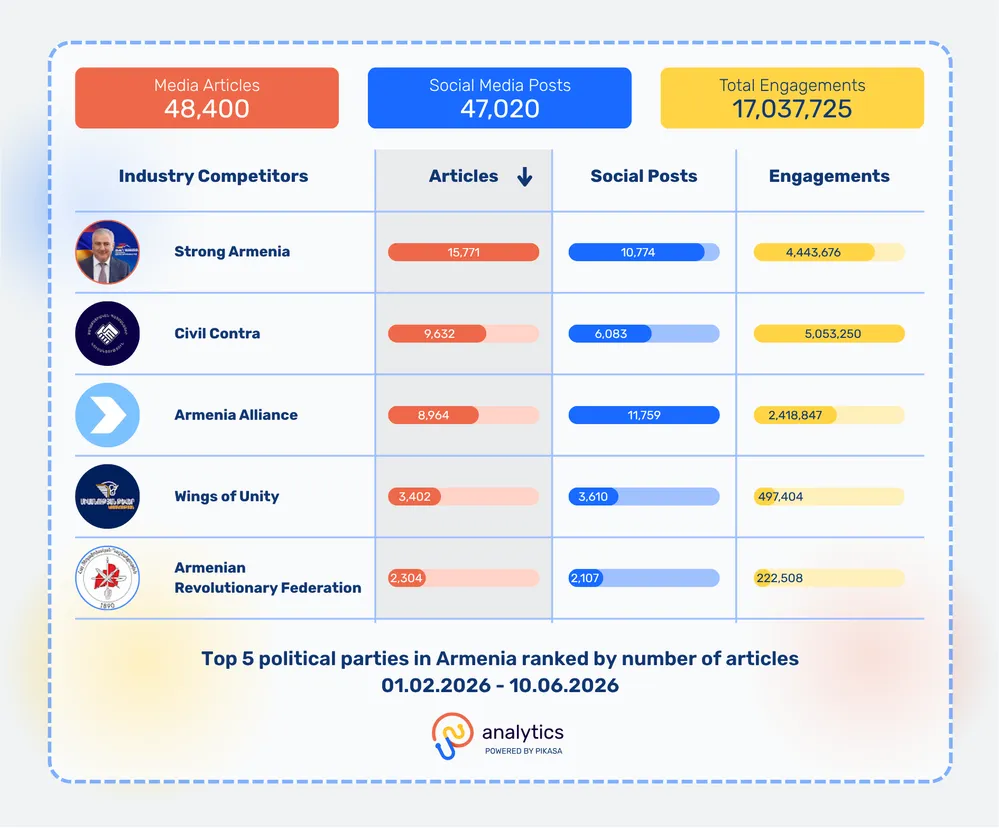
Engagement figures, however, restore the incumbent's advantage. Civil Contract generated more total engagement than Strong Armenia, despite trailing in volume. Armenia Alliance, fronted by Kocharyan, trailed both despite its high social post count, suggesting that their content circulated widely but did not convert into deeper or more meaningful audience interaction.
When the Topics Talk Back: Pashinyan Owns the Agenda, but Not All of It
Mapping the flow between politicians and the themes attached to their coverage adds a layer the mention counts alone don't capture who owned which conversation, not just who got talked about most.
Pashinyan's coverage, despite its overall volume, concentrates heavily on Parliament and Legislative Processes and Elections, the procedural, campaign-cycle beats expected of an incumbent fighting for re-election. Karapetyan's topic distribution mirrors this same concentration almost exactly, suggesting that both front-runners were pulled into the same horse-race framing rather than carving out distinct narrative territory.
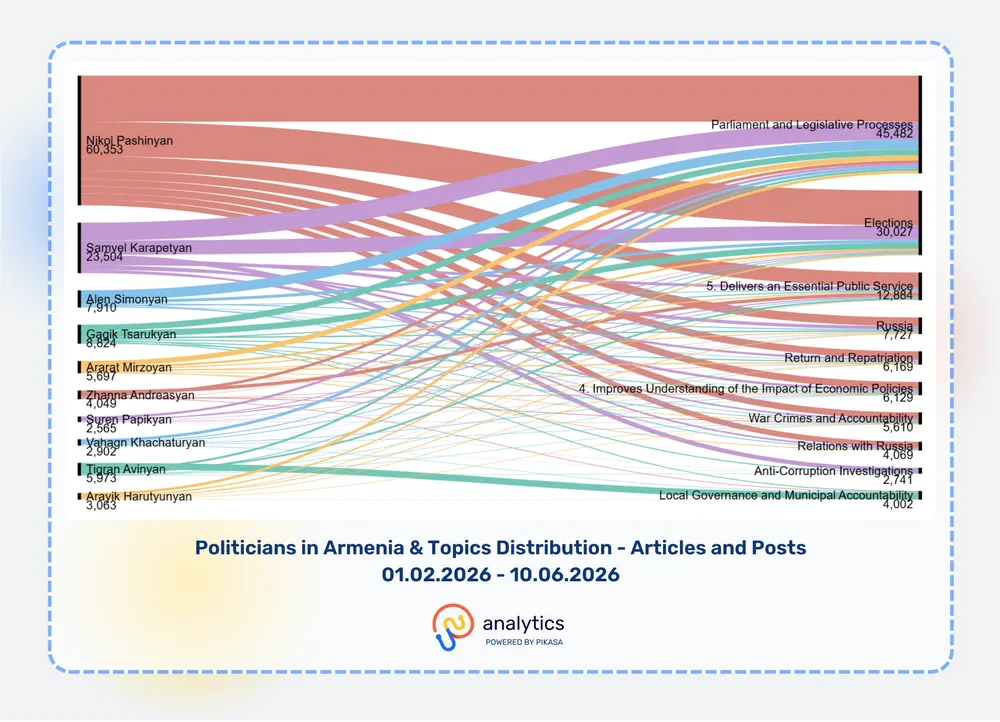
Further down the visibility ranking, figures like Tsarukyan, Simonyan, and Avinyan show a markedly more diversified topic spread despite their lower overall volume, picking up meaningful coverage on Russia, Return and Repatriation, and Local Governance and Municipal Accountability, themes that barely register for the top two candidates. This points to a division of narrative labor within the campaign: the leading figures absorbed the election-cycle framing, while secondary figures absorbed the policy-specific and geopolitically flavored coverage.
War Crimes and Accountability and Anti-Corruption Investigations, while smaller in absolute volume, draw from a wide spread of political figures rather than concentrating on any one or two, indicating these functioned as cross-cutting accountability narratives implicating the broader field rather than storylines tied to a single politician's brand.
Key flashpoints in the Election timeline
When it came to the broader topic of the elections, it generated 50,874 articles across 91 outlets, accumulating 770,940 engagements, or an average of 15.15 engagements per article. Social media activity was considerably more extensive, with 27,143 posts from 569 profiles producing 4,651,741 engagements, equivalent to 171 engagements per post. As with previous elections monitored by Pikasa Analytics, the engagement-per-post ratio vastly outpaces the engagement-per-article figure, confirming that social media rather than editorial output was the primary engine of audience interaction around the election's topic.
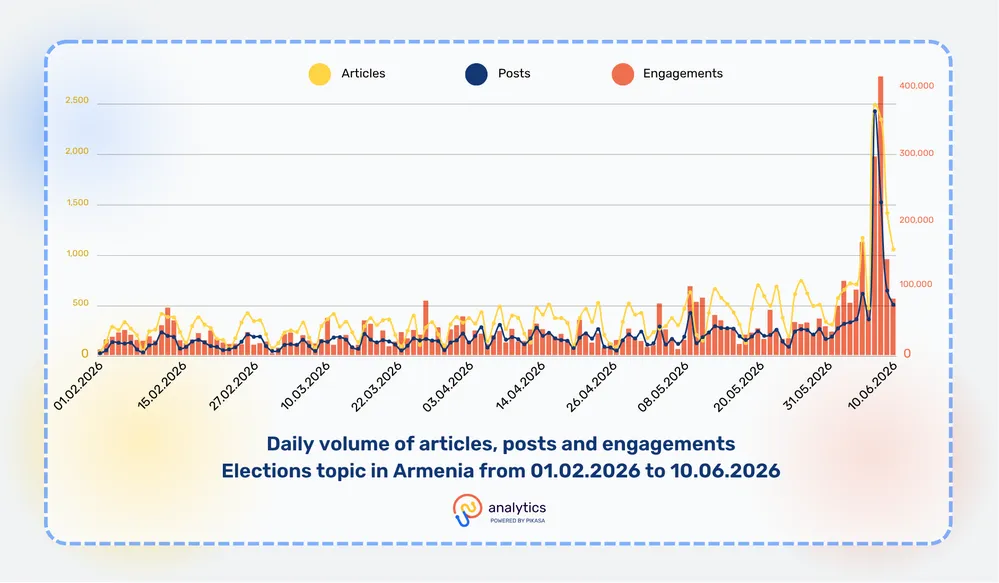
Article output held relatively steady from February through late April, oscillating between roughly 200 and 650 pieces per day with a consistent weekly rhythm of peaks and dips. Social posts (red line) tracked articles closely to traditional media output throughout this period. This occurrence was unusual compared to prior election cycles monitored by Pikasa, where the two metrics tended to diverge more sharply. This suggests that for much of the monitoring period social media discourse was reactive to traditional media rather than driving its own independent output cycle.
A gradual upward drift in both article volume and engagement becomes visible from early May onward, likely reflecting the accumulation of campaign-period catalysts. While they were not as clear and prominent as were the events prior to Slovenia’s elections, nevertheless there are some important dates that sparked online conversations and news articles. On the 8th of May, Russian State Duma member Konstantin Zatulin commented that Russia should not recognize the election results if Pashinyan wins, made uptick in coverage, which also introduced a geopolitical dimension to the domestic electoral narrative.
On the 19th of May, it was revealed that Karapetyan's passport file listed the FSB information center as his place of employment marks a further escalation point, feeding directly into the pro-Russian narratives that were already prominent in the media space. With the news steadily slowing down in the days before this disclosure (just 132 total articles captured in the data set for the 18th of May), the media space boomed back with 705 on the day that the news of Karapetyan passport was revealed. The most significant inflection point arrives in the final days before the vote. On the 5th of June, calls to ban Strong Armenia over bribery charges contributed to a sharp pre-election spike, garnering by far the most media attention with 1174 articles published that day.
Consistent with previous election case studies conducted by Pikasa Analytics, the highest levels of activity were recorded on election day. On the 7th of June, posting volume peaked at 2,493, which was the highest daily total of the monitoring period, while engagement simultaneously climbed to approximately 450,000 interactions. Unlike the Bulgarian election, where audience attention peaked before voting day, the Armenian election saw both publication volume and engagement culminate on the day of the vote itself, suggesting that public attention remained concentrated through the conclusion of the electoral process.
Outlet Analysis
Among the five most active outlets by article count, Aravot led with 2,307 articles, followed closely by Oragir News (1,839), 168.am (1,814), 24 news (1,599), and Panenian (1,588). Notably, 24News recorded the highest engagement figure among the five at 37,513 despite ranking fourth by article volume, which could mean that the outlet had a more engagement-efficient editorial approach, producing fewer but more widely circulated pieces.
The ranking of outlets by total engagement presents a markedly different picture from the ranking by publication volume. Armtimes led all publishers in audience engagement efficiency, generating 84,647 interactions from just 762 articles, with an average of approximately 111 engagements per article. Factor followed with 97,873 engagements from 1,233 articles (approximately 79 per article), while Mamul generated 84,174 engagements across 1,474 articles (57 per article). 1Lurer and 24News completed the top five.
The disparity between publication volume and audience engagement demonstrates that visibility does not necessarily translate into influence. While the most prolific outlets in the dataset were instrumental in driving the volume of election coverage, they were not always the most effective at capturing the attention of their audience. Conversely, publishers with lower output but substantially higher engagement rates achieved greater impact per article, may mean that they have stronger distribution networks, more loyal audiences, or more compelling editorial strategies.
Sentiment Analysis: Top 250 Articles by Engagement
The sentiment data in this analysis was done for each of the three politicians whose parties secured seats in the 9th National Assembly - Nikol Pashinyan, Robert Kocharyan, and Samvel Karapetyan. Each article's tone was evaluated using Pikasa Analytics sentiment classification system, which assigns a single tonal label to each piece based on its dominant register.
Since the coverage of each candidate received was unbalanced, the analysis was based on the 250 best performing articles by engagement mentioning each candidate. Logically, this would allow us to see what type of media coverage each candidate received.
Prime Minister Nikol Pashinyan generated the highest average engagement by a considerable margin (743.7 interactions per article). Neutral coverage performed best, averaging 818.6 engagements, compared to 708.8 for positive and 681.0 for negative articles. This suggests that audiences were most responsive to informational and event-driven reporting rather than overtly supportive or critical narratives.
In Samvel Karapetyan case, the articles mentioning him ranked second with an average of 597.7 engagements per article. As with Pashinyan, neutral coverage generated the strongest response (652.3), outperforming both positive (565.9) and negative (538.8) content.
Robert Kocharyan attracted substantially lower engagement, averaging 224.2 interactions per article. Although 60% of coverage was negative (150 articles), neutral reporting again generated the highest engagement (265.5), exceeding both positive (208.7) and negative (203.4) coverage.
What can be surmised across all three candidates is that neutral coverage consistently produced the highest engagement, indicating a clear audience preference for factual reporting over partisan framing.
Conclusion
Armenia's 2026 parliamentary elections confirm a pattern that Pikasa Analytics has now documented across five consecutive election studies that while media dominance and electoral success are related, they are not interchangeable. Pashinyan's victory was built on an almost unassailable combination of personal brand saturation, institutional credibility, and a geopolitical narrative that resonated far beyond his core base, though not enough to secure a supermajority so that he can enact his constitutional amendments. His opponents, by contrast, generated a media buzz, and in some cases considerable social media heat, without ever converting it into a coherent challenge at the ballot box.
What makes the Armenian case particularly instructive is the sheer scale of the informational contest surrounding it. With over 133,000 articles and 122,000 social media posts tracked, this was one of the most intensively covered elections in the region. Yet volume alone proved an unreliable predictor of outcome. Strong Armenia led at the party level in both articles and social posts, Kocharyan's alliance generated social engagement that far outstripped its traditional media footprint, and Karapetyan's personal visibility was substantial - and ultimately inconsequential.
How this analysis was made possible
Monitoring of Armenia's elections between February and June 2026, examining political communication and media impact through news articles and social media posts tracked via Analytics.Live. Using AI-powered monitoring, the report applies filtering, sentiment classification, and narrative-level analysis to assess candidate visibility, party coverage, engagement, sentiment, topic co-occurrence, and narrative ownership.
Election Focus is Pikasa Analytics' ongoing monitoring series across Central Asia, the Western Balkans, the Baltic, and Black Sea regions, applying narrative, sentiment, and engagement level analysis to electoral cycles in real time. For organizations monitoring electoral integrity, candidate visibility, or information-environment risk, the same framework can be commissioned for pre- and/or post-election.
Written by
Matej Trojachanec
June 22, 2026