Ever typed “Picasa AI” and ended up at an obscure photo‑editing site instead of a cutting‑edge media‑monitoring platform? You’re not alone. Our latest report shows that many curious users are hunting for Pikasa - and they don’t always spell it correctly. While we can sympathize with anyone who confuses us with a certain image organiser from the early 2000s, the misspellings reveal something important about how people search online and how brands can turn those mistakes into SEO opportunities.
Typos and trends: what people actually type
It’s easy to assume that your audience always enters the correct name into the search bar. Data says otherwise. When we analysed a thousand search queries that led visitors to Pikasa, we found dozens of alternative spellings. These aren’t just random keystrokes - many are logical mistakes based on pronunciation. Some of the most common variations include:
Top search variations used to find Pikasa in the last 3 months
| Search term |
Impressions |
| picassa ai |
1,925 |
| picasa ai |
1,828 |
| pikasa analytics |
1,262 |
| picasa |
1,227 |
| picasa kya hai |
1,049 |
| picassa |
1,035 |
| piksa ai |
1,026 |
| picassa ia |
1,022 |
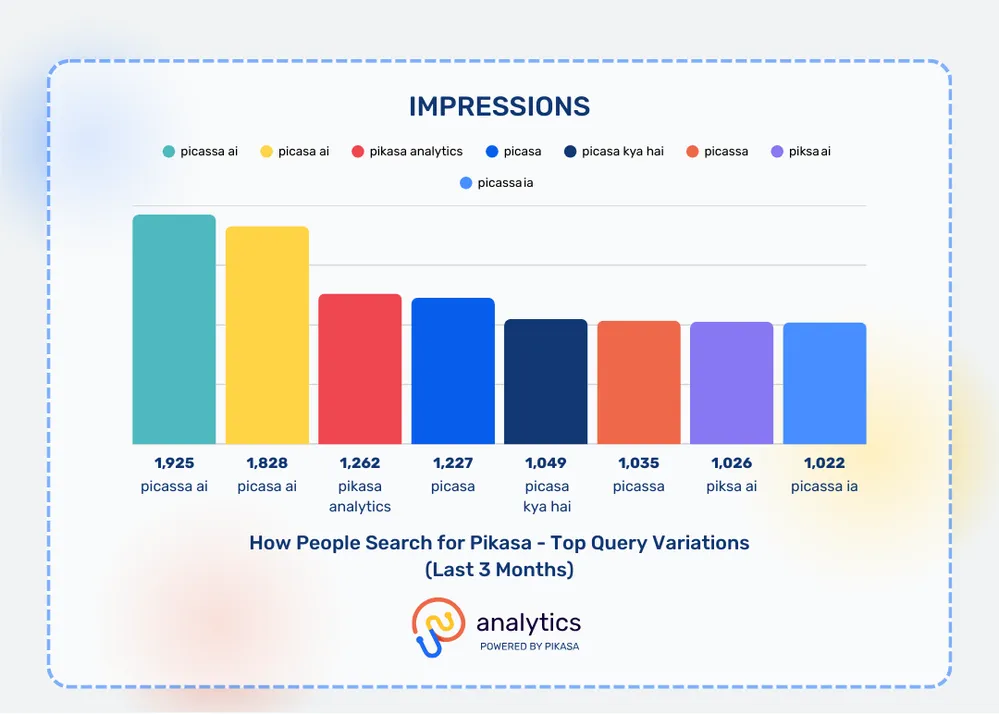
These typos aren’t hurting us - on the contrary, they’re helping us understand how people think. For example, “Picasa AI” and “Picassa AI” racked up more than 3,700 impressions combined. That tells us that prospective users associate us with artificial intelligence (good) but still default to the name of a retired photo‑app (not so good). Recognising and embracing these terms can improve your SEO: by including common misspellings in metadata or FAQ pages, you make it easier for wandering fingers to reach the right destination.
Many companies underestimate how brand misspellings in Google search affect their SEO visibility. Analyzing these variations through tools like Google Search Console can reveal how users actually discover your brand online.
The bigger picture: what searchers care about
We also noticed that many queries reaching Pikasa aren’t about us at all. They’re about whatever happens to be trending. In the last three months, people have searched for “Big Brother VIP Kosova live 24/7,” “coconut oil diet keywords,” and “social media monitoring for elections.” Our platform picks up these peaks because it watches everything: breaking news, reality‑TV chatter, even diet fads. That’s a reminder that your audience’s attention is constantly shifting and your monitoring tools need to keep up.
Who (or what) is Pikasa, really?
Spelling aside, Pikasa isn’t a photo editor. Pikasa is the company and brand behind the AI-powered analytics platform Analytics.Live media monitoring and social listening platform designed for businesses, policymakers and media professionals. Through Analytics.Live, Pikasa combines local expertise, global reach and AI innovation to provide real-time insights across 30-plus countries. Advanced models process huge data streams to identify emerging narratives, measure influence and forecast audience behavior. Here’s what sets it apart:
- Localized monitoring: Pikasa tracks thousands of digital and social media channels across more than thirty countries in real time. That means it picks up relevant news whether it’s published in Skopje, Tirana or Tashkent.
- AI & machine‑learning: Its models spot emerging trends, evaluate sentiment and forecast audience behavior with precision. This helps you see what’s about to go viral, before it dominates Instagram or TV.
- Human expertise: Senior analysts and data scientists transform complex information into actionable intelligence. In other words, there’s always a human behind the machine to explain the nuance.
- Custom dashboards and alerts: Tailored dashboards and automated alerts ensure each user receives the insights they need. Whether you’re monitoring an election or a product launch, you see the metrics that matter.
What our data tells us about searcher intent
Looking beyond the typos, we saw several other clusters of queries:
- People looking for media‑monitoring tools. Searches like “media monitoring tools for print and digital news,” “social media monitoring for elections” and “press monitoring tools” indicate that users are actively comparing platforms. Many even name our competitors (“Talkwalker vs YouScan”, “Brandwatch vs Meltwater”, “Determ vs Brand24” ), showing that readers are evaluating options. This suggests that your content should explain why your tool is different, not just what it does.
- Entertainment and pop culture. Queries about “Big Brother VIP Kosova” or “Big Brother Albania” dominated a section of the list. These topics may seem unrelated, but they demonstrate the breadth of information our monitoring platform can track. When a reality-TV moment goes viral, Pikasa detects it instantly across media and social networks. A good example is our analysis of Big Brother Kosova vs Big Brother Albania media coverage, where we explored how audiences engage with the show across different platforms.
- Health and lifestyle fads. Searches such as “coconut oil diet SEO keywords” or “keywords for weight loss” reveal that health trends drive search traffic. Companies in food or wellness industries can use Pikasa to monitor these conversations and adjust their messaging accordingly.
How to turn typos into traffic
Misspellings might seem like a nuisance, but they’re actually a gift. Here are a few takeaways for marketers and SEO professionals:
- Optimise for common misspellings. Incorporate the most frequent variants (like “picasa ai” and “picassa ai”) in your keyword strategy. This helps search engines connect mistyped queries to your brand.
- Educate through content. A blog post, like this one, can playfully acknowledge the mistakes while introducing readers to your actual product. By clarifying that you are an AI‑driven media‑monitoring platform, not a photo editor, you reduce confusion and set expectations.
- Leverage trending topics. Use your monitoring tool to identify which cultural phenomena (e.g., reality‑TV shows or diet trends) are driving traffic. Craft content that connects your brand to these conversations without straying off message.
- Highlight your unique selling points. When potential customers are also searching for competitors, clearly communicate your differentiators: localised coverage, advanced AI, expert analysis and custom dashboards.
Final thoughts
Typos tell a story. They show that users are trying to find you, even if they can’t spell you. They reveal what else is on their minds: reality shows, diet crazes, election news, and they highlight the need for a robust media-monitoring tool. By paying attention to how people search, you can refine your SEO strategy, connect with your audience and even have a little fun along the way. After all, whether you type Pikasa, Picassa, Picasa or Piksa, you’ll still end up on the right platform - one that turns scattered data into meaningful insights.
And if you want to go even deeper, tools like Pikasa Analytics can help you uncover detailed search patterns, brand perception and media trends. Or simply contact us to explore how data-driven insights can support your SEO and communication strategy.
Written by
Anja Nikolovska
March 05, 2026