This analysis covers social media content and media published during Q1 2026 for banks in Bulgaria and in Greece. Data was collected and processed by Pikasa Analytics using Analytics.Live.
Executive Snapshot of Bulgaria’s and Greece’s Banking industry
- 4,063 social media posts analyzed across commercial banks, five platforms and two markets - one of the most comprehensive banking social media analyses in the region to date
- The Product & Services category has the highest volume of posts in both markets - 35% of Bulgarian and 26.8% of Greek posts - yet earns the weakest engagement return of any content category
- Brand & Engagement earns 3x to 8x more engagement per post despite receiving a fraction of the investment - 608 avg. engagements in Greece and 179 in Bulgaria versus 77 and 144 for Product & Services content
- The highest single post earned 18,680 engagements - a Eurobank Greece YouTube competition for a Samsung smartphone, outperforming every product announcement in the entire dataset combined
- Thought Leadership category is the most over-invested and has the weakest rate of return - Greek banks publish it at 16.9% of content and earn 65 avg engagements, less than half the platform average
- The same bank performs 2.4x better in one market than the other - Eurobank Greece averages 412 engagements per post versus Postbank Bulgaria's 170, using the same products but completely different content strategies
By the Numbers
Before examining what banks publish and how audiences respond, the scale of the conversation should be appropriately contextualized.
Across Bulgaria and Greece in Q1 2026, Pikasa Analytics tracked 4,292 social posts, 10,018 articles, and 605,437 total engagements. The two national markets are comparable in engagement volume – Bulgaria generated 308,005 total engagements from 2,756 social posts, Greece generated 297,432 from 1,536 – yet they arrive at that result through completely different paths.
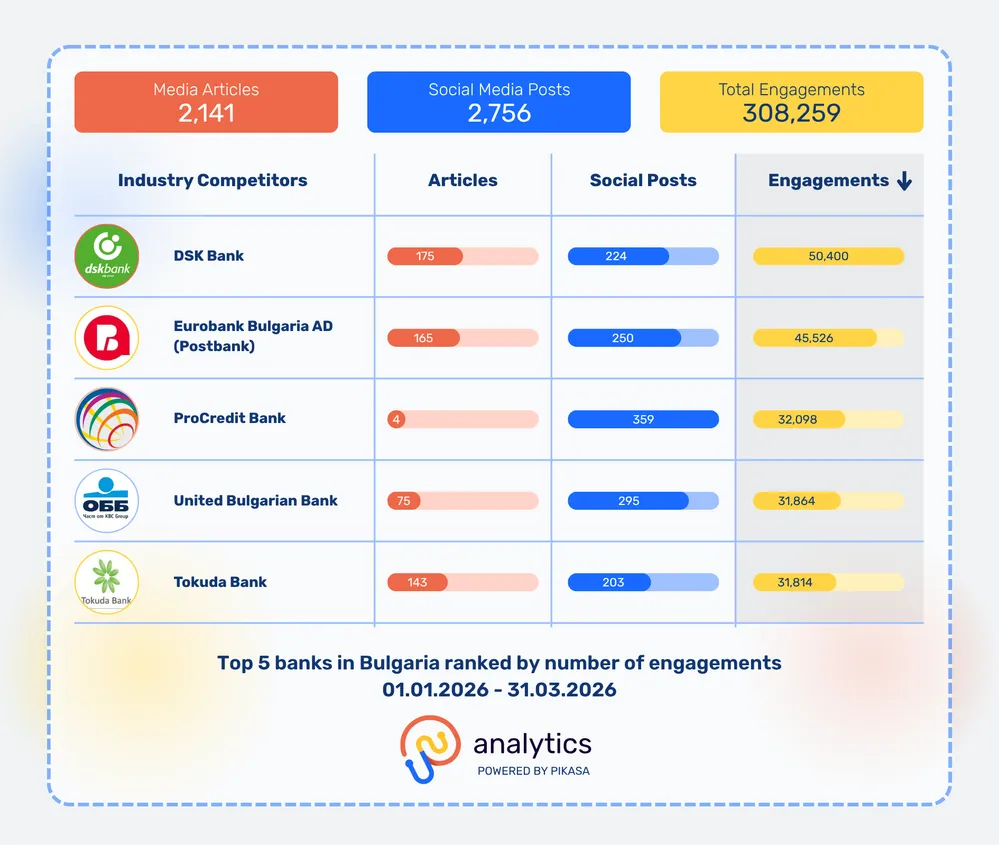
Greece produces a press footprint more than three times larger than Bulgaria's: 7,877 articles versus 2,141. Eurobank alone accounts for 2,503 articles and 34% of the Greek market's share of voice, with Piraeus Bank accounting another 31%. The two banks generate nearly two thirds of all Greek banking press coverage.
In Bulgaria the distribution is more even - DSK Bank leads at 16% share of voice with 175 articles, Postbank follows at 14% with 165 - but no single institution dominates the conversation.
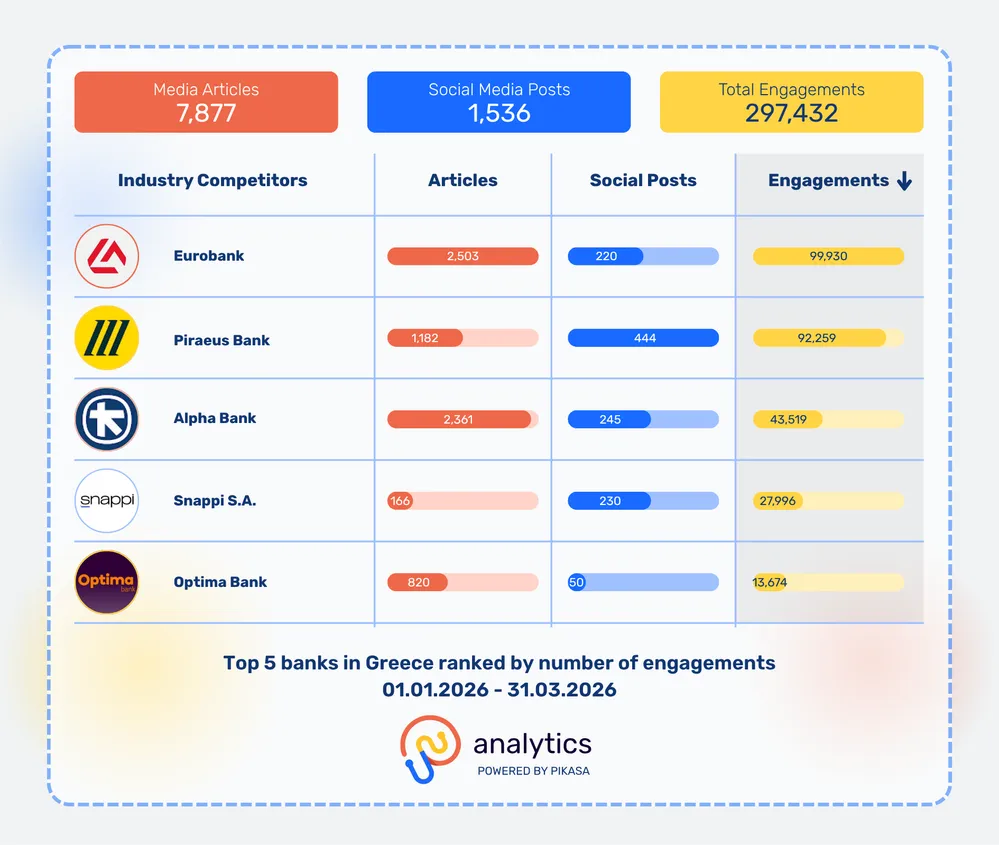
The headline number is the one that matters most: Bulgaria and Greece generated nearly identical total engagement despite Greece publishing nearly five times more press articles. More coverage does not produce more responses. This suggests that more coverage did not translate into greater public response.
Key Finding 1: Banks publish most where audiences respond least
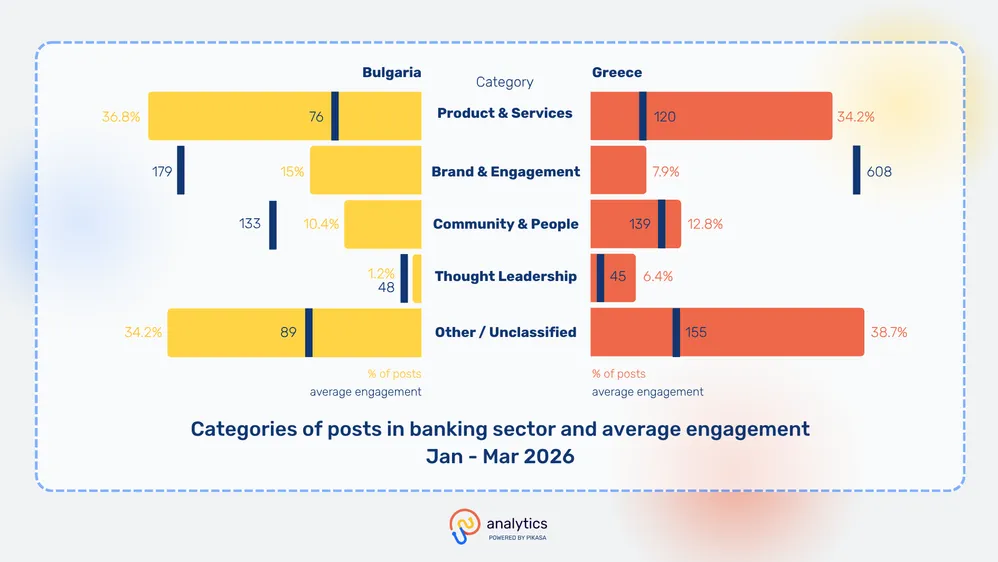
The dominant content category in both markets is Product & Services - cards, payments, loans, deposits, digital features, fraud warnings. It accounts for 37% of Bulgarian banking content and 34% of Greek banking content. At the same time, it earns the weakest engagement return in both countries together with Thought Leadership.
The pattern is consistent across both markets – the most published category earned the lowest engagement per post. And, inversely, the classified category with least publications earned the highest.
Key Finding 2: The Brand & Engagement gap is structural, not accidental
Greek banks invest less than 10% of their content in Brand & Engagement, such as giveaways, sponsorships, cashback campaigns, award moments, and earned an average of 608 engagements per post from it. Bulgarian banks invest 15.4% in the same category and earned 179.
The difference is not volume. It is content quality within the category. The highest-performing Greek banking post in Q1 2026 was a Eurobank YouTube competition for a Samsung Galaxy S26 Ultra framed as "The War Has Begun" – earning 18,680 engagements. Piraeus Bank ran a series of football ticket giveaways tied to AEK and Olympiacos Euro League matches, with individual posts earning between 4,799 and 10,548 engagements.
In Bulgaria, the highest-performing post was a Postbank Instagram giveaway for a kitchen appliance framed around saving time – earning 6,932 engagements. The second highest was an Easter cooking device giveaway on Facebook with 4,629.
The top posts in both markets share one structural characteristic. The bank is not the hero of the content. The audience is. A ticket to a sold-out basketball match. A flagship smartphone. A kitchen device that makes daily life easier. The bank is the mechanism. The prize, or the feeling, is the content.
Key Finding 3: Thought Leadership costs more than it earns
Greek banks invest 16.9% of their content in Thought Leadership – economic analysis, weekly market reports, investment commentary, geopolitical briefings. This is the category banks are most qualified to produce. It earns an average of 65 engagements per post, the lowest of any category in the Greek dataset.
| Category |
posts |
% of total |
avg. engagement |
total engagement |
| Brand & Engagement |
148 |
9.6% |
608 |
89,984 |
| Thought Leadership |
259 |
16.9% |
65 |
16,835 |
Specifically, Greek banks published 75% more Thought Leadership content than Brand & Engagement content and earned 81% less total engagement from it. The same inversion appears in Bulgaria, where Economic Analysis earns 44 average engagements – the lowest of any named category in the dataset.
This does not mean banks should stop producing economic analysis. It means they should not expect their audiences to engage with it on social media as much as the other categories.
Key Finding 4: The same bank performs 2.4x better in one market than the other
Eurobank operates in both markets – as Eurobank in Greece and as Postbank in Bulgaria. Same parent company, same financial products, however two completely different content strategies and two completely different results.
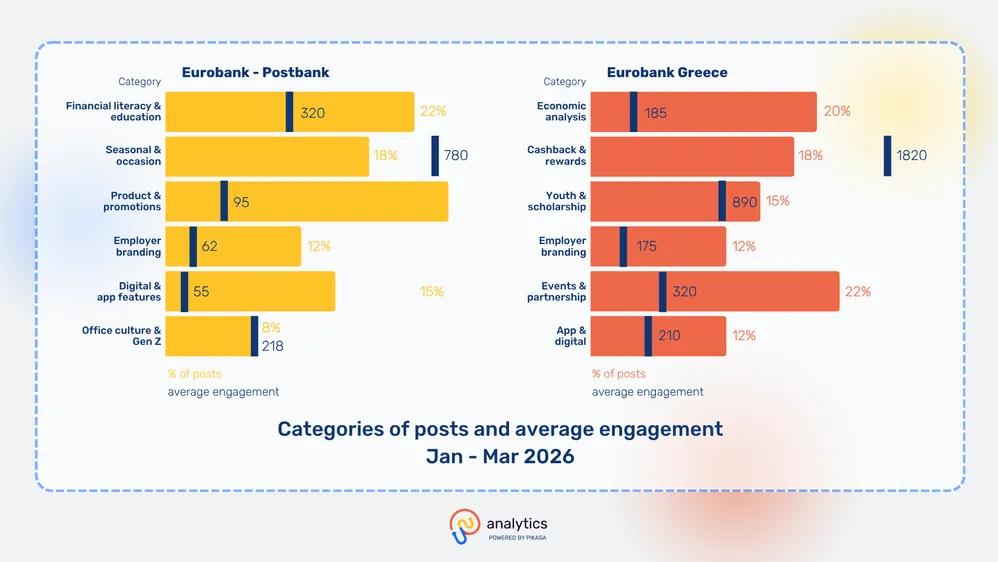
Eurobank Greece built its social presence around the cashback programme – a 20-year loyalty mechanism turned into platform-native content. The anniversary campaign alone earned over 10,000 engagements on a single TikTok post. The content is not about the bank. It is about 20 years of giving money back to customers, framed as a story the audience has lived through.
Postbank Bulgaria's most distinctive content is the "Финанси под Ctrl" financial literacy series – Gen Z-facing explainers on credit scores, budgeting, and financial planning. It earned a BAPRA award and averaged 320 engagements per post, eight times more than their digital app features. Both banks have found content that works, and neither publishes enough of it.
Platform Intelligence
Platform choice in both markets follows a recognizable pattern. Facebook absorbs most posts across all banks regardless of strategy, and LinkedIn is where banks invest in professional credibility – it is the only platform where banking content outperforms the platform average. TikTok remains largely untapped by Bulgarian banks, except for Postbank's Gen Z content, while Eurobank Greece has built a genuine TikTok presence anchored to the cashback programme.
Methodology
Pikasa Analytics monitored all social media content published by major commercial banks in Bulgaria and Greece during Q1 2026. National and central banks were excluded. Engagement is defined as the sum of reactions, comments and shares - views and reach are tracked separately and not included in engagement calculations. Posts were classified into four content categories using MLA classification validated against manual spot-checking: Product & Services, Brand & Engagement, Community & People, and Thought Leadership.