This analysis covers social media content and media published during Q1 2026 for A1, Vivacom and Yettel in Bulgaria. Data was collected and processed by Pikasa Analytics using Analytics.Live.
Executive Snapshot
- 3 operators monitored across social media and media in Bulgaria - A1, Vivacom and Yettel - covering the full competitive telecom landscape
- 526 social posts analyzed across Facebook, Instagram, LinkedIn and YouTube during Q1 2026
- A1 led engagement with 176 average engagements per post and 48,682 total, which is the highest in the dataset despite not publishing the most content
- Vivacom led press volume with 198 articles, yet almost all are PR texts with near-zero audience response
- Yettel has the smallest social footprint at 42 average engagements per post but the most genuine media coverage of the three
- Instagram is the highest-earning platform in the dataset. Vivacom averages 327 engagements per post there – the single strongest platform-brand combination
By the Numbers
Three operators. One market. Three completely different philosophies of how social media is utilized.
In Q1 2026 Pikasa Analytics tracked 526 social posts and 492 articles across A1, Vivacom and Yettel in Bulgaria, generating 68,522 total social engagements and a combined press reach of over 14 million. The numbers look competitive on the surface. Underneath, the strategies diverge sharply.
A1 published 277 posts and earned 48,682 total engagements, which was the highest in the sector, at an average of 176 per post. Vivacom published 134 posts and earned 15,770 total engagements at 118 per post. Yettel published 115 posts and earned 4,870 total engagements at 42 per post. In press, Vivacom led with 198 articles, followed by Yettel with 157 and A1 with 137.
The operator publishing the highest volume of articles generated the lowest social engagement per post, while the operator with the fewest press articles achieved the highest engagement. High output in one channel did not translate into stronger performance in the other.
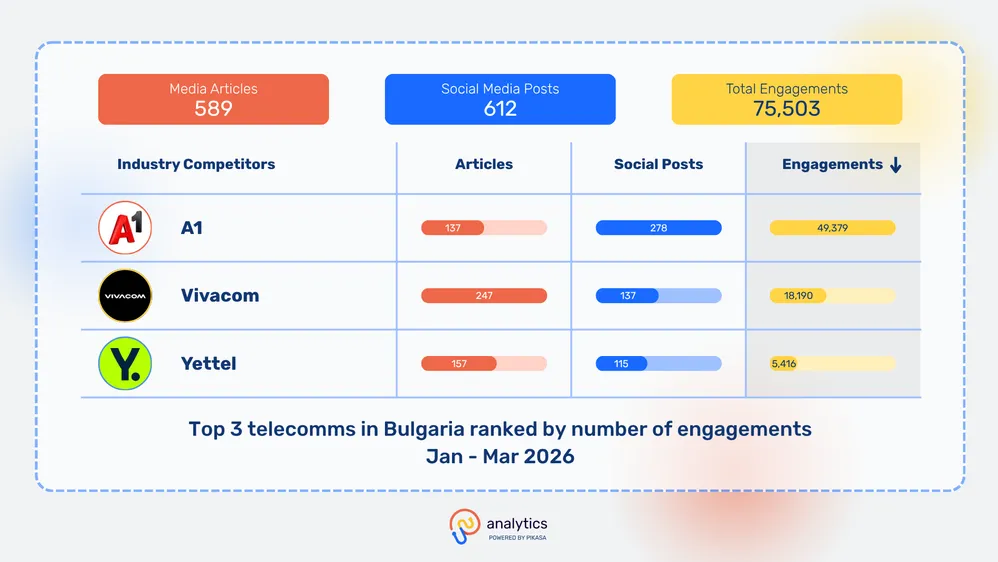
Key Finding 1: Each brand has made a completely different platform bet - and only one aligns with where audiences engage
All three operators published on the same platforms. What they publish could not be more different.
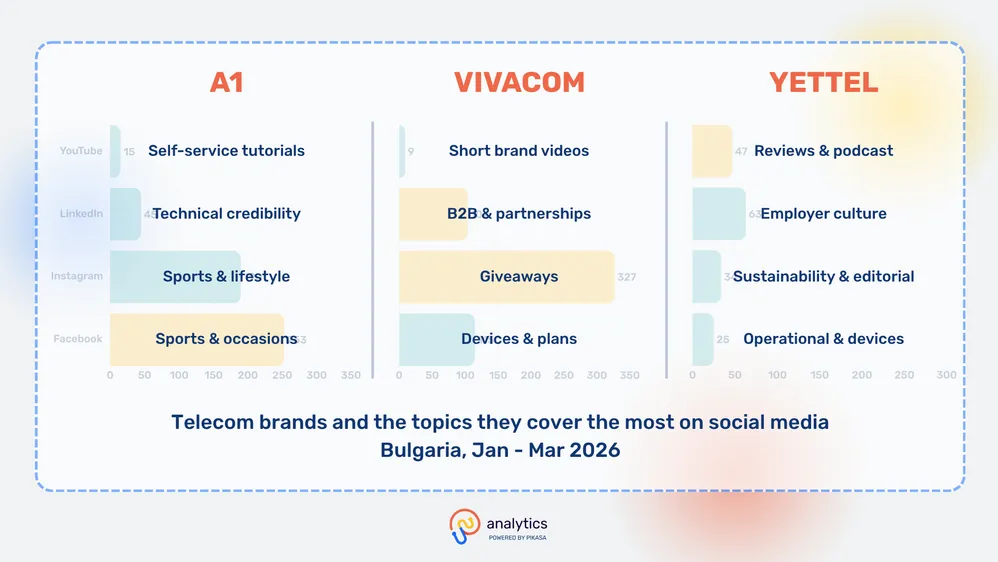
A1 won on Facebook with sports and occasions content - the snowboarding World Cup, ski season, athlete results, New Year and the 8th of March. A1 averaged 253 engagements per post on Facebook, which was their strongest platform. On LinkedIn they built technical credibility - 5G cross-border projects, network awards, and internal academy. On YouTube, they published self-service tutorials. The strategy was coherent and functional: mass emotion on Facebook, professional authority on LinkedIn, and utility on YouTube.
Vivacom's strongest platform was Instagram, which recorded the highest single platform-brand number in the entire dataset, driven largely by Valentine's Day giveaways and influencer-led EON averaging 327 engagements per post. Facebook content focused primarily on devices and plans; LinkedIn emphasized cybersecurity, university partnerships, and smart city projects, while YouTube consisted mainly of short promotional clips with an average of 9 engagements per video.
Yettel's most distinctive platform was LinkedIn, where CEO transition announcements, Top Employer certification and intern programme content contributed to a strong employer-brand identity. On Instagram, the company focused on sustainability and editorial-style content, such as Forbes Sustainability Forum, the Super People podcast, and health devices, while on YouTube it stood out as the only telecom using the platform for original content series rather than primarily tutorials.
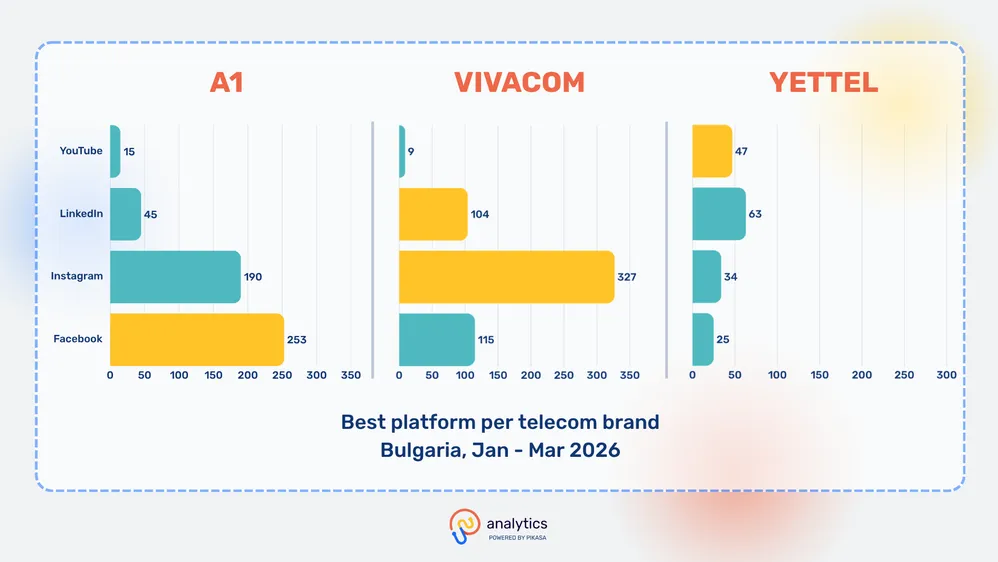
Each brand peaked on a different platform - and that peak corresponds directly to where their content strategy was most deliberate.
Key Finding 2: Press coverage volume means almost nothing without a real story behind it
Vivacom led the sector with 198 articles, though overwhelming majority were PR-driven announcements covering device launches, job programme announcements, satellite operator rankings, employer awards - published across dozens of outlets and earning near-zero audience engagement. The press is present. The audience is not.
The exception was the Varna network crash. When Vivacom's infrastructure failed and left subscribers without internet and television, journalists covered it because something genuinely happened. That single story earned more real engagement than the combined response to months of product announcements. One failure generated more press response than a hundred planned communications.
A1 appeared in 137 articles but rarely as the subject. Their flagship achievement - the first cross-border 5G project in Europe, connecting Bulgaria and Greece - generated a dozen articles with near-zero reader engagement. Their highest-earning press mention came from a story about fake vignette websites where A1 was referenced only because they sell vignettes. A1 is present in journalism as scenery or as a sponsor of something more interesting.
Yettel published fewer articles than both competitors, yet generated the most genuinely varied coverage, ranging from tactile strips for visually impaired customers installed in their stores and digital literacy programs that reached 60,000 children to volunteering culture pieces and brand-linked entertainment stories. These were not simply promotional announcements, but tangible actions and human-centered initiatives that have journalists' meaningful stories to report.
The ratio that runs consistently across all three operators and across every sector Pikasa Analytics monitors: journalistic content averages three times more real engagement per article than PR content. The brands that earn genuine journalism do so not by producing more press releases but by making decisions worth writing about.
.webp)
Key Finding 3: The best-performing content is never the most-published content
Across all three operators, the highest engagement consistently came from the content categories they published least often. A1's Facebook sports content earned 253 average engagements, which was their highest by platform, but sports and occasions represented a minority of their total output. Vivacom's Instagram giveaways earned an average of 327 engagements, but Instagram was their smallest volume platform. Yettel's LinkedIn employer culture content earned 63 average engagements - modest in absolute terms but their strongest platform - despite LinkedIn representing a small share of their posting activity.
The pattern is structural. The content that performed best was built around specific audiences and targeted emotions - excitement about a ski season, the chance to win a product, pride in a workplace. The content published most was built around what the brand needed to say - product launches, service features, corporate announcements. The gap between those two editorial directions was where engagement is lost.
Key Finding 4: YouTube is an untapped asset across the entire sector
YouTube was the weakest-performing platform for all three operators in absolute engagement terms. A1 averages 15 engagements per YouTube video. Vivacom averaged 9. The platform was being used as a repository for content produced for other purposes - self-service tutorials, short promotional clips, device launch videos - rather than as a channel with its own editorial logic.
The exception was Yettel, which averaged 47 engagements per YouTube video by publishing device reviews and episodes of the Super People sustainability podcast. Original content built for watch time rather than click-throughs. It was the only telecom in the Bulgarian dataset treating YouTube as a media channel rather than a content archive. The gap between 9 and 47 average engagements is not a budget gap; it is an intent gap.
Vivacom reached the most people on YouTube - 130,000 average views per video, the highest in the sector - but converted almost none of that reach into engagement. Reach without response is the most expensive form of invisibility in digital communications. The audience was watching, but they were not reacting, commenting or sharing. That distinction matters more than the view count in any serious analysis of content effectiveness.
Methodology
Pikasa Analytics monitored all social media content and media coverage for A1, Vivacom and Yettel in Bulgaria during Q1 2026. Engagement is defined as the sum of reactions, comments and shares. Views and reach are tracked separately and not included in engagement calculations. Media content was classified into journalistic and PR content based on editorial origin and cross-referenced against engagement data to assess real audience response. Platform analysis covers Facebook, Instagram, LinkedIn and YouTube. TikTok presence for all three operators was negligible during the period.
Written by
Natasha Dimova
June 18, 2026