This analysis covers social media content and media articles published during Q1 2026 for DHL and FedEx across Bulgaria, Romania, Greece, Hungary, Serbia and Albania. Data was collected and processed by Pikasa Analytics using Analytics.Live media monitoring and social media listening platform.
Executive Snapshot
- 2 global operators analyzed across six markets - Bulgaria, Romania, Greece, Hungary, Serbia and Albania, covering social media and media articles in Q1 2026
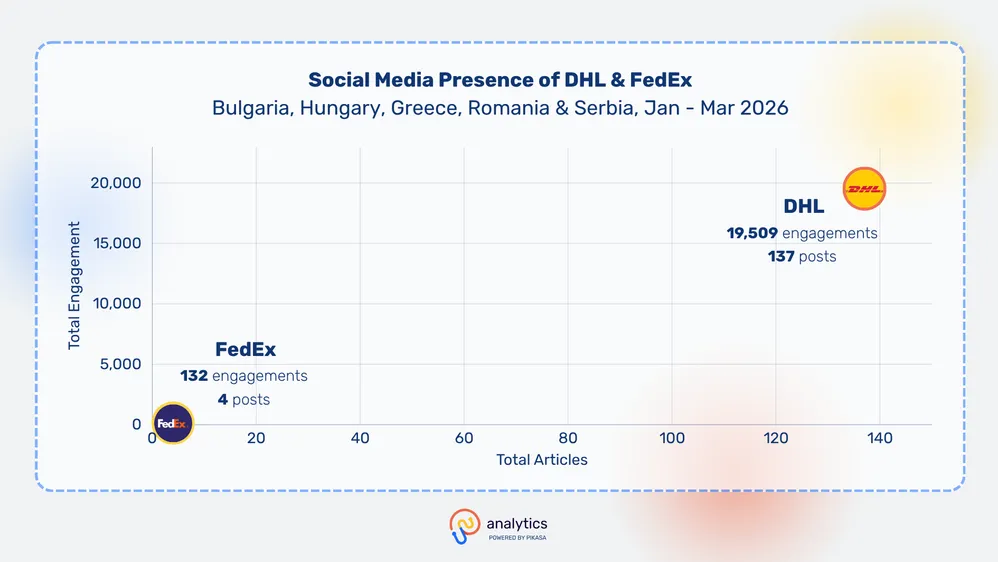
- DHL made a local bet - 5 country accounts, 137 posts, 19,509 total engagements across six markets
- FedEx made no local bet - 4 posts across six markets, none confirmed from a local account earned them meager 132 total engagements
- DHL outperformed FedEx on every social metric - 148x more total engagement, 4.3x higher avg engagement per post, 269x more total views
- FedEx led on press volume - 169 articles versus DHL's 148 - driven entirely by global events picked up by local journalists
- Neither brand had combined local presence with global authority - the vacancy that defines both markets simultaneously
By the Numbers
Two of the world's largest logistics brands. Six markets. One quarter. A gap so wide it reframes what presence actually means in regional communications.
In Q1 2026 Pikasa Analytics tracked 141 social posts and 317 articles focusing DHL and FedEx in Bulgaria, Romania, Greece, Hungary, Serbia and Albania. The social numbers tell one story. The press numbers tell another. Together they tell a third story that neither brand has fully understood yet.
DHL dominated every social metric. FedEx led the press volume by 21 articles. The press engagement gap between the two brands - 756 versus 805 - is negligible. The social engagement gap - 19,509 versus 132 - is not.
Key Finding 1: DHL chose local. FedEx chose to be absent.
DHL operates five country-level social media accounts across the six markets. Romania led with 69 posts and an average of 193 engagements per post - the highest country-level performance in the dataset. Serbia delivered the highest average engagement of any DHL market at 345 per post from just five posts, suggesting significant untapped potential. Hungary averaged 100, Bulgaria 87. Greece was the outlier - 12 posts, 1 average engagement - suggesting an account that exists without a functioning content strategy behind it.
FedEx had no equivalent. Across six markets and an entire quarter, four posts and no local voice. The brand exists in these markets - packages are delivered, warehouses operate, customers interact - but none of that presence was translated into owned communication. FedEx is a global brand that has decided the region does not warrant local conversation.
The content DHL produced in the markets where it works is deliberately local. Spring delivery campaigns were framed as new beginnings. Valentine's Day was framed as the emotion of connection. Seasonal storytelling sounded like a neighbor who happens to deliver your parcels. It was not a sophisticated content strategy. It was the basic act of showing up and speaking the audience's language.
Key Finding 2: FedEx earns press without trying - and it shows
FedEx appeared in 169 local press articles across six markets despite publishing four social posts. None of those articles exist because FedEx communicated something to local journalists. They exist because global events involving FedEx were large enough that local newsrooms translated and republished them.
The InPost acquisition - a €7.8 billion deal that reshapes European last-mile logistics. A lawsuit filed against the Trump administration over import tariffs. FedEx surpassing UPS in market capitalization for the first time in years. An AI workforce analysis projecting significant job displacement. These are Wall Street and Brussels events that local business journalists cover because their readers are affected by them - not because FedEx briefed anyone in Sofia, Bucharest or Athens.
DHL's 148 press articles follow a different logic. Coverage of local operations, regional partnerships, sustainability initiatives, and market expansions. Earned through presence rather than inherited from global headlines.
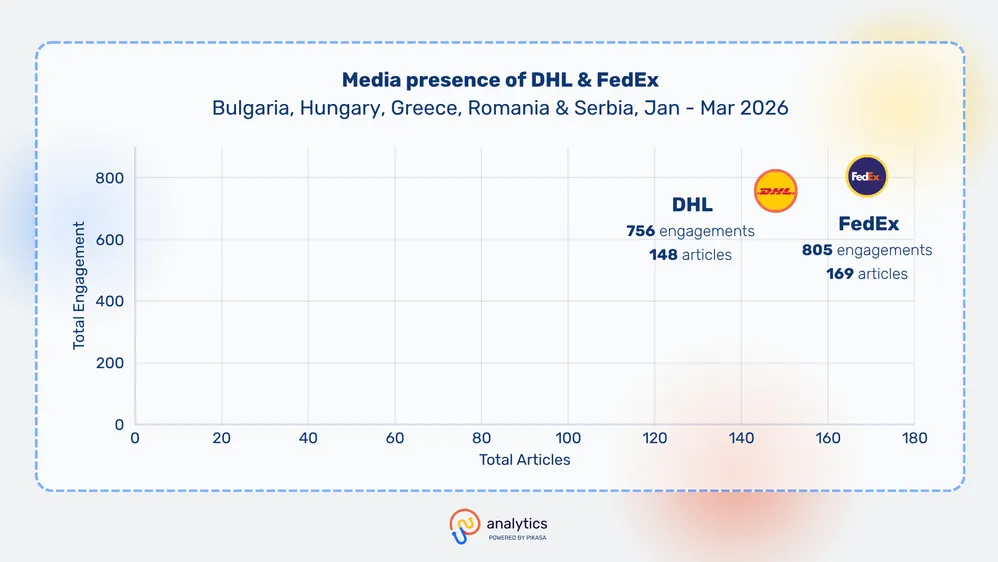
The press reach and engagement numbers are almost identical. That equivalence is the most revealing data point in the entire analysis. DHL worked to earn local press presence through consistent regional communication. FedEx received a comparable press presence for free, as a byproduct of decisions made in Memphis and Brussels. Both strategies produced similar press metrics. They produced completely different relationships with local audiences.
Key Finding 3: The most engaging content is the most human content
DHL's highest-performing content across the six markets was not about logistics. It was not about delivery times, tracking technology, or network capacity. It was about the moments that surround the package.
In Romania, spring campaign content framing deliveries as new beginnings earned the highest average engagement in the dataset. Valentine's Day content built around the emotion of giving - rather than the mechanics of sending - consistently outperforms operational posts across all five active markets. The content that worked treated delivery as a human act rather than a supply chain step.
The four FedEx posts that exist in the dataset are generic global content repurposed for regional audiences. No local language, no local moment, no local relevance. The average engagement of 33 per post - compared to DHL's 142 - reflects the difference between content produced for a market and content that accidentally reached one.
The gap between 142 and 33 average engagements per post is not a budget gap. Both brands have the resources to build a regional social media presence. It is a decision gap. DHL decided the region deserved a local voice. FedEx decided it did not. The audience noticed.
Key Finding 4: Both strategies work - for completely different things
The uncomfortable finding in this analysis is that neither brand is simply winning. They have made different bets, and those bets are paying off in different currencies.
DHL owns the social conversation. Real engagement from real customers in five markets. Brand presence that feels local because it is local. The kind of relationship that makes a customer choose DHL when they have a choice - because the brand feels familiar rather than abstract.
FedEx dominated the business press through coverage in financial and trade media driven by global corporate decisions that incidentally carry the company’s name. It is a form of institutional authority that cannot be replicated through lifestyle or seasonal campaigns, and one that carries particular weight in B2B sales, investor relations, and regulatory environments.
DHL is present but not consequential enough to generate real journalism about what it does in the region. FedEx is consequential but invisible to the person opening the door when the driver arrives. The brand that closes that gap - genuine local presence combined with global authority made locally relevant - will own the attention economy in regional logistics in a way that neither brand currently does.
Methodology
Pikasa Analytics monitored social media content and media coverage for DHL and FedEx across Bulgaria, Romania, Greece, Hungary, Serbia and Albania during Q1 2026. Engagement is defined as the sum of reactions, comments and shares. Views and reach are tracked separately. Media articles were classified by origin - local versus international pickup - and cross-referenced against engagement data.
Written by
Natasha Dimova
June 30, 2026