Slovak banks are active across many communication channels, but the topics that get attention are not always the same as the topics customers care about most. Looking at media coverage, banks’ own social media activity, and public comments helps show how these different conversations develop.
For the period from January to June 2026, Pikasa compared these three areas to identify the main messages, the topics that received the most attention, and the issues that customers discussed most often.
The comparison shows two different patterns. On banks’ own social media channels, broader content such as giveaways, lifestyle, sponsorships, culture, CSR, and sport represented 43.3% of posts and generated 62.8% of total engagement.
Public discussion was analyzed separately through Facebook comments. In these comments, users more often raised practical banking issues such as fees, failed or delayed payments, mobile banking, cards, branch and ATM access, and customer support.
By looking at what banks publish, which posts receive reactions, and what people discuss in the comments, the analysis shows which messages attract attention and which everyday banking issues lead to customer discussion.
Key data analyzed: 615 news articles, 2,154 social media posts, 399,637 social media engagements, and 53,155 public comments.
1. Giveaways win attention, but not necessarily brand affinity
Giveaway posts generated almost one fifth of total social media engagement-18.9%. Although they represented only a small part of the overall content published by banks, they attracted a much larger share of reactions and comments.
The clearest example was 365.bank. The bank published 185 posts, but only 17 were contests. Even so, those 17 posts generated 64.1% of all engagement on the bank’s page. The difference was even stronger in the comments: out of 2,871 comments, around 97.9% were posted under competitions. In other words, almost the entire conversation around 365.bank was driven by users trying to win prizes.
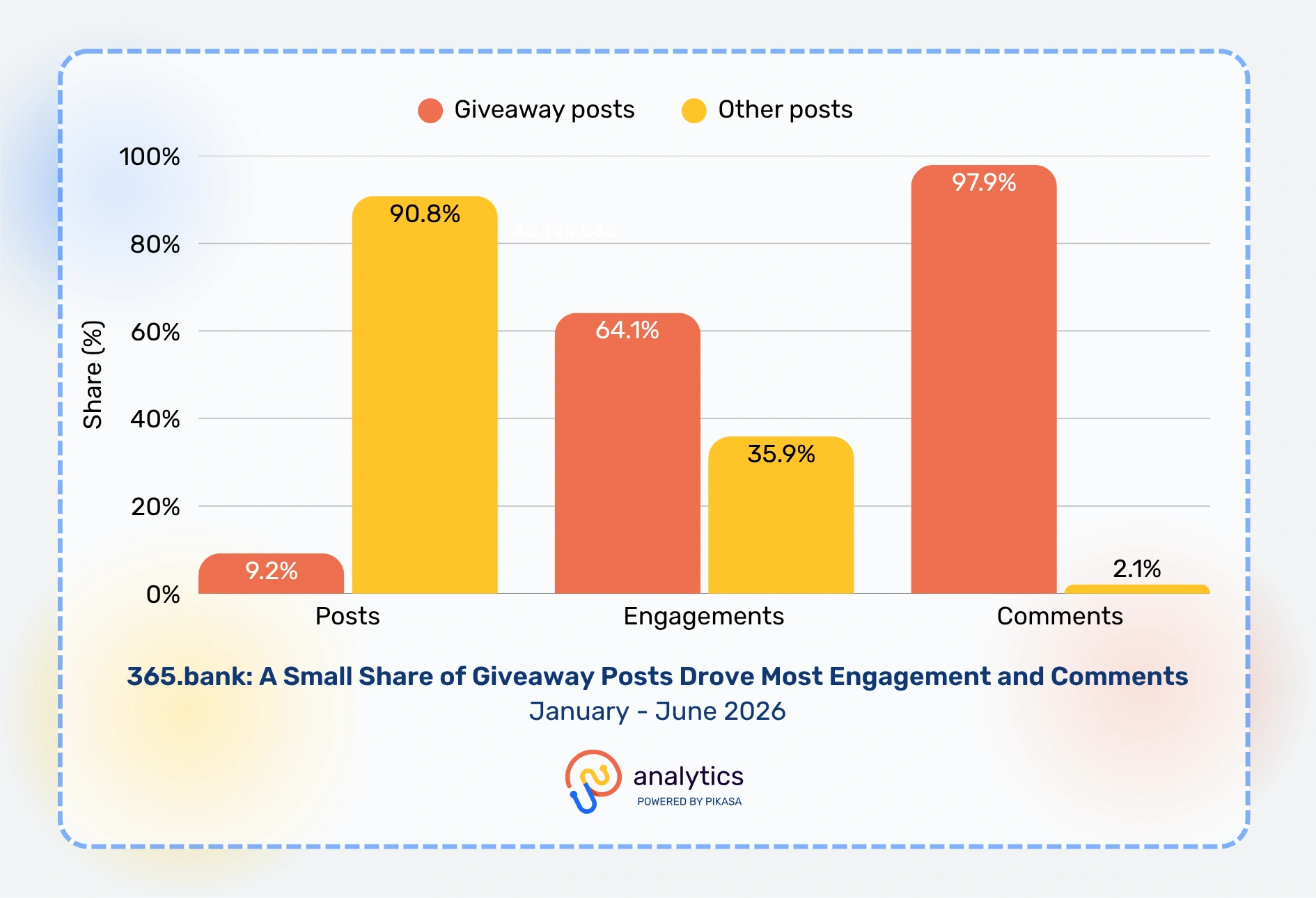
*17 of 185 posts were giveaways (9.2%), yet they generated 64.1% of engagement and 97.9% of comments.
A similar, but less extreme, pattern appeared for Slovenská sporiteľňa. The bank recorded the highest social media engagement in the analyzed dataset, with 195,860 engagements from 383 posts, accounting for almost half of all social engagement. At the same time, only 23 contest posts generated approximately 25.8% of its total engagement.
During the analyzed period, the post with the highest engagement was Slovenská sporiteľňa’s MacBook Air giveaway, which generated 21,780 engagements. Another competition offered an iPhone as a prize while promoting investing through George, the bank’s digital banking platform, and generated 7,093 engagements. A giveaway for tickets to the Pohoda Festival followed with 6,432 engagements.
These examples show that contests can generate engagement far above regular banking content. For this reason, total engagement should be viewed together with the type of content that generated it, especially when comparing social media performance between banks.
2. Banks promote lifestyle and innovation, while customers discuss everyday banking
Giveaways are only one part of the story. Across all analyzed banks, a wider group of non-product content-including giveaways, culture, sponsorships, CSR, sport, festivals, and lifestyle posts-made up 43.3% of all posts and generated 62.8% of total engagement.
This is different from the earlier 365.bank example, where 64.1% of that bank’s engagement came from giveaways alone. Here, the 62.8% refers to several types of brand and lifestyle content across the whole banking sector.
Customer comments showed a different focus. People were more likely to talk about failed payments, fees, mobile app problems, card charges, branch and ATM access, and customer support.
For example, VÚB banka users discussed payment problems and fees, ČSOB customers mentioned app issues and card charges, Tatra banka comments focused on fees and access to services, while mBank users questioned whether its promoted free account was really free.
The key point is simple: brand and lifestyle content attracts attention, while customer conversations focus more on how banking services work in everyday life.
3. Viral reach can hide the most important reputational risks
Of the 9,018 comments directly matched with posts published by the analyzed banks, around 6,424 comments-or 71.2%-were posted under giveaway posts.
The share of comments coming from giveaways was especially high for:
- 365.bank: 97.9% of all matched comments were under giveaways
- Slovenská sporiteľňa: 86.9% of all matched comments were under giveaways
- Prvá stavebná sporiteľňa: 85.8% of all matched comments were under giveaways
A similar concentration appeared in news media. Out of 615 articles, nearly three out of four (73.8%) received no recorded engagement. The top 10 articles generated 50.7% of all news engagement, while the top 50 generated 86.6%.
The highest-engagement media stories were usually not about banking products themselves. They were linked to wider public issues such as new bank fees, payment disruptions, fraud warnings, fiscal measures, industrial decline, and support for cultural institutions.
This is important because the topics that generate the most engagement are not always the topics that best show customer concerns. Smaller discussions about failed payments, unclear charges, or unresolved complaints may receive less attention overall, but they can still reveal important everyday problems customers are facing.
4. External voices generate more impact than Banks’ own channels
Of the 2,154 social media posts analyzed, around 105 posts (4.9%) were published by pages outside the banks’ own channels, including media outlets, partners, creators, and other organizations. Although these posts represented only a small part of the total content, they generated 18.4% of all social media engagement.
The difference was also clear when looking at average engagement per post. Posts published by banks received around 159 engagements per post, while posts published by other pages received around 699 engagements per post-approximately 4.4 times more.
Media outlets such as Refresher and Startitup helped bring more attention to topics linked to ČSOB, 365.bank, digital banking, fraud, fees, and financial services.
Most active media outlets
| Rank |
Media Outlet |
Articles |
| 1 |
Teraz |
120 |
| 2 |
HNonline |
107 |
| 3 |
Startitup |
89 |
| 4 |
Refresher |
82 |
| 5 |
Interez |
64 |
| 6 |
Trend |
42 |
Teraz was the most active media outlet, publishing 120 articles, mainly focused on economic developments, corporate news, and expert banking commentary. HNonline followed with 107 articles, with strong attention to mortgages, fiscal policy, interest rates, and consumer finance.
Startitup published 89 articles, focusing more on practical consumer issues such as banking fees, fraud, digital services, and major acquisitions. Refresher, with 82 articles, approached banking through personal finance, younger audiences, savings, and digital banking tools.
Interez published 64 articles and stood out for coverage of economic risks, service changes, fees, and issues directly affecting consumers. Trend completed the ranking with 42 articles, concentrating mainly on investments, financial results, acquisitions, and wider business developments.
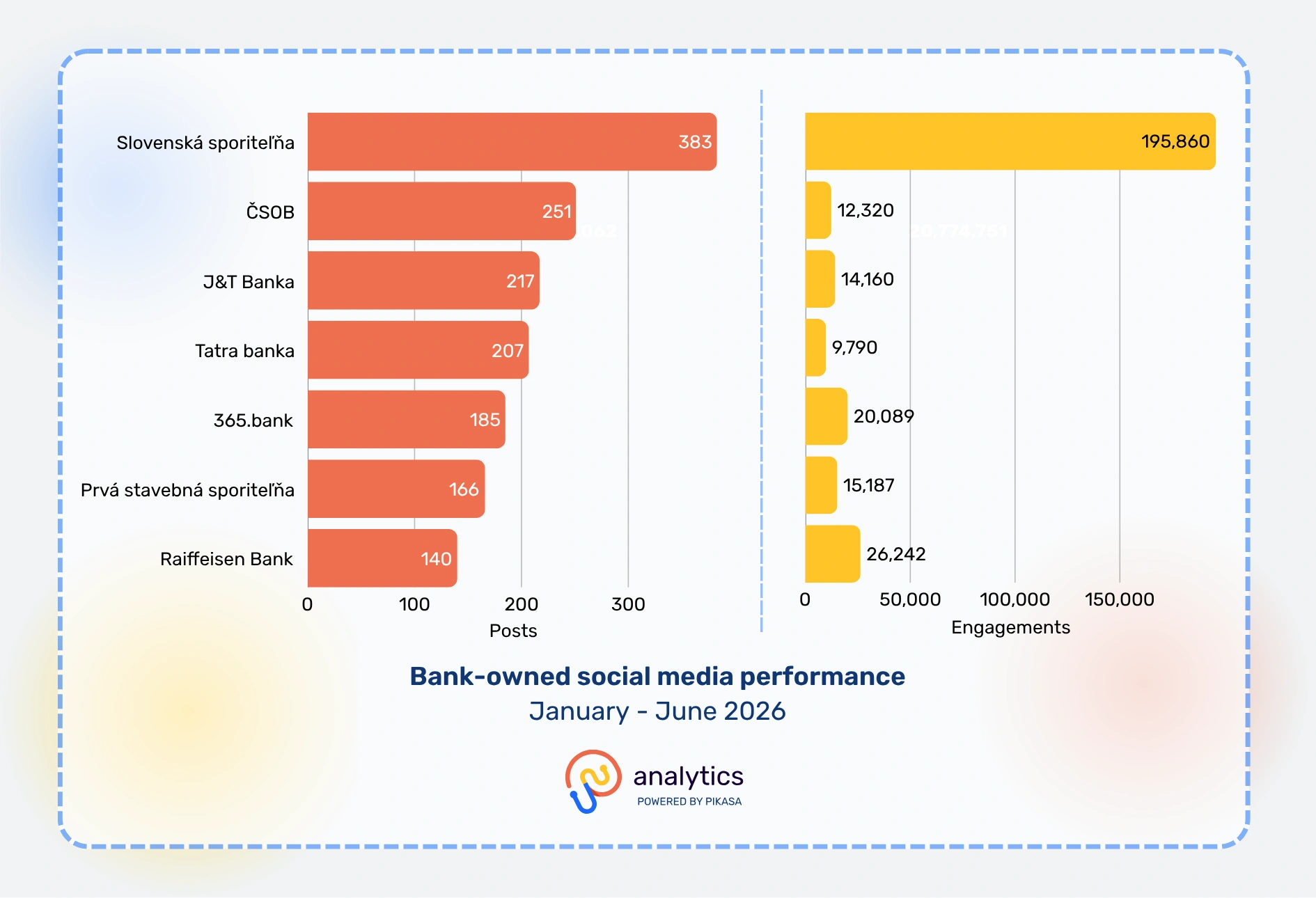
Slovenská sporiteľňa clearly dominated both activity and audience response, publishing 383 posts and generating 195,860 engagements. Its engagement was several times higher than any competitor, showing the impact of its broad mix of lifestyle, cultural, investment, and competition content.
However, posting more did not always lead to stronger performance. Raiffeisen Bank published only 140 posts, the lowest volume in the ranking, but generated 26,242 engagements-the second-highest result. 365.bank followed with 20,089 engagements from 185 posts, while Prvá stavebná sporiteľňa achieved 15,187 engagements from 166 posts.
By comparison, ČSOB was the second-most active bank with 251 posts, but generated only 12,320 engagements. J&T Banka published fewer posts-217-but achieved a higher 14,160 engagements, mainly through investment and economic content. The ranking shows that publishing frequency alone does not guarantee audience interest; content relevance and format have a much stronger effect on engagement.
Final Takeaway
The most visible Slovak banks were not always the ones creating the most relevant customer conversations.
Giveaways and lifestyle content helped banks get more attention, while media coverage increased their visibility. But customers often talked about different things, such as fees, payment problems, mobile apps, branches, and customer support.
Written by
Meriton Nagavci
August 25, 2026