A data-driven analysis of Ukrainian online media coverage of the US - Russia negotiations aimed at ending the war in Ukraine - tracking volume, sentiment, engagement patterns, and two major coverage spikes across January 2026.
In January 2026, US-led peace negotiations became a dominant agenda-setting topic in Ukrainian online media, generating sustained, high-volume coverage across the national information space. Real-time monitoring by Pikasa platform analytics.live captured 15,048 articles published across 79 Ukrainian media outlets, generating over 363,000 reader engagements and reaching a broader audience via social media - with 5.5 million social engagements across 8,066 social posts
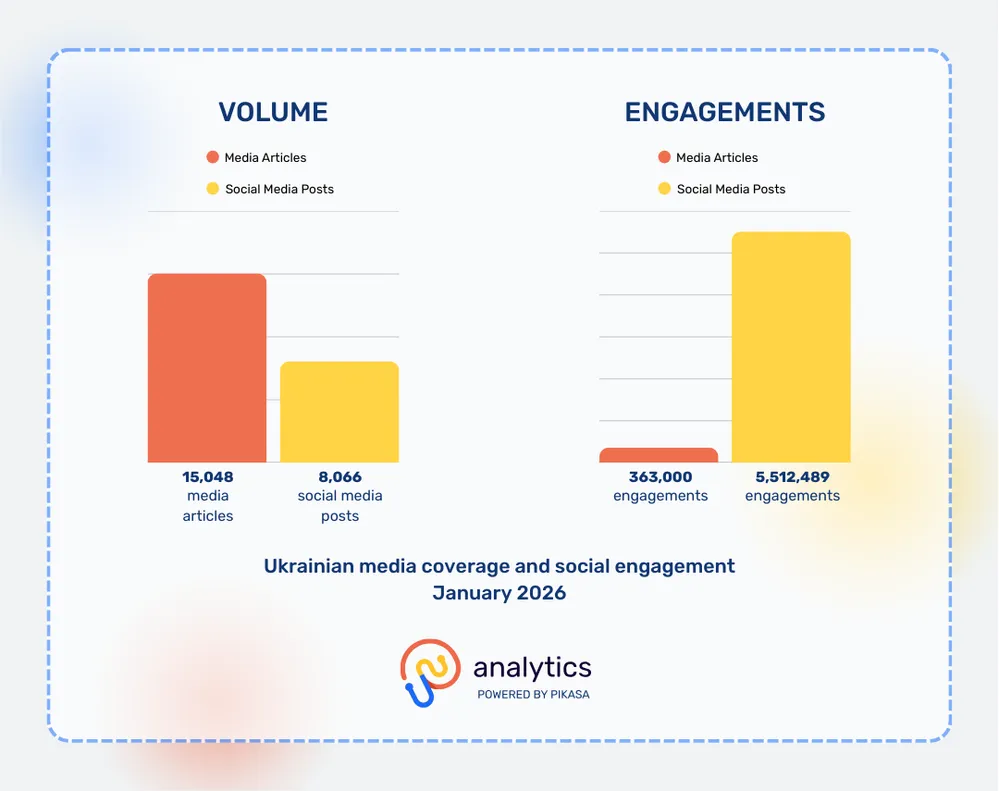
January 2026 volume and engagement comparison of Ukrainian online media articles and related social media posts covering the US-Russia negotiations, based on Analytics.Live real-time monitoring data.
The data points to a high-intensity and sustained coverage environment, structured around two clearly identifiable attention peaks: the first on January 7, driven by the US seizure of Russian-linked oil tankers and early indications of diplomatic contacts; and the second, and larger, on January 22, when US envoys Steve Witkoff and Jared Kushner arrived in Moscow for direct talks with President Putin, followed by trilateral meetings in Abu Dhabi.
Across the full month, the dominant tone in Ukrainian media was neutral, reflecting a press corps that reported the facts of an evolving and high-stakes diplomatic process with cautious pragmatism, neither cheerleading for nor condemning the US-led process, while remaining acutely attentive to Ukrainian sovereignty and territorial integrity.
"The two major peaks in January coverage, January 7 and January 22, correspond precisely to concrete US diplomatic actions, confirming that Ukrainian media amplification of peace talks is event-driven, not speculative."
Two Days That Reshaped the Media Conversation
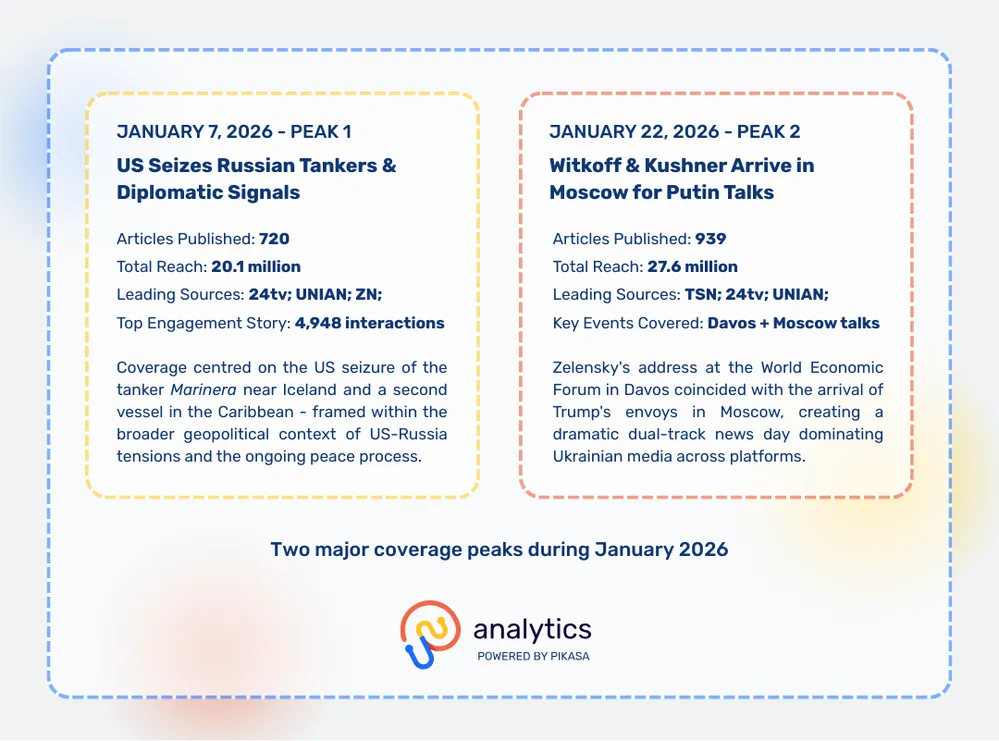
January 2026 peak coverage analysis highlighting two major Ukrainian media spikes driven by US–Russia negotiations and related geopolitical developments, based on Analytics.Live monitoring data.
The monthly trend data of Ukrainian coverage tells a clear story. While daily coverage levels remained elevated throughout January - reflecting the sustained salience of the peace negotiations topic - two sharp spikes stand out, each anchored in specific, newsworthy diplomatic events.
January 7: The Tanker Incident Frames Diplomatic Stakes
The first coverage peak was trigged by one event: the US seizure of the oil tanker Marinera (sailing under a Russian flag) near Iceland, and a second vessel in the Caribbean. Ukrainian media covered this extensively - not merely as a maritime enforcement story, but as a diplomatic signal, read as an indicator of how the Trump administration intended to press Russia ahead of formal negotiations.
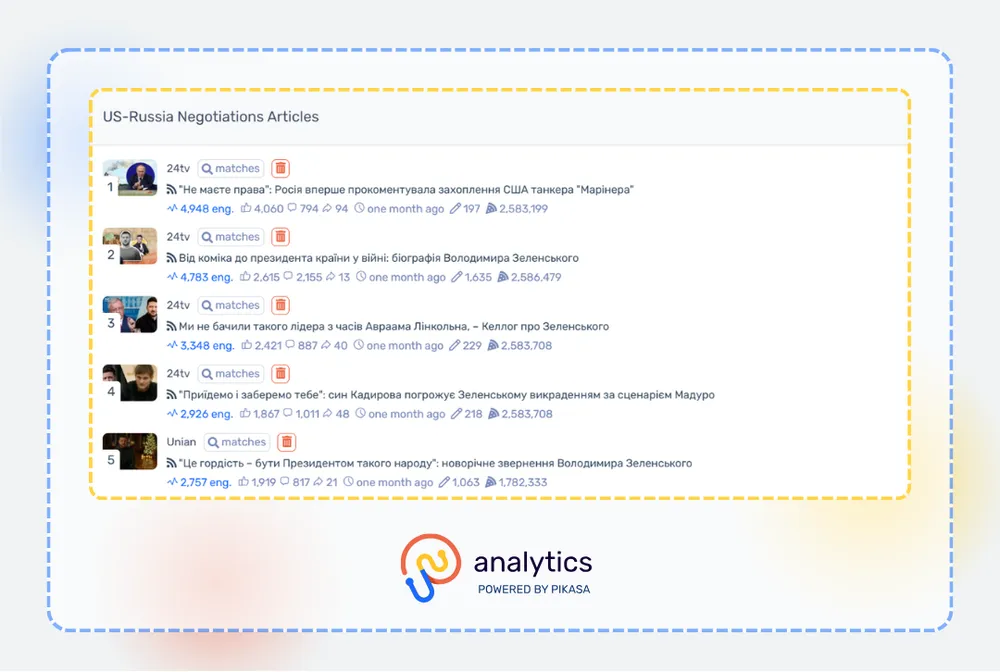
Engagement data confirms the salience of this framing. The highest-engagement article of the day, and of the entire month on the news side, came from 24tv: "You have no right": Russia responds for the first time to the US seizure of the tanker Marinera, which generated 4,948 engagements and reached an audience of over 2.58 million people. Complementary coverage focused on inflammatory reactions from the Russian State Duma, including calls to “torpedo American patrol boats,” which Ukrainian outlets presented as evidence of Moscow’s continued belligerence even as Washington pursued dialogue.
At the same time, Ukrainian media contextualised the diplomatic developments through the lens of battlefield realities. Multiple articles referenced Ukraine’s extensive defensive fortifications in Donbas, citing The Economist’s warning that these defences , however formidable, “may be in vain depending on the terms of the peace agreement.” This juxtaposition underscored a recurring editorial theme: that military realities and diplomatic negotiations were inseparable, and that outcomes at the negotiating table carried direct consequences for sacrifices made on the ground.
January 22: Witkoff, Kushner, Davos - A Day That Moved the Needle
The second, larger peak on January 22 was the result of overlapping high-profile diplomatic events that made it the single most covered day of the month. Ukrainian media reported extensively on the arrival of US Special Envoy Steve Witkoff and Jared Kushner at Moscow’s Vnukovo Airport, confirmed by the Kremlin, for direct discussions with President Putin regarding “possibilities for ending the war in Ukraine.” In parallel, outlets highlighted preparations for trilateral talks involving US, Russian, and Ukrainian delegations scheduled to take place in Abu Dhabi on January 23-24.
The same day, President Zelensky addressed the World Economic Forum in Davos, revealing that Russia was losing 35,000 soldiers killed per month, up from 14,000 the previous year, and that the Russian army had effectively "stopped growing" due to drone warfare. His meeting with President Trump in Davos also drew intense coverage, described by BBC Ukraine as conducted "without press and without joint statements."
Taken together, Ukrainian media coverage on January 22 reflected a complex, multi-layered narrative. Reporting simultaneously conveyed cautious optimism regarding renewed US diplomatic engagement, persistent concern over the protection of Ukraine’s territorial integrity, and a sense of strategic confidence rooted in continued military pressure on Russian forces. Zelensky’s Davos statistics functioned as a central reference point, linking battlefield dynamics directly to the diplomatic calculus shaping the peace process.
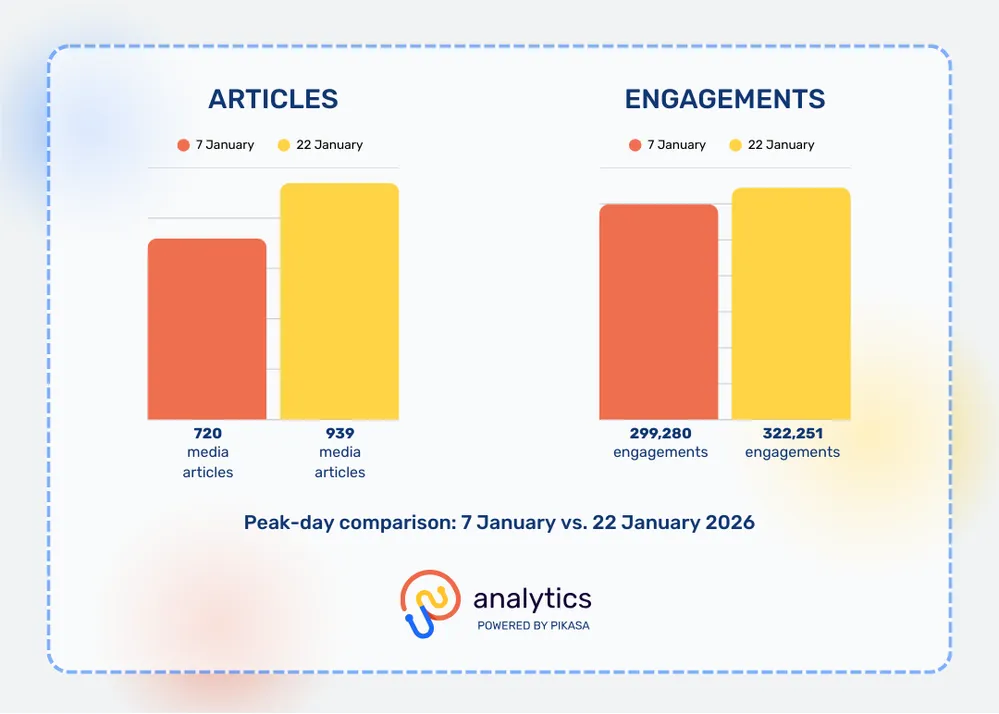
Comparison of the two major January 2026 coverage peaks in Ukrainian media, showing higher article volume and stronger audience engagement on 22 January, based on Analytics.Live monitoring data.
The Content That Moved the Audience
Analysis of the highest-engagement articles across January, by Pikasa platform analytics.live, reveals a clear pattern in Ukrainian editorial priorities. Audience attention concentrated on coverage that combined high-impact diplomatic actions with strategic confrontation narratives - particularly US-Russia interactions, President Zelensky’s international advocacy, and reporting that linked the diplomatic process to the human and military costs of the war. Together, these themes indicate that Ukrainian audiences engaged most strongly with content that framed negotiations not as abstract diplomacy, but as events with direct implications for national security, sovereignty, and lived wartime realities.
From Facts to Frames: How Ukrainian Media Shaped the Peace Narrative
Moving beyond quantitative indicators, close textual analysis of articles published on both peak days identifies consistent editorial frames through which Ukrainian media interpreted the US-led peace negotiations.
1. Sovereignty and Territorial Integrity as a Non-Negotiable Frame
The most consistently recurring theme in Ukrainian media was concern over whether any peace deal would preserve Ukrainian sovereignty and territorial integrity. Articles repeatedly referenced the Donbas negotiations, specifically US proposals that Moscow be allowed to retain de facto control over territories it had seized, describing these as unacceptable in Ukrainian public opinion. One widely circulated UNIAN article, drawing on The Economist, warned that Ukraine's impressive Donbas defensive fortifications "may be in vain depending on the terms of the peace agreement," a phrase that encapsulated the anxiety underpinning all coverage.
2. Zelensky as Ukraine’s Primary Messenger
President Volodymyr Zelensky emerged as the central individual voice in Ukrainian media coverage, consistently appearing in the highest-engagement articles of the month. Audience interaction data indicates that Ukrainian outlets framed the country’s diplomatic position largely through the figure of the president, reinforcing his role as both political leader and narrative anchor of Ukraine’s international stance.
3. US Actions as Event Triggers
Both coverage peaks were directly trigged by concrete US government actions, the tanker seizures on January 7 and the Witkoff–Kushner Moscow visit on January 22, confirming that Ukrainian media attention to the negotiations was reactive and event-driven, not speculative. Ukrainian outlets covered both events with factual intensity, supplemented with expert commentary on implications for the peace process. This pattern suggests that further US diplomatic moves in February-March 2026 will produce similarly sharp media spikes.
4. Neutral Tone Throughout - But Watchful
Across both peak-day datasets, encompassing 1,659 articles combined, the tone was generally neutral. This reflects neither passive indifference nor enthusiasm, but rather the professional restraint of a Ukrainian press corps that understood the stakes were too high for editorial cheerleading. The emotional register was watchful, analytical, and at times cautiously hopeful, but never uncritically supportive of any particular diplomatic outcome.
Four Patterns, One Picture: What Ukrainian Media's January Coverage Means
This analysis of Ukrainian media coverage in January 2026 yields four principal findings for communications professionals, policymakers, and organisations tracking the information environment around the Ukraine war and US peace efforts:
Volume confirms salience.
With 15,048 articles in January from 79 outlets, the US-Russia negotiations topic was among the most-covered issues in Ukrainian online media throughout the month, indicating that Ukrainian public attention to the peace process was high and sustained.
Social amplification was massive.
The 5.5 million social media engagements generated by 8,066 posts, averaging 684 engagements per post, indicate that the negotiations topic transcended traditional media audiences and became a broadly viral conversation across Ukrainian social platforms.
Coverage is event-driven.
The two peaks on January 7 and January 22 correspond precisely to concrete US diplomatic actions. This means coverage volume is a sensitive real-time indicator of diplomatic activity - and that future major US moves will be closely tracked by Ukrainian audiences. Platforms like Analytics.Live make it possible to detect and act on these points as they unfold, not after the fact.
The tone is neutral but not passive.
The uniformly neutral sentiment coding masks a nuanced editorial stance in which Ukrainian media reported facts without bias while consistently foregrounding Ukrainian sovereignty as the lens through which the negotiations were evaluated.
How This Analysis Was Made Possible
The insights in this report were generated by the Analytics.Live media intelligence platform. Rather than manually sifting through thousands of Ukrainian news sources, Analytics.Live automatically tracked, classified, and quantified every article published on the US-Russia negotiations topic - in real time, across 79 outlets, throughout the entire month of January.
Without automated monitoring, coverage peaks like January 7 and January 22 would only be visible in hindsight, if at all. Analytics.live detected them as they happened, enabling communicators, analysts, and policy teams to respond while the conversation was still live.
Written by
Natasha Dimova
February 25, 2026