When Peter Magyar walked away from Fidesz in 2024, few predicted he would be Hungary's next Prime Minister. Two years later, that is exactly what happened despite Viktor Orbán dominating nearly every media metric we tracked. Using Analytics.Live, we mapped the full media landscape of Hungary's 2026 elections, and what the data reveals challenges some common assumptions about visibility, power, and what moves voters.
On the 12th of April, Hungarians held their parliamentary elections which saw the incumbent Prime minister Viktor Orban of the ruling Fidez party (“Hungarian Civic Alliance” or “Magyar Polgári Szövetség”), facing off against a protégé formally from his own rank, Peter Magyar, who in 2024 left Fidez and joined the fledgling Tisza party (“Respect and Freedom Party” or “Tisztelet és Szabadság Párt”). Monitoring what seemed to be a tight race between the Orban and Magyar using the data from Analytics.Live, article-level analysis to explore how the narratives evolved in the three months leading up to the elections, as well as whether the US President Donald Trump’s endorsement and his Vice President’s, J. D. Vance visit to Orban’s campaign a week before the elections had any bump in the mentions or interactions on social media. Monthly aggregations, source-level engagement breakdowns, daily coverage heatmaps, and outlet comparison rankings were all taken from Analytics.Live.
Visibility vs. Victory: Analytics.Live Breaks Down Hungary's 2026
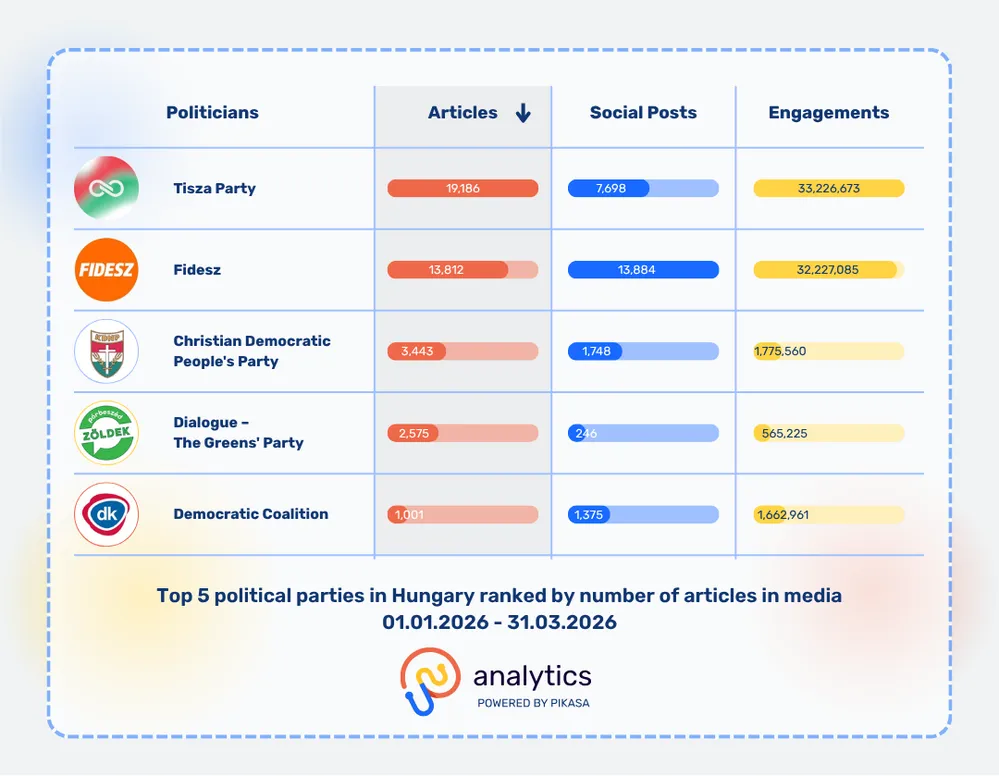
It comes as little surprise that Fidesz and Tisza dominated both the traditional and social media landscape. Of the 42,709 articles written about Hungarian political parties during the monitoring period, the two parties accounted for more than three-quarters of all coverage - with Tisza mentioned in 19,186 articles and Fidesz in 13,812. A similar pattern emerged on social media, where the two parties together featured in just under three-quarters of all posts, though with a notable reversal: Fidesz was mentioned nearly twice as often as Tisza, at 13,884 posts compared to 7,698. Despite this gap in mentions, both parties generated a remarkably similar level of engagement, accumulating 32.23 million interactions combined over the three-and-a-half-month period - equivalent to 86 percent of all social media interactions referencing Hungarian political parties. Again, though, while Mi Hazánk ("Our Homeland Movement") secured 6 out of the 199 seats in parliament, the party was barely present in the larger media space. It was even outshined by five other parties who didn’t secure even a single seat in the new parliament.
What the Numbers Really Tell Us About Hungary's 2026 Elections
Although this analysis covers the three and a half months preceding the Hungarian parliamentary elections on the 12th of April 2026, the two frontrunners had been clearly established nearly two years prior. With no other opposition party being even close, Tisza was steadily closing the gap on Fidesz from 2024 onward, eventually overtaking them in the polls by early 2025. As such, this analysis focuses on Tisza's leader and eventual Prime Minister, Péter Magyar, and the incumbent Viktor Orbán of Fidesz.
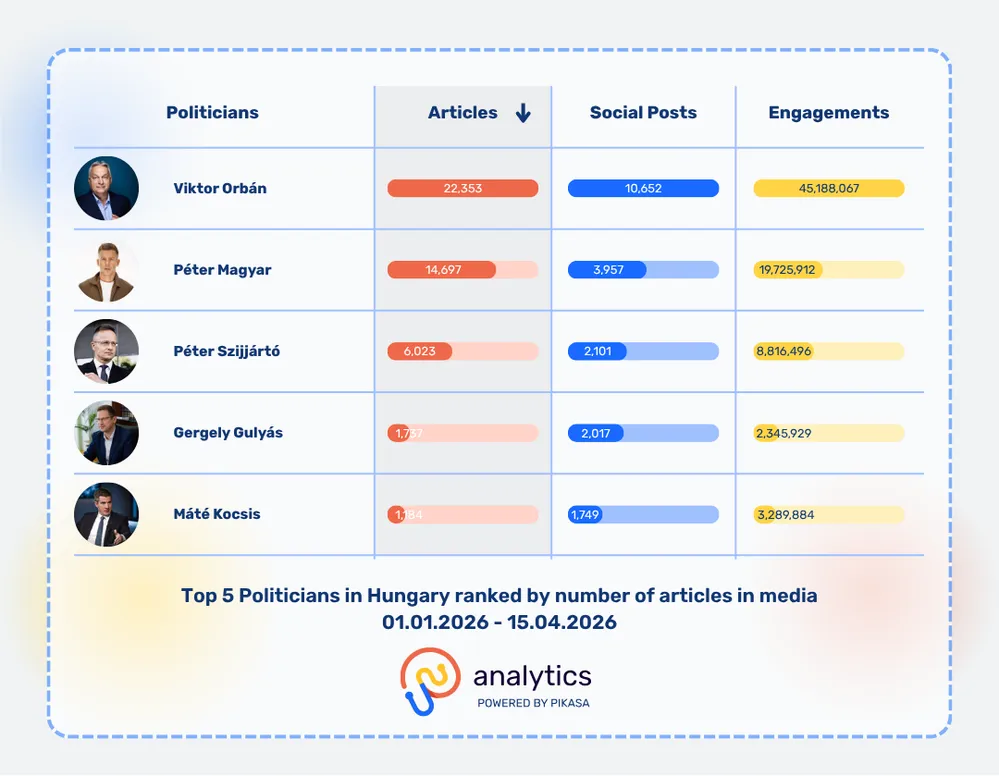
Across 52,141 articles analyzed in our dataset, more than two thirds mentioned Orban (22,353) and Magyar (14,697). The third most mentioned politician was Péter Szijjártó who served as the Minister of Foreign Affairs and Trade in Orban’s government - being mentioned in 6,023 articles. Correspondingly, out of the 32,635 social media posts analyzed, almost a third were about Orban, or 10,652, whereas substantially lower were about Magyar or 3,957 social media posts. As outsized, the number of social media posts was for Orban, so too were total numbers of engagement on them. Of the 94.24 million social media engagement counted, almost half or 45.18 million were found on the posts mentioning Orban, whereas only 19.72 million were on the posts mentioning Magyar. It should be noted that Toroczkai László, who headed the Mi Hazánk ("Our Homeland Movement" or "Mi Hazánk Mozgalom"), the only other party to win seats in the 10th Hungarian parliamentary election besides Tisza and Fidesz, had by far the least article mentioning him (412) and social media posts (613).
Tone at the Top: What High-Engagement Coverage Reveals
The sentiment data in this analysis is drawn from the top 1,000 posts by engagement for each politician - not a random sample of all coverage, but the content that spread furthest and reached the widest audiences. What resonated with readers, rather than what was merely published, is what these numbers reflect.
The top 1,000 most-engaged posts mentioning Orbán were majority negative in tone: 50.3% fell into critical or negative categories, with only 5.2% classified as positive. The dominant share of "critical" coverage (36.8%) suggests that much of this engagement was driven by evaluative or analytical content - commentary, fact-checks, and opinion pieces - rather than outright hostility. Magyar's high-engagement posts tell a different story: 56% were neutral, 19.3% positive, and only 24.7% carried a negative tone. His positive rate was nearly four times that of Orbán's, meaning content favorable to Magyar was considerably more likely to break through and accumulate meaningful engagement.
Taken together, the sentiment picture adds a crucial dimension to the visibility gap documented elsewhere in this analysis. Orbán dominated raw coverage volume throughout the monitoring period, yet the posts that most actively circulated among audiences were predominantly critical of him. Magyar, working from a smaller coverage base, generated high-engagement content with a substantially more favorable tonal profile. In this election, visibility and resonance were pulling in opposite directions - and resonance, it turned out, mattered more.
The Newsroom Math Behind the Campaign
Analysis based on 20,826 media posts and articles from March 15 – April 15, 2026, covering the Hungarian parliamentary election campaign and its immediate aftermath.
In the four weeks leading up to Hungary's April 12, 2026, parliamentary election, Viktor Orbán dominated raw media volume with 8,153 articles mentioning him - nearly 1.7 times more than the 4,741 articles covering Péter Magyar. This asymmetry reflects Orbán's structural advantage as a 15-year incumbent: every government decision, diplomatic meeting, and official statement automatically generates media attention. Magyar, despite being the de facto face of the opposition, had to fight to occupy narrative space already owned by the Prime Minister.
Yet volume alone tells only part of the story.
Despite fewer articles, Magyar's coverage consistently outperformed Orbán's in audience engagement metrics:
- Reactions per article:
Magyar 293 vs. Orbán 229 - 28% higher
- Comments per article:
Magyar 53 vs. Orbán 39 - 36% higher
- Shares per article:
Magyar 9.7 vs. Orbán 7.3 - 33% higher
- Average reach per article:
Magyar 81,400 vs. Orbán 62,800 - 30% higher
This pattern suggests that while Orbán dominated the information environment in sheer quantity, Magyar generated more active public interest and debate. His content was more likely to be shared and discussed - a key dynamic in a high-stakes election where voter mobilization mattered.
Among the top five outlets who covered the elections, Magyar Nemzet published the most balanced coverage between the two politicians - 1,111 Orbán articles vs 1,069 Magyar (1.04:1) - while Origo showed the widest gap at 986 vs 612 (1.6:1), the highest Orbán-to-Magyar skew of the group. Mandiner sat close behind Origo in ratio (961 vs 890, or 1.08:1), though with a notably high co-mention count of 923, meaning roughly 96% of its Magyar articles also referenced Orbán in the same piece. A similar pattern held at 24.hu - 626 vs 548 (1.14:1), with 559 co-mentions covering about 89% of its Magyar articles. Telex stands out with a different dynamic: its co-mention count of 597 exceeds Magyar's individual total of 493, indicating that virtually every Telex article mentioning Magyar also mentioned Orbán, with the two politicians appearing together rather than in separate coverage streams.
War, Corruption, and the Price of Petrol
The pre-election media landscape reflected two fundamentally different campaign strategies. Orbán's coverage leaned into geopolitical framing war, migration, energy sovereignty, anti-Brussels sentiment issues where his government had a clear narrative advantage and years of message infrastructure behind it. Magyar's coverage carried stronger associations with domestic accountability, institutions, and public services.
Both politicians dominated coverage on Ukraine, Russia and energy Orbán at 49%, Magyar at 55% with energy policy nearly identical (41.6% vs 40.9%), reflecting how central the cost-of-living argument was to both campaigns, with headlines ranging from fuel price caps to the Friendship Pipeline dispute with Ukraine. The clearest divergences appear in migration (9.7% Orbán vs 6.7% Magyar), where Orbán's coverage was linked to sovereignty narratives and warnings about external threats headlines framing Ukraine as "life-threatening to Hungary" and attacking Brussels for escalating the conflict while Magyar's comparatively sparse migration coverage points to a deliberate shift toward domestic issues. Those domestic issues show up clearly in the numbers: corruption and justice (16.9% Magyar vs 12.6% Orbán), democracy and media freedom (22% vs 16.2%), healthcare (7.7% vs 4.7%), and education (4.7% vs 3.4%) all skewed toward Magyar, reflecting a campaign built around institutional accountability and everyday public services topics such as hospital conditions, teacher pay, and court independence rather than geopolitical framing. Security coverage also favored Magyar (36.1% vs 29.3%), driven largely by the discovery of explosives near the Turkish Stream gas pipeline in Serbia days before the vote, an incident that generated competing narratives across the media landscape.
However, it should be noted that both Magyár's and Toroczkai’s digital footprint captured by Analytics.Live are relatively limited to select public platforms. Unlike many public figures, neither one maintains an official Facebook or Instagram account - Magyar has only a private profile, while Toroczkai has no presence on either platform. Since private profiles fall outside the scope of data collection, and with no other relevant official accounts to draw from, media monitoring coverage for both figures in sources exclusively from platforms where public content is available, such as TikTok and YouTube.
From Attention to Outcome - Making Sense of Hungary's Election Media Landscape
This analysis highlights how media visibility and public engagement do not always move in lockstep, and Hungary's 2026 elections offer a clear illustration of that divergence.
Orbán commanded a significantly larger share of both traditional and social media coverage. Nearly half of all social media engagement was tied to content mentioning him, yet Magyar's Tisza Party ultimately prevailed at the ballot box. The data also shows that external political signals, particularly Orbán's repeated appearances alongside Trump and Vance, generated measurable spikes in media attention at key moments throughout the campaign, from the Peace Council signing in Davos to Vance's visit days before the vote, without those spikes translating into electoral gains.
At the thematic level, the two campaigns occupied largely the same media terrain on Ukraine, energy, and the economy, while diverging on migration, institutional accountability, and public services with each politician's coverage skewing toward the issues most associated with his campaign message. In this context, Analytics.Live tracked not just volume but the timing, sourcing, and topical concentration of coverage, offering a more granular view of how narratives evolved across the monitoring period. What the Hungarian case ultimately illustrates is that in highly polarized media environments, attention and engagement can reflect existing loyalties as much as they shape new ones and that media dominance, however pronounced, rarely tells the whole story.
Written by
Matej Trojachanec
April 21, 2026