Pikasa Analytics tracked Bulgaria’s election conversation from January to April 2026 through Analytics.Live, analyzing nearly 28,000 articles and over 4,000 social posts. The study maps visibility, sentiment and key narratives - from corruption to party dynamics - to show how media attention shaped the campaign, defined the tone and amplified the result. This is the fourth study in our Election Focus series, following Hungary, Slovenia, and Albania.
Key takeaways:
- Radev was the central figure of the election narrative, appearing in more than 40 percent of all monitored articles - more than the next five politicians combined.
- Candidate visibility proved more decisive than party visibility, with Radev strongly outperforming his own party in media attention and becoming the personal face of the campaign.
- Media volume and social engagement alone did not predict electoral success, as GERB led party-level coverage and engagement yet still finished a distant second, while MECh generated exceptional online engagement without converting it into even a signle parliamentary seat.
- Critical coverage ultimately worked in Radev’s favor by amplifying his visibility and reinforcing his anti-corruption positioning, as corruption became the defining narrative of the election cycle and his ownership of that theme transformed media attention into a clear political advantage.
On the 19th of April 2026, Bulgaria held its eight parliamentary elections in five years, which saw the former two-term president Rumen Radev and his newly founded party Progressive Bulgaria (“PB” - “Прогресивна България”) marching to victory on all fronts. Radev's party, founded just four months before the election, secured a landslide victory with 44.7% of the vote, securing to 135 seats in the 240-seat parliament. This outright majority grants it the rare ability to govern alone, a feat unseen in Bulgarian parliamentary politics since 1997. The incumbent GERB party (“Citizens for European Development of Bulgaria” or “Граждани за европейско развитие на България”), led by the ex-prime minister Boyko Borisov came second with 13.4% and the liberal PP-DB coalition (“We Continue the Change” or “Продължаваме Промяната”; and “Democratic Bulgaria” or “Демократична България”) led by Assen Vassilev third with 12.8% share of the votes.
Radev was covered more often than the next five politicians combined
In contrast to Hungary’s election in which Viktor Orban’s total domination in both traditional and social media spaces did not translate into winning another mandate, the opposite was true for Radev’s landslide victory. Of the 27,971 articles analyzed in our dataset, more than 40% focused on Radev (11,268). Whereas Borisov of the incumbent GERB was covered three times less than Radev (or 4,512), and Vassilev was part of 2,628 articles. To put Radev’s media dominance in perspective, he was mentioned as much as the next five politicians added together.
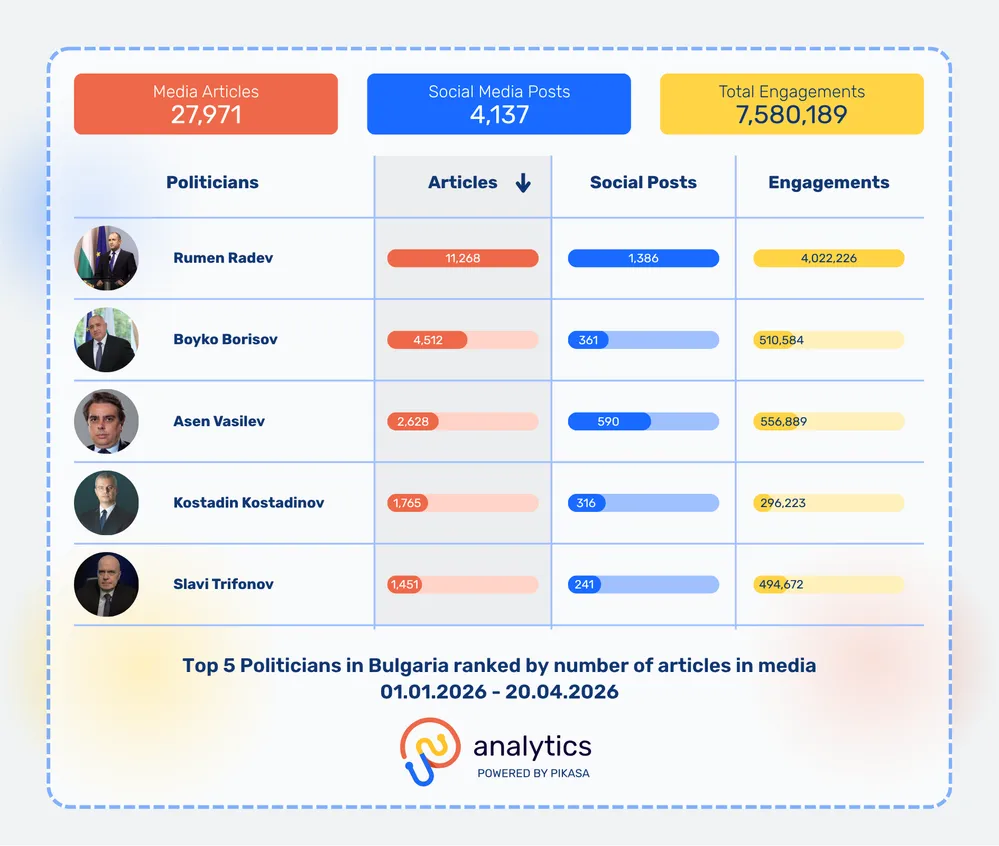
Image: Politician-level mentions across traditional vs. social media, January-April 2026, captured via Analytics.Live
Although Radev was less dominant on social media than in digital media, he still led the field by a clear margin. Out of 4,265 monitored social posts, he appeared in 1,386, or more than one quarter of the dataset, compared with 590 for Vasilev and 361 for Borisov.
Similarly with previous instances (see Pikasa Analytics reports on Hungary’s and Slovenia’s parliamentary elections), in Bulgaria, too, there were political outliers in the sense that they weren’t as present in the traditional media space, who nevertheless had an outsized presence on social media. Such is the case with Radostin Vasilev of the party MECh (an abbervation of “Morality, Unity, Honour” or “Морал, Единство, Чест”). However, what is most striking is that Vasilev generated almost 20% of the total engagement on all posts in our dataset.
What makes MECh’s Vasilev such an outlier is that while he was less visible in traditional media, he generated almost 20% of total social engagement, with an average of 3,363 interactions per post - even higher than Radev’s 2,451. Yet this visibility did not translate into votes. Despite strong online traction, MECh failed to win a seat in the 52nd National Assembly, after holding 11 seats in the previous parliament. In Bulgaria, engagement created noise, but not political conversion.
The leader who outshone his own party
A clear finding from the party-level data is the gap between Radev’s personal dominance and the visibility of his own party. While Radev became the central figure of the campaign, the Progressive Party did not generate the same level of attention. Of the 49,148 articles mentioning political parties, less than 10% focused on the Progressive Party, while only 436 social media posts mentioned it.
By contrast, GERB dominated the party-level media environment. It was the most covered party in news articles, with 13,259 mentions, the most visible party on social media, with 2,329 posts, and the strongest performer in total engagement, generating around 2.4 million likes, comments and shares.
This shows an important distinction - Radev won the election through candidate-led narrative dominance, while GERB led the party-level metrics without converting that visibility into victory. PP-DB’s We Continue the Change also showed stronger traction on social media than in digital media, becoming the second most discussed party and generating more than 20% of total party-level engagement. But, as with GERB, visibility and engagement alone were not enough.
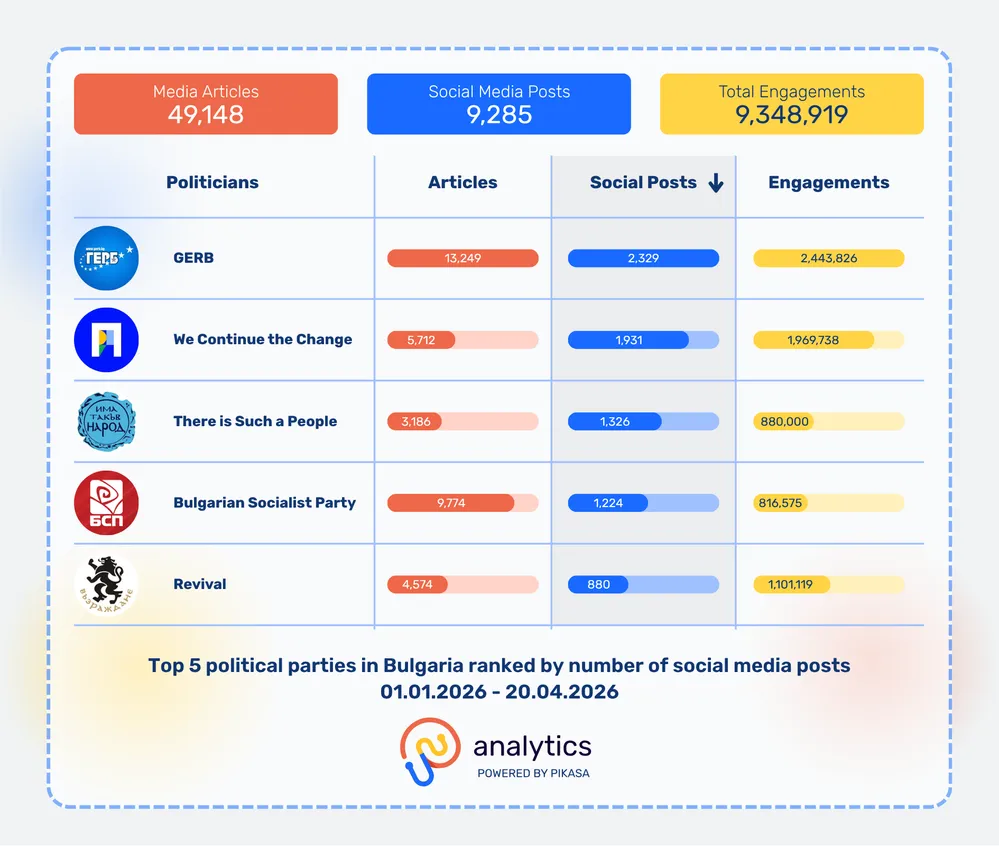
Image: Party-level mentions and engagement, top five parties, January-April 2026 - captured via Analytics.Live
One narrative, three months, 28,000 articles
A key layer of the analysis examined the overlap between election-related coverage and corruption, the theme that structured much of Bulgaria’s electoral discourse and gave Radev’s campaign its strongest narrative advantage.
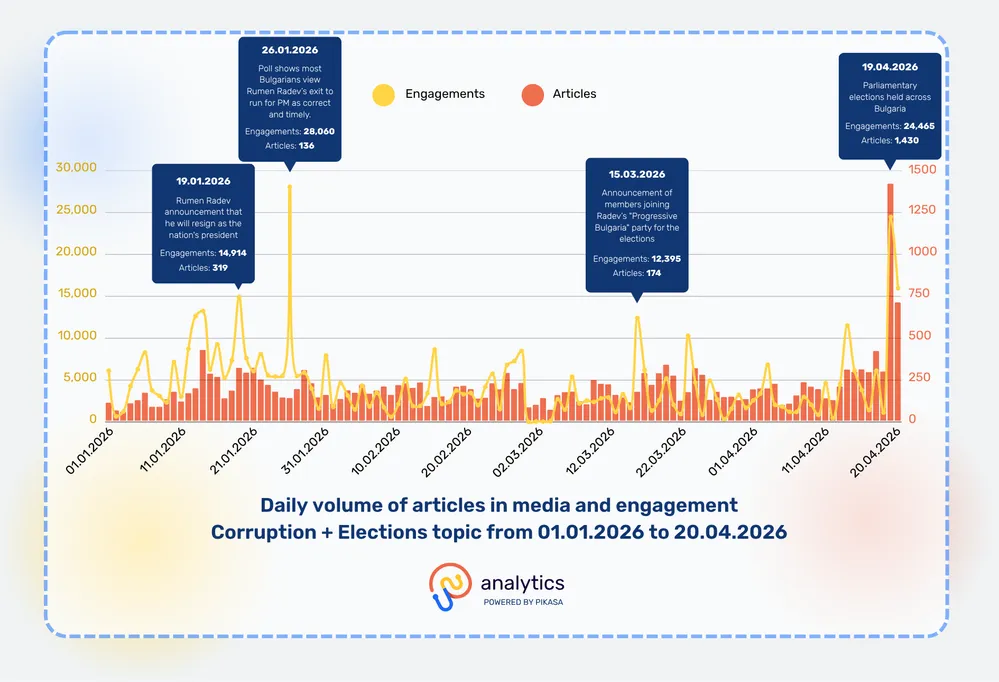
Image: Daily volume and engagement, corruption + elections co-occurrence, January-April 2026 - captured via Analytics.Live
Article output remained broadly consistent from the start of the new year until the final days of the election, oscillating between roughly 150 and 420 pieces a day. The most significant spike in the dataset occurs in the third week of April, or just around the commencement of the elections, where both article volume and engagement spike sharply and simultaneously. Daily article counts briefly to reach approximately 1,420, mirroring the engagement peak which climbs to roughly 160,000 on the right-hand axis. This is the only point in the period where both metrics converge at such magnitude, indicating that the elections were a high-impact event that generated exceptional cross-platform resonance.
Compared with general news coverage, both social posts and opinion articles remained relatively limited throughout the period, rarely moving beyond 50–60 items per day. This suggests that the corruption-election narrative was not mainly driven by broad public posting or sustained commentary, but by mainstream news production.
The flatness of social and opinion activity is important. It indicates that engagement spikes were likely caused by a smaller number of high-reach stories or posts, rather than a wide, participatory debate across many actors. In other words, the narrative gained impact through concentrated amplification, not through mass content creation.
The paradox of critical coverage
Across the 1,000 highest-engaging articles mentioning Radev, the tone was not overwhelmingly positive. Nearly half of the sample was neutral, while critical and negative coverage together outweighed positive articles.
But the engagement data tells a more interesting story. What looked like a challenging media environment on the surface became one of Radev’s strongest visibility advantages. Critical coverage did not push him out of the race narrative - it kept him at the center of it.
| Tone |
Article count |
Average engagement per article |
| Critical |
191 |
97.97 |
| Positive |
172 |
57.88 |
| Neutral |
470 |
39.62 |
Table: Sentiment classification of 1000 highest-engagement articles mentioning Radev
Critical articles, despite their relatively modest count of 191, generated the highest average engagement per post at 97.97, surpassing even positive coverage (57.88) and articles with neutral tone (39.62). This indicates that critical framing, rather than undermining Radev's standing, may have paradoxically amplified his visibility by provoking stronger audience responses. Notably, as the broader analysis suggests, corruption-related coverage tended to position Radev as a remedy to systemic dysfunction rather than a perpetrator of it. This could be interpreted to mean that high-engagement critical content likely reinforced, rather than eroded, his anti-corruption credentials, as Radev positioned his whole campaign on the fact that he will uproot the endemic corruption in the country.
The contrast with competitors is instructive. Where Borisov and others attracted critical and negative coverage that associated them directly with wrongdoing, Radev's critical mentions operated within a different narrative register, one that kept him central to the conversation without diminishing his credibility.
On social media, the sentiment picture was more volatile. High-engagement actors such as Vasilev of MECh generated substantial interaction through emotionally charged content, yet this engagement was driven by division rather than persuasion and did not translate into comparable electoral support. The data thus supports the key distinction - solution-oriented narrative framing sustains electoral momentum, whereas emotion-driven engagement, absent coherent narrative alignment dissipates without significant political consequence or electoral victories.
In aggregate, Radev's sentiment profile reflects a campaign that successfully converted even adversarial coverage into an asset. This rare dynamic that helps account for the scale of his eventual electoral margin, something that wasn’t the case with Viktor Orban’s recent monumental defeat in the Hungary’s parliamentary elections.
What the data says
Bulgaria 2026 is a textbook case of what narrative dominance looks like in data. Radev's victory was not simply a product of visibility, nor of social media buzz. It was the result of owning the right story, consistently, across the right channels - and converting even adversarial coverage into reinforcement of that story.
The pattern across our Election Focus series is now consistent enough to state plainly:
- High engagement does not predict votes. MECh generated the most engagement per post in the Bulgarian dataset and won no seats.
- Total media volume does not predict votes. GERB dominated every party-level metric and finished a distant second.
- Even sentiment, on its own, can be misleading. Radev’s most engaging coverage was often critical, but it reinforced his anti-corruption positioning rather than weakening it.
Bulgaria therefore offers the clearest contrast to Hungary in the series so far. The same media metrics produced the opposite political outcome because Radev had what other actors lacked: narrative ownership of the issue that defined the campaign.
In fragmented media environments, that alignment matters more than raw volume. The decisive question is not only who gets attention, but whether that attention strengthens the story voters already believe.
How this analysis was made possible
Monitoring of Bulgaria’s parliamentary elections between January and April 2026, examining political communication and media impact through news articles and social media posts tracked via Analytics.Live. Using AI-powered monitoring, the report applies filtering, sentiment classification, and narrative-level analysis to assess candidate visibility, party coverage, engagement, sentiment, topic co-occurrence, and narrative ownership.
Election Focus is Pikasa Analytics' ongoing monitoring series across Central Asia, the Western Balkans, the Baltic, and Black Sea regions, applying narrative, sentiment, and engagement level analysis to electoral cycles in real time. For organisations monitoring electoral integrity, candidate visibility, or information-environment risk, the same framework can be commissioned pre- or post-election.
Get in touch to discuss bespoke monitoring.
Written by
Matej Trojachanec
May 11, 2026