This analysis draws on datasets from Pikasa media monitoring and analytics platform Analytics.Live covering the period from January 2026, until the end of March 2026, with a special focus on the Slovenian parliamentary elections which were held on 22nd March. In total, 25,047 articles from 78 unique outlets, as well as 14,579 social medial posts were analyzed, covering all politicians and political parties running in the elections as well as the wiretapping incident and Black Cube (“Črna Kocka”), the Israeli espionage agency that is at the center of the wiretapping scandal.
Using the data from Analytics.Live, article-level analysis was performed through keyword searches for specific cases across all two datasets (e.g. “Elections” and “Black Cube”) to identify cross-topic mentions and track how narrative threads evolved over time. Monthly aggregations, source-level engagement breakdowns, daily coverage heatmaps, and outlet comparison rankings were all taken from Analytics.Live.
Two Politicians, One Narrative Battlefield: Inside Slovenia’s Election Media Power Game
In the three months in the since the start of the year and just after the end of the Slovenian parliamentary elections in March 2026, it came to no surprise that the two frontrunning politicians, Janez Janša and Robert Golob, and their respective parties, Slovenian Democratic Party (Slovenska demokratska stranka - SDS) and Freedom Movement (Gibanje Svoboda - GS) where the most mentioned during the pre-election period. In total, out of almost 25,000 news articles mentioning the politicians and their parties, Janša and Golob were mentioned in 30% of them. Similarly, in almost 14,000 social media posts, they were the topic of 22% of them, although those posts generated significantly more engagement with the audience, or slightly under 39% of the total engagement of all posts.
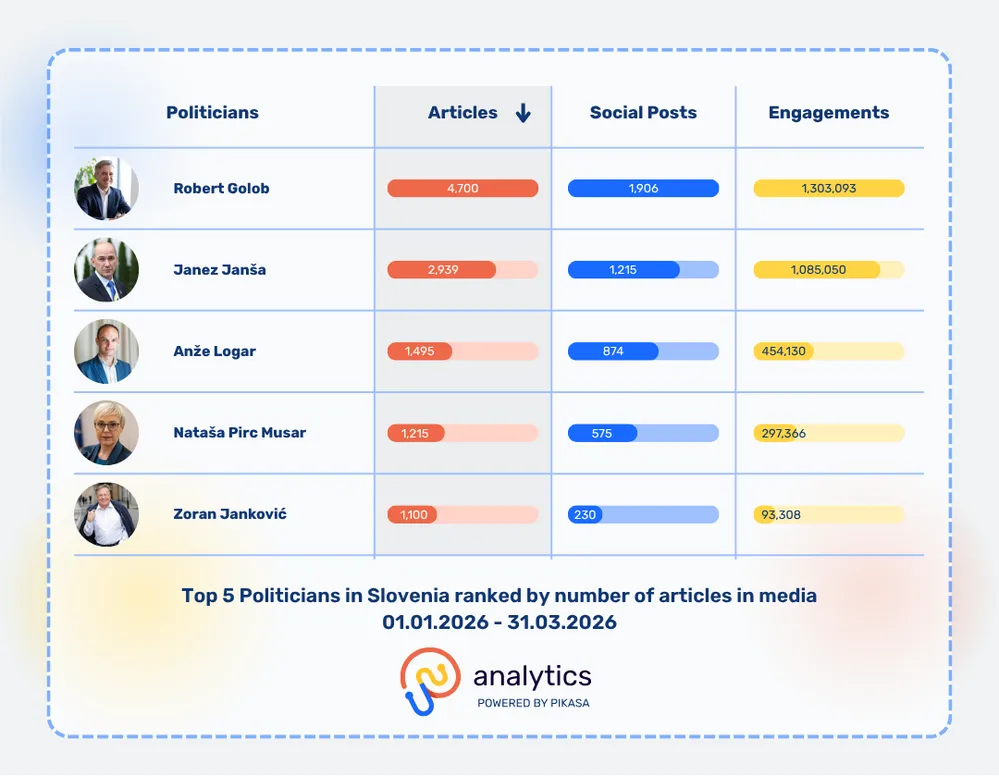
After the two most prominent politicians of this elections, Anže Logar from the party Democrats and the president of Slovenia, Nataša Pirc Musar, were 3rd and 4th most mentioned politicians within this dataset. Additionally, what can be observed is that in the while there were 573,894 in the social media comments about each of the politicians, the hate speech detected within them was quite low though not insignificant, hovering just around 2-3% of the total amount of comments shared.
The Attention Gap Between Leading and Smaller Parties
As mentioned, the leading parties in these parliamentary elections, Janša’s Slovenska Demokratska Stranka and the Golob’s Gibanje Svoboda, were by far the most prominent parties in news, with the Socialni Demokrati (Social Democrats), Nova Slovenija (New Slovenia) trailing behind them. Likewise, SDS and GS were the two most mentioned parties in the social media posts as well, however this was not the case for the rest of the parties.
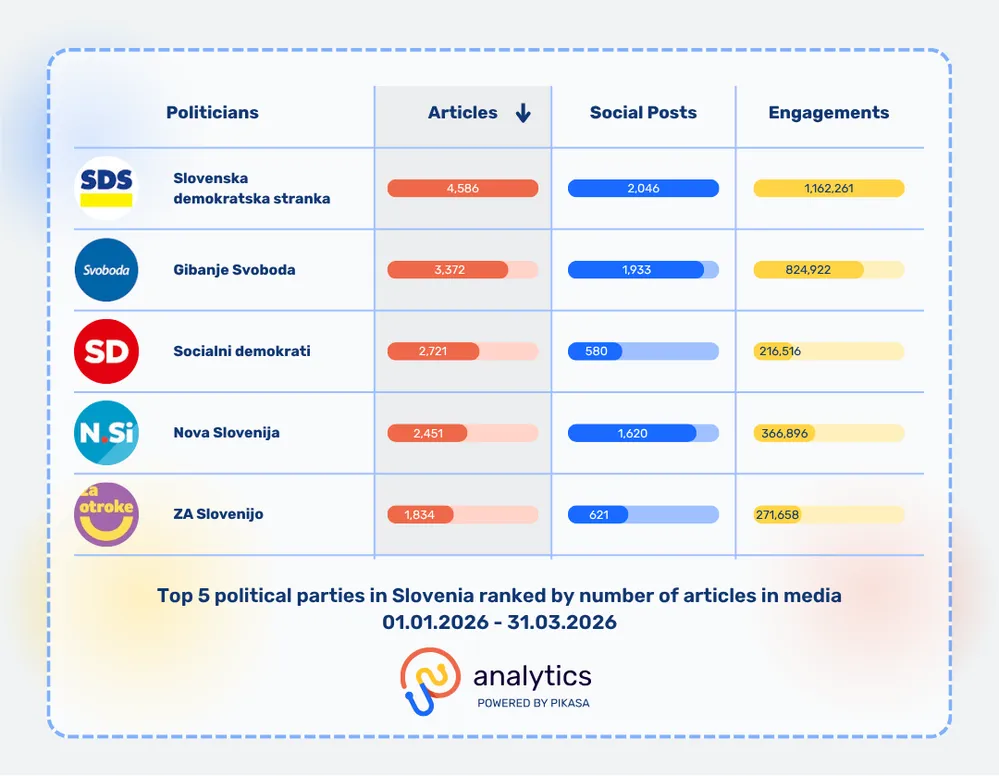
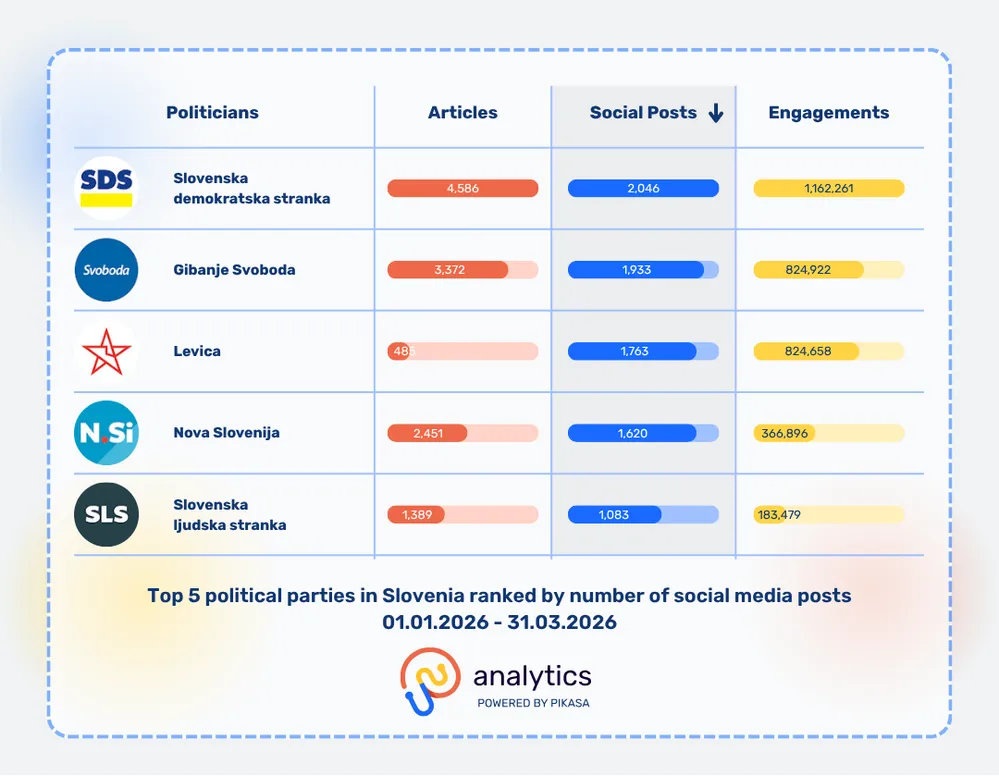
Among the most prominent parties tracked since the start of the year, a clear divergence emerged between traditional media coverage and social media activity. While Levica received significantly fewer news article mentions - roughly ten times fewer than Janša's SDS - they generated a disproportionately high volume of social media posts and, consequently, far greater total engagement.
The ratio tells the story plainly. For every two news articles mentioning SDS, approximately one social media post focused on the party. Levica showed the inverse, for every news article, nearly four social media posts referenced them. This suggests that while SDS dominates the traditional media agenda, Levica commands a stronger and more active social media presence, indicating a fundamentally different, and arguably more mobilized, online audience.
It should be noted, however, that most of the social media posts mentioning Levica were driven by the party's own social media team - meaning Levica itself was the primary publisher of content referencing the party and its electoral activity. Consequently, the engagement captured in the dataset largely reflects audience reactions to the party's own output, rather than independent or organic third-party discussion. This self-generated activity accounts for their outsized presence in social media figures.
From Domestic Policy to Global Spillovers
This Sankey diagram from Analytics.Live maps media mentions of Slovenia's top politicians against key topic categories across news articles and social media posts.
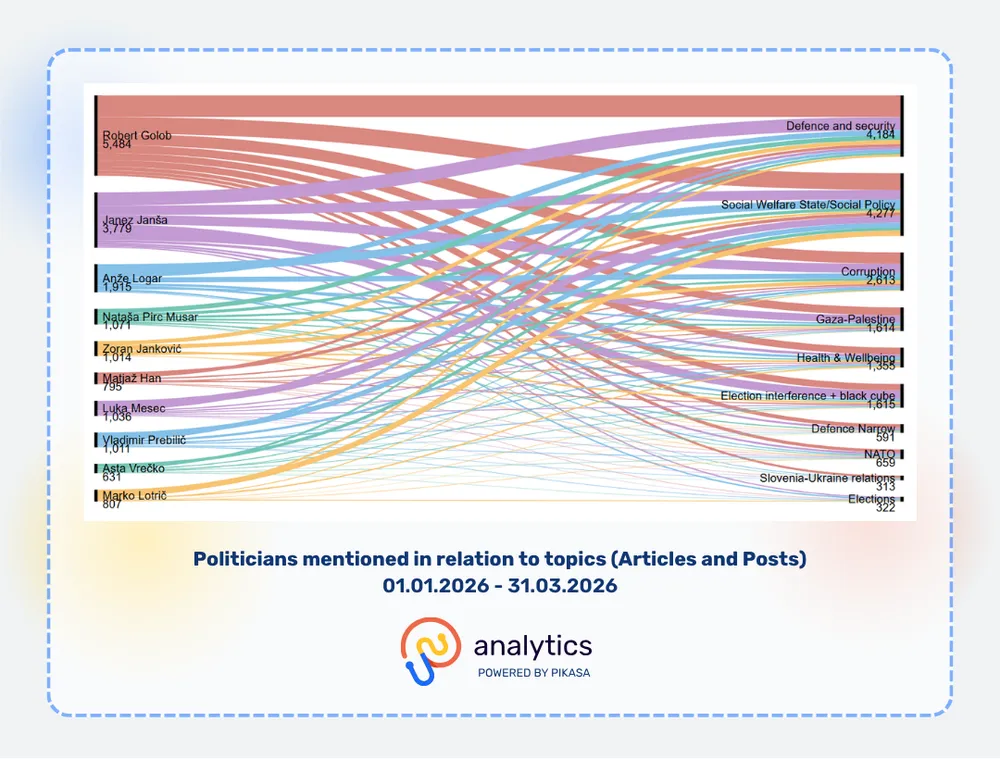
Prime Minister Robert Golob leads with 5,484 mentions, followed by opposition leader Janez Janša at 3,779, together accounting for nearly half of all tracked political coverage. This reflects their central roles in shaping public discourse.
The top two topics, Defense & Security (4,184) and Social Welfare/Social Policy (4,277), dominate the right-side clusters, reflecting Slovenia's policy priorities amid NATO commitments and domestic welfare debates. Corruption (2,613) and Election Interference + Black Cube (1,615) signal ongoing scrutiny of political integrity.
Golob and Janša have the broadest cross-topic flows, appearing across virtually all topic clusters. Smaller figures like Asta Vrečko (631) and Vladimir Prebilič (1,011) show narrower coverage, suggesting more issue-specific public profiles.
Gaza-Palestine (1,614) emerging as a standalone topic demonstrates how international events filter into domestic political discourse, particularly tied to Slovenia's foreign policy positioning.
Why This Matters
Tools like Analytics.Live enable this kind of cross-dimensional political intelligence - linking who is being talked about to what they're being associated with. As media monitoring research consistently shows, volume alone is insufficient; topic-politician mapping reveals narrative ownership, reputational risk, and agenda-setting power in real time.
Black Cube Scandal: A Turning Point in Media Coverage
The Black Cube scandal entered Slovenian media discourse tied to allegations of wiretapping and political interference. Initially, coverage was sparse, a low-level background noise of mentions tracking alongside routine Elections reporting throughout January and February 2026. There are three important inflection points that need to be highlighted.
The first inflection point arrived around 4 March, driven by the Facebook page Maske Padajo and a handful of accompanying articles. This marked the first meaningful uptick; public attention was beginning to form, though still contained.
A second, moderate wave followed between 9-15 March, where Black Cube and election mention co-appeared with growing frequency. Still not explosive, but the narrative was clearly built.
The third and decisive inflection came from 16 March onward, a full media eruption. Articles peaked at over 110 per day, with engagements spiking to 15,000+. The trigger: reporting that Janez Janša had directly met with the Israeli intelligence-linked firm Black Cube, moving the story from abstract wiretapping allegations to a named, personal encounter.
The two central figures are, once again Golob and Janša. Janez Janša sits at the center of the scandal, alleged to have both met with Black Cube operatives and ordered the wiretapping campaign. His position as the primary accused made him the gravitational point around which all coverage orbited. On the other hand, Robert Golob, Slovenia’s Prime Minister and the target of the wiretapping, represents the other axis. His party members, allies, and partners were reportedly subjects of surveillance, making him and his circle both victims and political beneficiaries of the story's momentum.
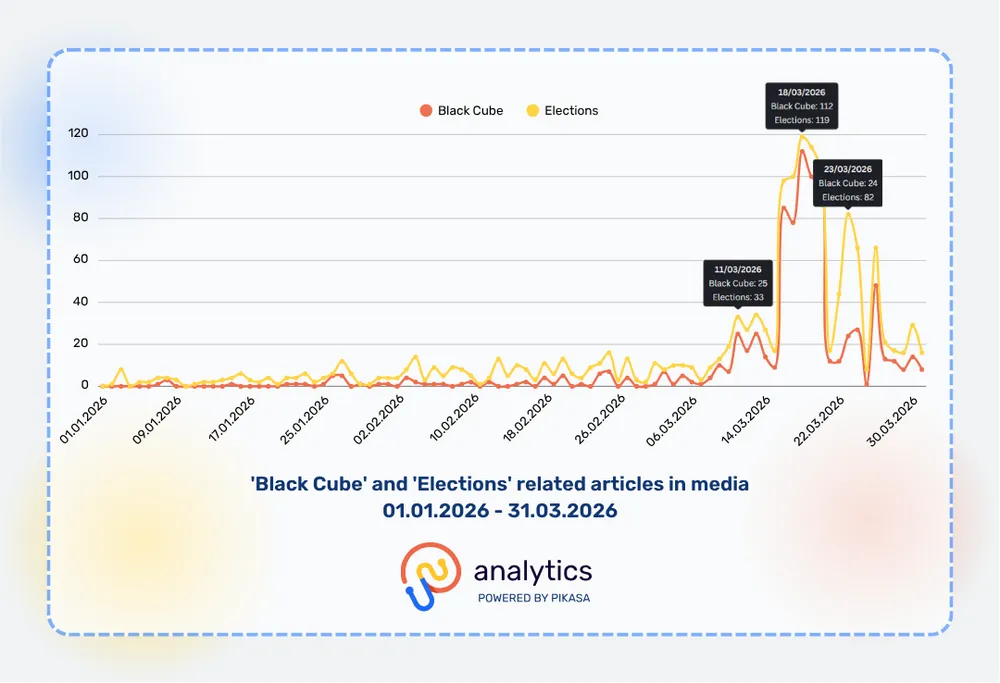
Notably, Black Cube and Elections tracked almost identically throughout the entire period, their peaks and valleys moving in near-perfect synchrony. This is not coincidental. The scandal fused electoral integrity with intelligence interference, meaning the media could not discuss one without invoking the other. With 845 Black Cube articles generating 34,510 engagements and 1,459 Elections articles generating 59,043, the engagement-per-article ratios remained nearly equal, 40.84 versus 40.47, confirming that audience interest in both topics was structurally identical, not incidental.
Beyond Volume: What Really Drives Influence
This analysis highlights how quickly attention can concentrate and how narratives evolve across media and social platforms. Rather than being evenly distributed, visibility tends to cluster around a small number of actors and issues, often shaped by key events and moments of escalation.
In this context, tools like Pikasa are useful for systematically tracking these shifts, linking volume with context and engagement, and allowing for a more structured understanding of how narratives develop over time. This can support analysis across elections, policy debates, or reputational risks, where timing and framing play a central role.
Overall, the findings suggest that interpreting media dynamics today requires looking beyond surface-level metrics and focusing more closely on how attention, narratives, and engagement interact.
Written by
Matej Trojachanec
April 09, 2026