This analysis draws on five datasets from Pikasa media monitoring and analytics platform Analytics.Live, covering the period from January 2025 through March 6, 2026. In total, 35,806 articles from 284 unique outlets were analyzed across five tracked topics: Femicides, Femicide-Rosica, Gender-Based Violence, Violence Against Women, and Women Murdered.
Using the data from Analytics.Live, article-level analysis was performed through keyword searches for specific cases across all five datasets to identify cross-topic mentions and track how narrative threads evolved over time. Monthly aggregations, source-level engagement breakdowns, daily coverage heatmaps, and outlet comparison rankings were all taken from Analytics.Live.
1. The Landscape at a Glance
Over 15 months, we tracked five related topics in North Macedonia’s media: Femicides, Femicide-Rosica (the specific case), Gender-Based Violence, Violence Against Women, and Women Murdered (broader topic). Together, they form a map of how the country’s media - and by extension, its public - processes the killing of women.
1,018
Articles on Rosica’s Case
5.68M
Total Reach of Rosica Coverage
36,620
Engagements on Rosica Articles
117
Outlets Covering Rosica in Sep
45
Outlets That Never Returned
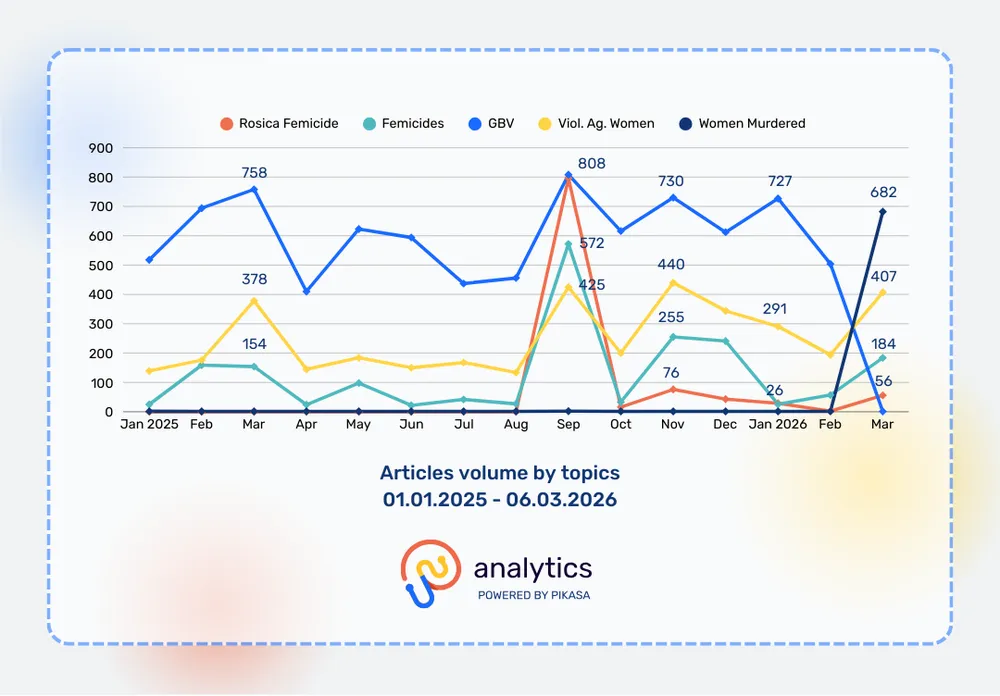
The broadest topic - “Women Murdered” - generated 19,600 articles over the period, maintaining a baseline of 1,000 - 1,600 articles monthly regardless of any specific case. Yet it is the Rosica case that exposes how the media actually functions: 78% of its dedicated coverage (796 of 1,018 articles) appeared within a single month. After that, 45 of the 117 outlets that covered the case in September never published another article about it.
2. The Murder of Rosica Koceva
What makes the Rosica case a study in systemic failure - and not merely a crime story - is what was known before her death.
The highest-engaged article in the entire Rosica dataset was a Слободен Печат report published on September 18, revealing that another woman had reported Rosica’s killer to police 12 years earlier - saying she herself “could end up at her place.” That article generated 2,126 engagements (2,025 reactions, 41 comments, 60 shares) and reached over 115,000 people.
The second highest-engaged article, published by Infomax on September 24, revealed that Rosica had personally written to Interior Minister Panče Toškovksi five months before her murder. That article generated 1,415 engagements with 212 comments - the highest comment count of any article in the dataset, indicating intense public debate.
148 articles in the Rosica dataset directly mention Interior Minister Toškovski. The political accountability narrative became inseparable from the crime itself.
These two revelations, a 12-year warning ignored and a direct plea to the minister, transformed the story from a domestic crime report into a systemic indictment. The articles that moved the public most were not those reporting the murder itself, but those exposing institutional failure.
3. The Anatomy of a Coverage Cycle
3.1 Two Waves Within Eighteen Days
The Rosica coverage did not follow a single arc. It erupted in two distinct waves within September 2025 - each with a different character and different drivers.
|
WAVE 1: THE MURDER
583
articles, Sep 13 - 21, 25,613 engagements
The murder itself, identification of the killer, revelation of the 12-year prior warning, emotional tributes. Coverage peaked at 154 articles on Sep 16 alone.
|
WAVE 2: THE RECKONING
213
articles, Sep 22 - 30, 7,316 engagements
Protests under “Ниту една повеќе” (Not one more), Rosica’s letter to Toškovski revealed, political demands for accountability. 72 articles covered the protest movement.
|
Between the two waves - September 20 - 22 - coverage dropped to just 13 articles over three days. The media took a weekend off. Then protests and the Toškovksi revelation reignited coverage for another week before it faded permanently.
THE DECAY CURVE
From the Sep 16 peak (154 articles) to Sep 19, coverage dropped by 64%. By Sep 22, it had dropped 99%. The second wave restored it temporarily, but by October 1, the Rosica case was generating 0 articles per day. The half-life of a femicide in Macedonian media is approximately 4 days.
4. What Brings the Media Back - and What Doesn’t
After September, the Rosica case generated only 222 more articles over six months. But most of those were not follow-ups. They were triggered by entirely new events that pulled the media back to the topic tangentially.
4.1 October 2025: The Drop-Off
Only 16 articles - and most are tangential. A Призма analysis titled “When the serial abuser is a popular urban figure” stands out as the only substantive follow-up (224 engagements). No investigative reporting on the case. No tracking of institutional reform. 45 outlets have already dropped coverage permanently.
4.2 March 2026: The Karpos Tragedy - History Repeats
Tragic deaths of a mother, Ivana, and her six-year-old daughter, Katja, who both fell from a balcony in Skopje's Karposh trigged again media to go back to Rosica case . Фемина publishes an article with psychologist Tiana Ivanovska that generates 3,671 engagements - the single highest-engaged article across all gender based violence coverage in the entire 15-month monitoring period. President Siljanovska-Davkova states: “This 8 March, after the incomprehensible death of Ivana and Katja, it is hard for me to experience this as Women’s Day.” SDSM demands Toškovksi’s resignation - the same demand made for Rosica six months earlier.
The media doesn’t forget femicide as a concept - it forgets individual women. Each new case temporarily resurrects the previous one, but only as context, never as a story that still demands answers.
5. Cross-Topic Data: Monthly Article Volumes
The chart below compares monthly article output across all five tracked topics. The Rosica case appears as a sharp spike against the steady drumbeat of broader coverage.
5.1 Cross-Dataset Rosica Mentions
We searched all five datasets for articles explicitly mentioning Rosica by name. The results confirm the temporal concentration: her name appears 427 times in September 2025 and only 6 times in the entire six months afterward. Her case was absorbed into the general statistical flow of “women murdered” - becoming a data point rather than a story demanding accountability.
6. Volume vs. Impact: Outlet Analysis
The outlets that produced the most articles about Rosica are not the ones that moved the public most. This split has important implications for understanding media influence.
6.1 Top Outlets by Article Count
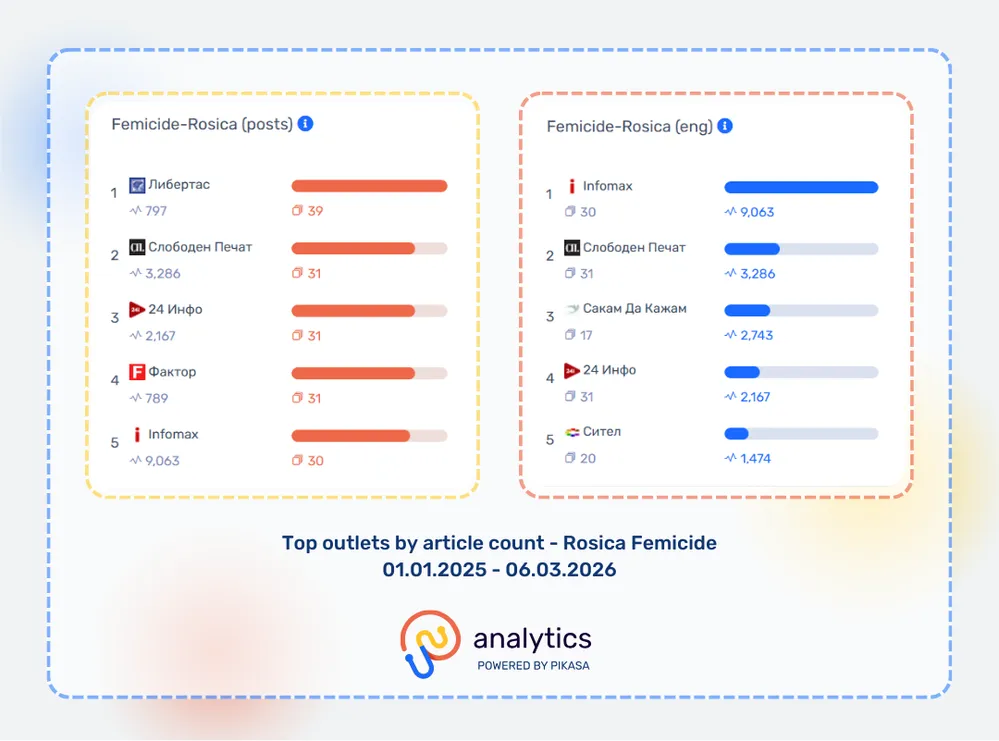
Infomax produced 30 articles - fewer than Либертас (39) - yet generated 9,063 engagements compared to Либертас’s 800. That is an 11× difference in per-article resonance. Infomax’s reach of 1.49 million dwarfed every other outlet.
THE SOURCE DROP-OFF
Of the 117 outlets that published at least one Rosica article in September, 45 (38%) never returned. Only 72 published anything in the Rosica dataset after September - and for most, their later articles were tangentially related. Sustained coverage was limited to fewer than 10 outlets.
7. Key Findings
- The half-life of a femicide case is approximately 4 days. From the September 16 peak (154 articles), coverage dropped 64% by September 19 and 99% by September 22. A second wave - driven by protests, not reporting - extended the cycle to roughly 18 days total. After that, the case effectively ceased to exist in the media.
- Systemic exposes engagement; crime reports don’t. The five highest-engaged articles all centered on institutional failure or political accountability, not crime itself. The top article - revealing a 12-year-old police report that went ignored - generated 2,126 engagements. The initial crime report generated 859.
- New tragedies resurrect old names - but not old stories. March Karpos tragedy triggered brief returns to the Rosica topic - but as background context, not as ongoing accountability. Rosica’s name was mentioned 427 times in September across all datasets and only 6 times in the subsequent six months.
- 38% of outlets that covered the story abandoned it permanently. Of 117 outlets that published Rosica articles in September, 45 never returned. The outlets with sustained engagement - Infomax, Слободен Печат, Сакам Да Кажам - are notably not the ones that produced the most volume.
- Systemic framing collapsed alongside coverage. Of 262 articles with systemic/institutional framing, 232 appeared in September. Only 30 were published in all subsequent months combined. The structural analysis of why femicides occur was a September-only conversation.
Conclusion
The data tells a clear story: North Macedonia's media responds to femicide with intensity but not with persistence. Rosica Koceva's case generated 796 articles in 18 days - and then effectively disappeared. When her name resurfaced months later, it was only because another woman had been killed.
The coverage cycle that followed Rosica repeated almost identically with Ivana and Katja in March 2026 - the same political demands, the same institutional outrage- with nothing changed in between. The media asks, "why did the system fail?" for approximately two weeks, then move on before anyone is required to answer.
What makes the data unmistakable is that the public's appetite for accountability exists. The highest-engaged articles were not crime reports - they were systemic exposes. The audience wanted to understand why institutions failed, not just what happened. But that conversation was abandoned by the media long before it could translate into institutional pressure or reform.
Until coverage shifts from reactive to sustained - from event-driven to issue-driven - each femicide will generate its own isolated spike of outrage for four days, followed by silence, followed by the next woman's name replacing the last.
Written by
Natasha Dimova
March 09, 2026