Why ETIAS and EES Matter for the Region
The European Union's Entry/Exit System (EES) and European Travel Information and Authorisation System (ETIAS) represent the most significant change to Schengen border management in a generation. For EU member states, these systems are an operational upgrade. For non-EU Western Balkan countries - North Macedonia and Serbia chief among them - they represent a structural change to how their citizens cross into the EU: biometric registration at the border, 90/180day stay tracking, and, eventually, mandatory pretravel authorisation.
Against this backdrop, Pikasa Analytics deployed its Analytics.Live platform to monitor how ETIAS and EES were covered across three distinct media landscapes - a non-EU candidate state (North Macedonia), a non-EU accession country (Serbia), and an EU member state (Greece) - over a seven and a half month period.
The result is one of the most granular cross border media datasets on EU border policy implementation in the Western Balkans to date: 5,997 articles, 662 social posts, and more than 158,000 combined engagements across digital news and social media platforms.
Key Findings
1. Serbia Drove the Conversation
Serbia produced more than half of all monitored articles (3,068 - 51% of total) and achieved the highest engagement rate of any country in the dataset: 14.24 engagements per article versus a regional average of 11.3. On social media, Serbia's per post average of 155 engagements outpaced North Macedonia (117) and Greece (80) by a significant margin.
Why? Geography and proximity to Greece explain much of it. Greece is the top summer destination for Serbian tourists. For Serbian audiences, EES was not an abstract EU regulation - it was a direct threat to annual travel plans, making coverage inherently more personally relevant and emotionally resonant.
General Statistics (from top 50 media outlets in the countries)
| |
MK |
GR |
RS |
| Media Articles: |
1,226 |
504 |
2,831 |
| Facebook Engagement: |
13,799 |
2,983 |
41,608 |
| Engagement per Article: |
11 |
5 |
14 |
| Number of Outlets: |
48 |
48 |
42 |
Social Statistics
| |
MK |
GR |
RS |
| Social Posts: |
256 |
37 |
370 |
| Engagement: |
29,973 |
2,988 |
57,350 |
| Engagement per Post: |
117 |
80 |
155 |
| Number of Profiles: |
104 |
16 |
117 |
2. The Border Blockade Was the Dataset's Defining Event
On 26 January 2026, truck drivers from across the Western Balkans blockaded cargo terminals at EU border crossings in protest at the EES rule limiting their stay in the Schengen area to 90 days within any 180 day period. The blockade triggered the single largest combined media spike in the monitoring period.
Combined articles on the border blockade crisis
(26-29 January 2026)
North Macedonia: 312 | Serbia: 200 | Greece: 52
564
This moment illustrates the core editorial logic driving engagement throughout the dataset: audiences did not engage with information about how a system works. They engaged with visible, human cost consequences - queues, delays, and economic disruption. Coverage that framed EES as a technical upgrade generated modest interaction. Coverage that framed it as a crisis generated the dataset's highest peaks.
3. North Macedonia: High Volume, High Anxiety
With 185 outlets producing 2,368 articles, North Macedonia had the broadest distribution footprint of any country in the dataset. As a landlocked EU candidate state with heavy dependence on EU border crossings for trade and emigrant traffic, its media ecosystem showed persistent sensitivity to any development that touched on citizens' freedom of movement.
North Macedonia also produced the most analytically striking sentiment finding in the entire dataset: positive framed content averaged 208 engagements per item - more than twice the next highest positive average (Greece: 66). This suggests that when Macedonian content framed ETIAS/EES in optimistic terms - resolved disruptions, improved access, EU integration progress - it resonated at unusual strength, likely amplified by the country's aspirational EU candidacy context.
4. Greece: Structural Indifference
Greece produced only 561 articles and 37 social posts across the entire monitoring period - the lowest of any country on both counts. Per article engagement (6.77) ran at roughly half the regional average. Even negative content, which in Serbia and North Macedonia reliably drove strong audience reaction, achieved only 12.34 engagements per item in Greece.
This is not a failure of Greek media - it is a structural reflection of Greece's position as an EU member state. Greek audiences do not experience EES as a change to their own travel rights. Despite Greece being the primary destination for Serbian and Macedonian tourists, coverage consistently failed to construct a personal stakes narrative - around tourism disruption, waiting times, or border procedure changes for visitors - that would give Greek readers and viewers a concrete reason to engage.
The one exception: when Greece announced a bilateral accommodation for Serbian tourists (exempting them from full EES checks ahead of the summer season), North Macedonia's media reacted far more strongly than Greece's own outlets - generating 64 articles versus Greece's 16. The political controversy was experienced elsewhere.
5. Social Media: TikTok as the Untapped Engagement Engine
Across all three countries, the platform data revealed a consistent hierarchy. TikTok achieved the highest per post engagement rates by a significant margin - but only where content was deliberately produced for the platform. In North Macedonia, 20 TikTok posts generated 14,154 engagements (708 per post). In Serbia, just 9 posts generated 18,753 engagements (2,084 per post). These figures almost certainly reflect algorithmic amplification of individual viral posts, but the directional signal is clear.
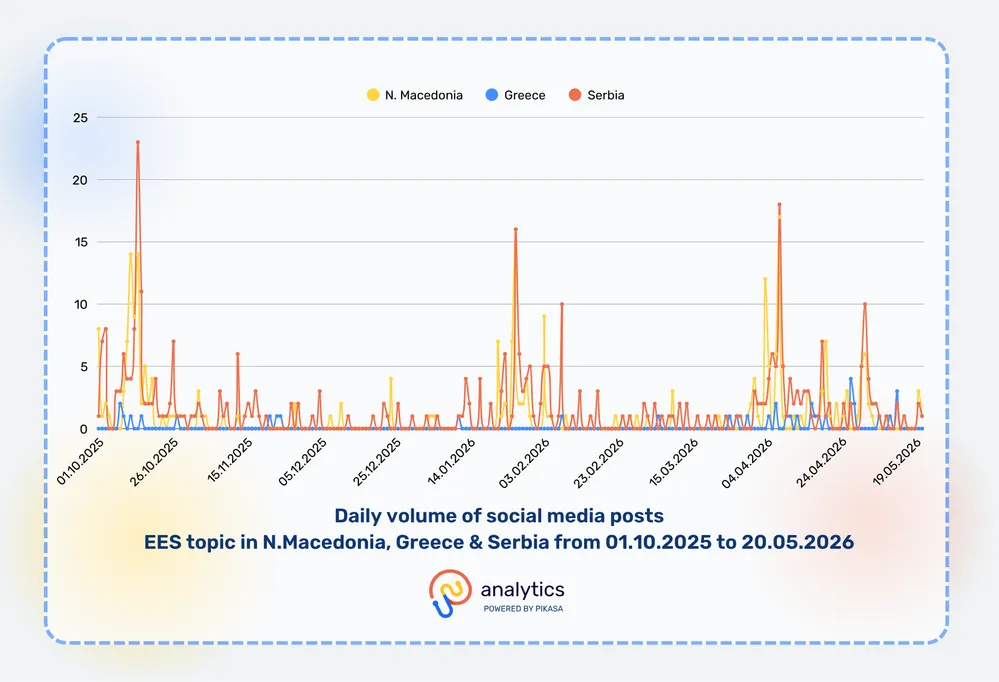
Greece recorded zero TikTok presence on this topic throughout the monitoring period.
Given TikTok's performance in the other two markets, this is a significant gap for any communication strategy targeting Greek audiences - particularly younger travelers, diaspora communities, and tourism sector workers likely to be directly affected by EES border procedures.
Coverage Timeline: Nine Peaks, One Pattern
Coverage of ETIAS and EES moved in distinct event driven pulses rather than accumulating gradually. The nine identifiable peaks map the full arc of the story - from the initial system announcement through crisis and implementation to its aftermath.
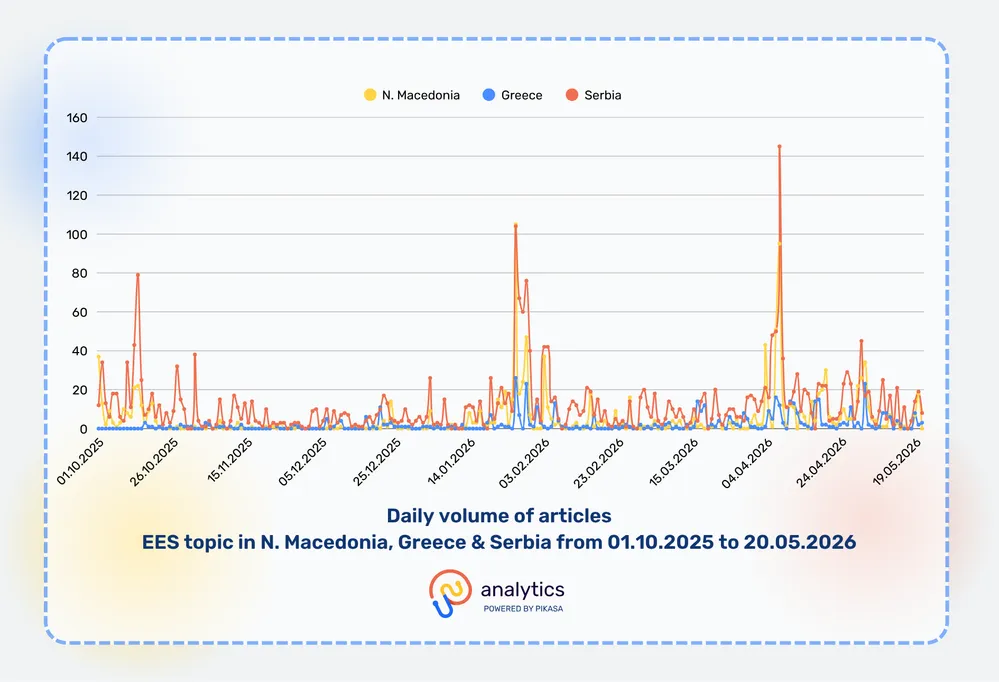
The pattern across all nine peaks is consistent: spikes are sharp and event driven, receding quickly once the triggering development is resolved. This means sustained public awareness cannot be maintained by institutional output alone depends almost entirely on whether the news cycle keeps delivering events with concrete, consequence oriented hooks.
| Date / Period |
Peak Event |
MKD |
SRB |
GRE |
Total |
| Oct 10-12, 2025 |
EES system announced |
84 |
87 |
0 |
171 |
| Oct 28, 2025 |
Hungary implements EES |
0 |
42 |
0 |
42 |
| Jan 26, 2026 |
Border blockade begins |
212 |
116 |
29 |
357 |
| Jan 29, 2026 |
Border blockade ends |
100 |
84 |
23 |
207 |
| Feb 3, 2026 |
Regulatory changes for transport |
70 |
45 |
0 |
115 |
| Apr 6–9, 2026 |
Pre implementation coverage |
105 |
54 |
16 |
175 |
| Apr 10, 2026 |
EES comes into effect |
163 |
153 |
13 |
316 |
| Apr 21, 2026 |
Greece deviates from EC rules |
64 |
25 |
16 |
89 |
| May 4, 2026 |
Greece relaxes EES measures |
61 |
49 |
25 |
135 |
Methodology
This case study is based on the monitoring ETIAS and EES mentions across North Macedonia, Greece, and Serbia, produced by Pikasa Analytics using the Analytics.Live platform. The report covers 1 October 2025 to 20 May 2026 and draws on data from 1000+ monitored outlets, thousands of social media profiles, and machine learning assisted sentiment and narrative classification.
Pikasa Analytics is a regional media intelligence firm specialising in narrative analysis, FIMI monitoring, disinformation research, and political communication analytics across the Western Balkans, Central Asia, the Baltic states, and the Black Sea region.
Interested in a similar more in depth study?
Contact us at Analytics.Live or visit Pikasa.ai to learn more about our monitoring services and thematic reporting capabilities.
Written by
Natasha Dimova
July 06, 2026