Pikasa Analytics tracked how the Western Balkans followed the 2026 Wimbledon Championships through Analytics.Live, monitoring digital and social media across Bosnia and Herzegovina, Montenegro, Serbia and North Macedonia from the 15th of June to 12th of July 2026 - from a week before the tournament through its final day. Following the daily pulse of nearly 900,000 engagements around Novak Djokovic's pursuit of a record 25th Grand Slam title, alongside 663 pieces of content on Lina Gjorcheska's historic debut, the study traces how attention rose and fell with each player's run - mapping daily engagement, platform performance and sentiment to show how two very different "historic" storylines lived, peaked and vanished in the regional media space.
Key takeaways:
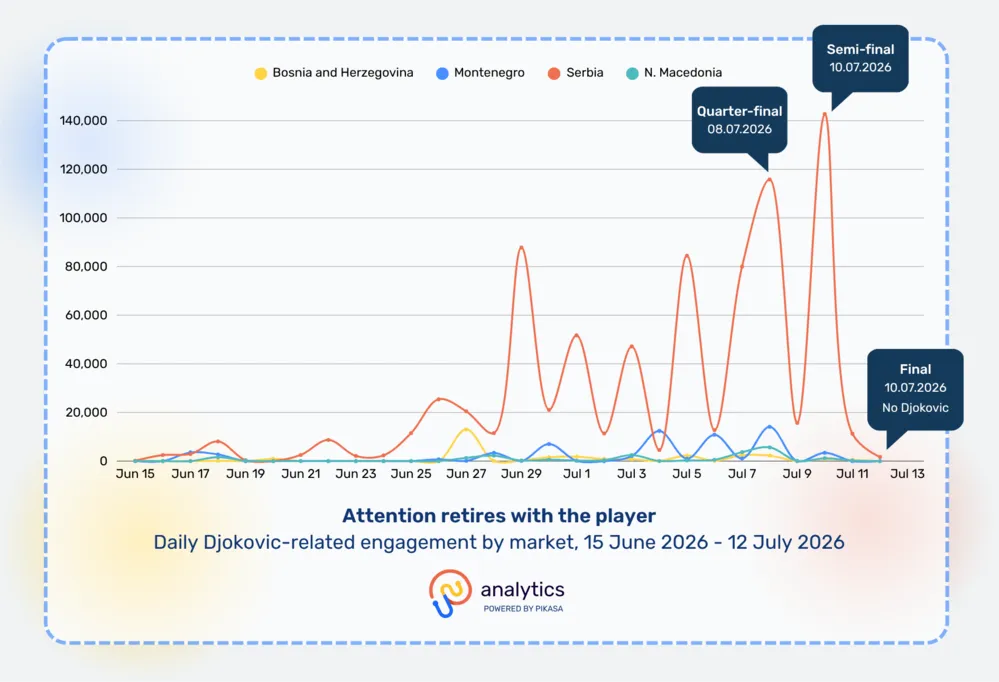
- The region watched a player, not a tournament. Daily engagement climbed in lockstep with Djokovic's run (peaking at 142,701 Serbian interactions on his semi-final day) then cratered by 99% in 48 hours once he was out, collapsing to just 1,746 on the day of a final he wasn't part of. Even a Grand Slam final weekend couldn't hold the Balkans' attention without its players in it.
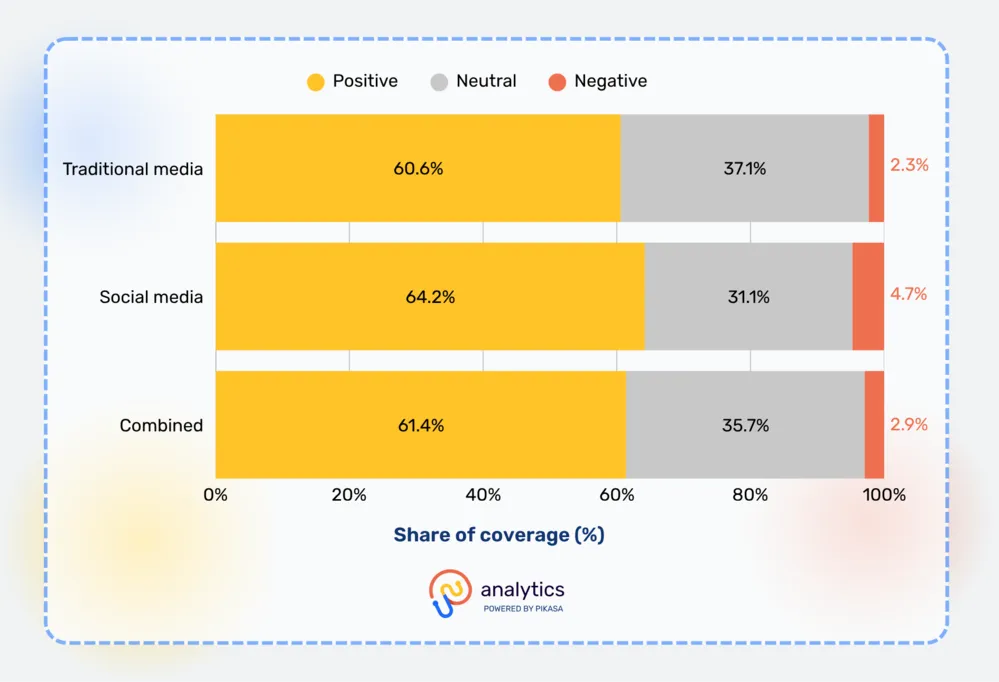
- Gjorcheska's limelight was smaller, but brighter - and entirely her own. Item-for-item, her coverage out-engaged the regional Djokovic content five times over, with a nation overwhelmingly behind her (over 60% positive, under 3% negative) and its rare criticism aimed at the system that failed to support her, not the player. Notably, even Djokovic's public endorsement barely moved the needle - her own results generated the buzz.
- Two platforms won, in opposite ways. Instagram conquered by volume, carrying half of all posts and a commanding 84% of engagement; TikTok won by precision, ranking second in per-post efficiency from the smallest footprint in the set - together making the legacy channels look busy rather than effective.
The warmup
For the second-year running, Novak Djokovic's Wimbledon ended one match short of the final. The 39-year-old Serbian legend, a seven-time champion at the All-England Club, was beaten in the semi-finals by world No. 1 and defending champion Jannik Sinner this past weekend, on the 12th of July 2026. While Djokovic chased the record books, Lina Gjorcheska was rewriting them for an entire country. At 31-year-old, she became the first player from North Macedonia to compete in a Grand Slam main draw, reaching Wimbledon after qualifying on her 13th attempt, the culmination of more than a decade of dedication through the lower-level tennis circuits.
Both players captured not only the imagination but also the attention of the media and its audience in the Balkans, especially in Bosnia and Herzegovina, Montenegro, Serbia, and North Macedonia. But when Pikasa tracked every article, post and reaction across the four markets, the data told two very different stories about how these moments actually lived in the media.
Game: attention retires with Djokovic
Follow the daily engagement and you don't see the shape of a tennis tournament. You see the shape of a single player's run.
For the first week, there was barely a ripple. Serbian engagement idled at a few hundred to a couple of thousand interactions a day, bottoming out at just 33 on the 20th of June, while Montenegro and North Macedonia regularly flatlined at zero. Then Djokovic started winning, and the line began to climb. Serbia stirred at 25,438 on 26 June, held a steady five-figure hum through the first week of matches, then surged as the stakes rose: 84,472 on the 5th of July, 115,835 on quarter-final day (8th of July), and finally 142,701 on the 10th July, the day of his semi-final; the highest single-day figure of the entire window. The neighbors followed the same script in miniature, with Montenegro spiking to 14,106 and North Macedonia to 5,663 on the 8th of July, their own peaks for the month.
And then he lost. The final is supposed to be the culmination of the whole tournament, but on the 12th of July, regional attention simply cratered. Serbia fell from 142,701 to 1,746, a 99% collapse in 48 hours, while Bosnia, Montenegro and North Macedonia managed 17, 6 and 30 engagements between them. Since Djokovic wasn't in it, the region stopped watching. The audience had come for the man, not the tournament, and the numbers make that painfully obvious.
It's a striking thing to see drawn out on a chart: an entire region's interest in a global sporting event rising and falling with the fortunes of fate of Djokovich. Nevertheless, this presents a wonderful show of strength for the Serbian tennis audience, yet it opens the uneasy question about the day after he retires.
Set: Gjorcheska’s limelight was smaller, but brighter
Coverage of Gjorcheska in Macedonian media totaled 106,286 engagements across 663 mentions, averaging 160 engagements per item, which is more than five times the rate of the general Djokovic/Wimbledon coverage in the country. The home-player story was not only larger but markedly more reactive with the audience.
It was also remarkably compressed. Virtually all of it (94% of engagement) fell inside a single six-day window, 25–30 June. Before it, the series is near zero; after it, it collapses. The peaks map cleanly onto her two on-court milestones: qualification on the 25th of June produced the biggest day of the window (43,591 engagements), while her first-round match against Anisimova on the 30th of June drove the second largest (29,575) and the highest daily content volume. Coverage spiked on what she did, rather than sustaining between milestones.
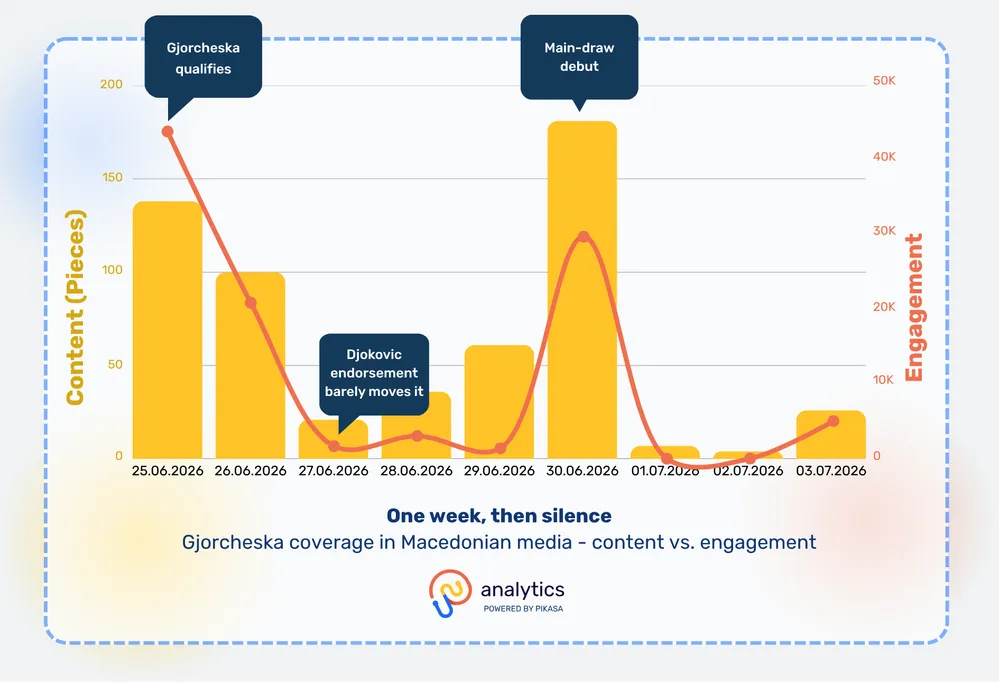
Notably, Djokovic's 27th of June endorsement, congratulating her and "Macedonian tennis… writing its history at this Wimbledon", landed inside this window but barely moved the needle, registering under 4% of the qualification peak. It was picked up as a talking point, but it was Gjorcheska’s own results, not Djokovic's validation, generated the engagement.
After 30 June, interest evaporated: the entire remaining twelve days produced under 5% of total engagement. Once she was out, the story closed almost immediately.
Additionally, sentiment toward Gjorcheska was strongly favorable across both traditional and social media, with nearly identical profiles in each channel, displaying one of the cleanest positive skews in the dataset. The country largely rallied behind her, with the overwhelming share of coverage framed her qualification as a national first and a shared point of pride, which drove both the volume and the tone. What little negative sentiment appeared was, notably, rarely aimed at Gjorcheska herself. Most of it targeted the institutional failure to support her (e.g. the absence of federation backing, the lack of any grass courts to prepare on, and the sense that she reached this milestone despite the system rather than because of it) while a smaller portion offered fair, measured criticism of her game: level, match sharpness, and the gap against top 40 opposition.
Match: one platform outperformed the rest
Across the four platforms that saw traffic, the monitoring window produced 730 social media posts and roughly 910,000 engagements, but that reaction was anything but evenly spread. This was a two-platform story, and the two winners couldn't have won more differently.
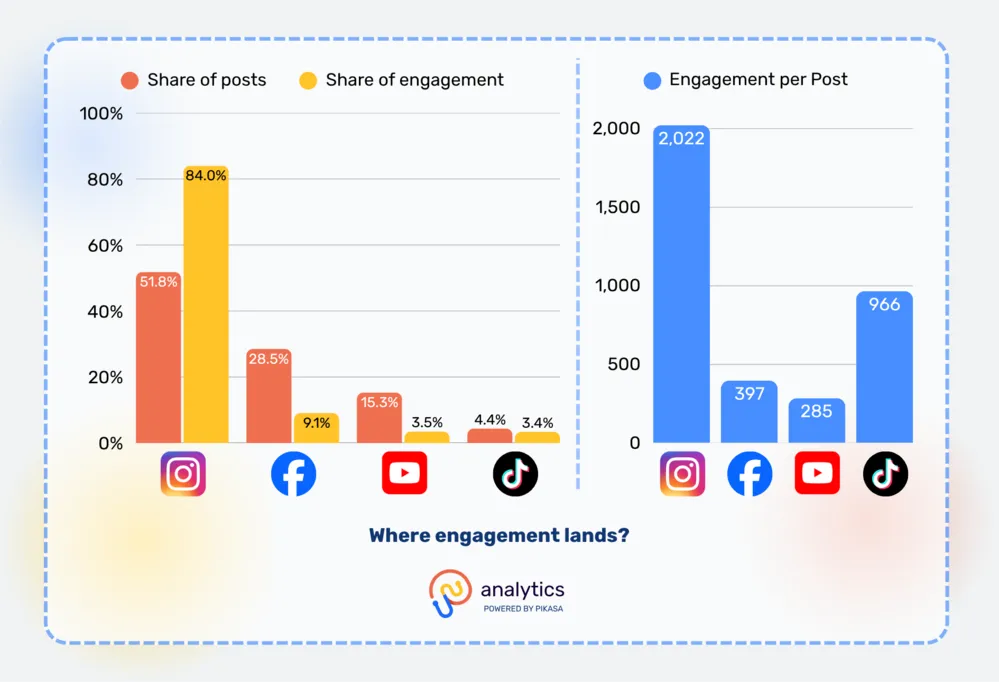
Instagram dominated through sheer scale, carrying half the posts but a commanding 84% of all engagement, at a per-post rate more than double any rival. TikTok won the other way - by barely showing up. With just 32 posts, the smallest footprint of any platform, it still ranked second in efficiency, outperforming both Facebook and YouTube per post while publishing a fraction as often. One platform conquered by volume, the other by precision; together they made the legacy giants look busy rather than effective.
And busy they were. Facebook ranked second in output but converted it poorly, while YouTube was the weakest performer outright, posting 3.5 times more often than TikTok for near-identical total engagement, at the lowest per-post rate in the set.
The takeaway for anyone planning coverage or campaigns is this: where you post matters as much as how often.
Lifting the trophy: how to make sense of the numbers
This year's Wimbledon gave the region two "historic" storylines, and the data shows both lived by the same rule: the audience followed the players, not the tournament. Djokovic's run was overwhelmingly a Serbian phenomenon (his home country generated 87.5% of all related engagement) and it climbed in lockstep with his progress, peaking on his quarter-final and semi-final days before collapsing to almost zero on the day of a final he wasn't part of. Gjorcheska's arc was identical in shape, if smaller in scale. Her engagement was compressed into the six days of her own milestones, then evaporated the moment she was out. Even a Grand Slam final weekend couldn't hold the region's attention once its players had left it.
What the players did hold was the backing of their nations. Serbia's devotion to its 39-year-old icon needs no elaboration, but Gjorcheska's case is the more striking one. Item-for-item, her coverage was five times more engaging than the regional Djokovic content, and the sentiment behind it was overwhelmingly positive; a country united behind their player. Where that engagement lived is the third lesson. Not spread across the media landscape, but concentrated on a handful of platforms, with Instagram and TikTok doing the heavy lifting while the legacy channels padded the volume.
The common thread is that all of it, the pride, the peaks, the buzz, was event-driven and perishable, fading within days of each exit. For Serbia, that leaves an unavoidable question about tennis interest after Djokovic. For North Macedonia, it leaves a rarer regret: a unifying national moment celebrated for a single week, its momentum never converted into a lasting narrative.
How Pikasa produced this story
Everything above came from a single Pikasa monitoring setup: four markets, digital media and four social platforms, tracked continuously across the tournament window. Pikasa didn't just count mentions - it measured engagement, reach, daily movement, platform efficiency and sentiment, then broke each down by country, channel and day.
That's what let this analysis go beyond "there was a lot of coverage" to answer the questions that actually matter: Where does attention concentrate? Which platforms convert reach into reaction? Does interest follow the event or the person? And what is the audience actually feeling?
Written by
Matej Trojachanec
July 17, 2026